
How much does a heat recovery ventilation system cost in Australia, and does it pay back?
The short answer
There’s no honest package price for heat recovery ventilation, because the box on the wall is only part of the job. The price follows the house: one central unit ducted to every room or small paired units in the outside walls, how many rooms the air has to reach, where the ducts can run, and whether the ceilings are still open. On payback, Perth’s winters are mild, so the energy saving is modest and we don’t sell it on the power bill. People buy it for fresh, filtered air in a well-sealed house without opening a window on the heating.
Heat recovery usually comes up when a house is being built and the builder or the energy assessor says it will be well sealed. That’s good news for the heating bill. It also means the house no longer breathes through its gaps, so fresh air has to come in on purpose, and heat recovery ventilation is how you do that without letting your heating out with the stale air. Below is what moves the price, what you get back for it, and how to compare two quotes that look nothing alike.
What sets the price of heat recovery ventilation?
The first choice is the shape of the system. A central system has one unit, about the size of a bar fridge, on a wall in the laundry, a linen cupboard or the garage, with ducts carrying fresh air into the bedrooms and living areas and taking stale, damp air out of the kitchen, bathrooms and toilet. For a small home, up to around 125 m², a compact unit can sit in the ceiling instead.
The other shape is room by room: small units set into the outside walls in pairs, one blowing out while its partner draws in, swapping over every 40 seconds or so. They need no ducts, which makes them far easier to put in. Our article on central or room-by-room heat recovery goes through which suits which house.
After that, the price follows the number of outlets more than anything else. Each outlet is a duct run, a hole in a ceiling and a grille, and a bigger or two-storey house has more of them. The unit also needs a power point and a drain for the water it pulls out of the air, and the ducts need a route inside the insulated part of the house, sometimes an insulated bulkhead built for them. Controls add a little, from a basic switch on the unit to a wall controller that reminds you about filters and turns the airflow up when a full house makes the air stuffy.
Why a new build costs less than a finished house
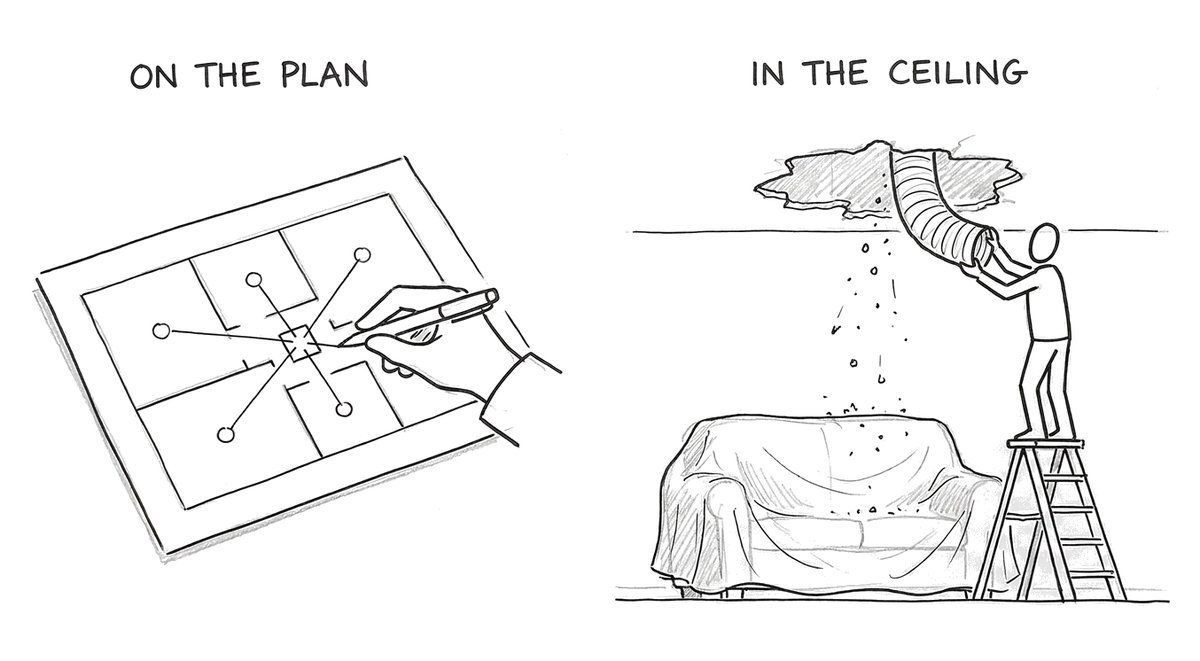
Duct routes, plant space and controls are cheap on a drawing and expensive in a finished ceiling. On a new build the ducts go in while the ceilings are open, the grilles go where the design says, and the unit gets a cupboard planned around it. In a finished house every duct means a hole in the plaster and a route through a roof space nobody planned for one, and sometimes there simply isn’t a good route.
That’s why existing homes usually get the room-by-room wall units. Each one needs an outside wall, a thin low-voltage cable back to a controller, and a slight tilt outwards so any water drains outside. Phil has a pair in his own home and likes them, with one honest limit: they make a little noise, so he keeps them out of bedrooms, where the still of the night shows it up. Living rooms, kitchens and studies are where they earn their place.
The part that decides whether you get what you paid for
Most heat recovery units are made in Europe for European houses, where the ducts run inside the heated part of the building. In Perth they often go in with long runs of bare duct through the roof space, which bakes in summer and goes cold on winter nights. Phil talks about one beachfront house with a jet-black roof where the roof space can reach 70 or even 80 degrees in summer. Run a bare duct through a space like that and the unit still recovers the heat, then the roof takes it straight back off the air on its way to the room.
Phil’s verdict on bare ducts in an unconditioned roof: “Your heat recovery capability is basically blown. It’s gone.” You feel it as warmer air than you expected from the grille in summer, and cooler air in winter. On a commissioning sheet it can still look like a pass, because nobody measured what happened between the unit and the room.
The fix costs money, and it’s the part of the price we’d least like you to cut: keep the unit and the ducts inside the insulated envelope, in a bulkhead or an insulated box built into the ceiling space, or use properly insulated duct sized for the extra resistance it brings. When two quotes differ a lot, this is often where the difference is.
Does heat recovery ventilation pay for itself in Perth?
Not quickly, and we wouldn’t buy it for that. Heat recovery makes fresh air cheaper. It doesn’t make it free, and Perth’s mild winters leave much less heat to keep than Canberra’s or northern Europe’s, so the saving on the bill is modest.
Where it does save is against what a sealed house would otherwise do: windows opened on a cold morning, or bathroom and kitchen fans throwing heated air outside all winter. Phil’s example from a wall unit: with the room at 22 degrees and 15 degree air outside, the fresh air comes in at around 20 or 21.
To work out a payback yourself you need three numbers: the extra cost over the simpler way of ventilating your house, the heat it keeps each year at today’s power price, and the years one takes to pay for the other. In a leaky house the middle number is close to zero, because the air already changes through the gaps, so seal and insulate first and ventilate second.
Be wary of anyone who promises a percentage saving before looking at your house, the duct routes and how much air your rooms need. Some of the percentages you’ll find online, including on old pages of ours, had no source behind them, which is why they’re gone.
What it costs to run and look after
The fans run day and night at a low speed, moving a little air all the time, which is why a good system is quiet and you never feel a draught. The small wall units draw a few watts each, in Phil’s words not hundreds and not even tens, so running them around the clock costs very little. A central unit has bigger fans doing more work, and ducts that are too small or too long make those fans work harder for the same air.
Filters are the one job the owner has. On most units they come out by hand in a minute or two, and Phil’s rule of thumb for the wall units is a change about every six months. A system with blocked filters ventilates badly and costs more to run than no system at all, so before you choose, ask what the filters cost and how easy they are to reach.
How to compare two heat recovery quotes
Two quotes for the same house can look nothing alike, one a box and a price, the other a page of drawings. Ask each what air-change rate it’s designed to deliver for your rooms; somewhere between about 0.3 and 2 changes of the air an hour is the usual range, and the designer should be able to say which and why. Then ask where every duct runs, how it’s insulated outside the heated part of the house, and where the fresh-air grilles go. They belong on the far side of the room from the door, so the air crosses the room instead of slipping straight out into the hall.
Last, ask how loud it is. Phil is blunt about it: “The most important thing to look for when you have a HRV system is the noise level.” His test is a bedroom at night, when the house is silent and any sound from a grille stands out, which is why our article on heat recovery noise has its own page. If a quote can’t answer these questions, what you’re being offered is a product with a price on it.
Other questions people ask us about heat recovery cost
Does heat recovery ventilation add value when I sell?
We know of no reliable Australian figure for that, so we won’t invent one. A buyer can’t see a duct. What they notice is a house that feels fresh and stays quiet with the windows shut. Our article on heating and resale value makes the same point about what buyers can and can’t see.
Is automated roof ventilation the same thing?
No, it does a different job. Roof ventilation pulls hot air out of the roof space in summer, with fans and louvres that compare the temperature inside and out. On the beachfront house with the black roof, one went in after the owners moved in, because the roof space got hot enough to damage equipment stored up there. It uses a little power for its fans and dampers, and it needs a well-built ceiling, because ventilating a roof in winter can pull heat out of the rooms below through gaps in the insulation.
Will heat recovery cool the house in summer?
No. It doesn’t heat or cool. When your air conditioning is running, it keeps most of the coolness in the air it swaps, the same way it keeps warmth in winter, but the cooling itself has to come from somewhere else.
Is a room-by-room system cheaper than a central one?
To put in, usually yes, because there are no ducts to run. The trade-off is less filtration and control, a little more noise and fewer places to put the units, since each one needs an outside wall. In a new build where the ducts can be planned inside the insulated part of the house, Phil’s preference is the central system.
Where to go from here
If you’re building or renovating in Perth or the south-west, the 5-minute quote gives you your options in writing within 3 working days, each with its price and a modelled running cost, and you don’t need plans to start. Mention heat recovery ventilation in the notes at the end so we know what you’re weighing up. If you’d rather read first, heat recovery ventilation, straight is the one-page version, and how heat recovery ventilation works explains the parts.