
Geothermal or hydronic heating? Why it isn’t either-or
The short answer
Geothermal and hydronic are two halves of the same system. Geothermal is where the heat comes from: a heat pump drawing warmth out of the ground. Hydronic is how the heat reaches you: warm water running through pipes in the floor, or through radiators. A geothermal heat pump nearly always feeds a hydronic system, and a hydronic system can just as well run on an ordinary air-source heat pump. So choose how you want to be heated first, then the heat source, and remember that the floor decides more of the bill than the ground does.
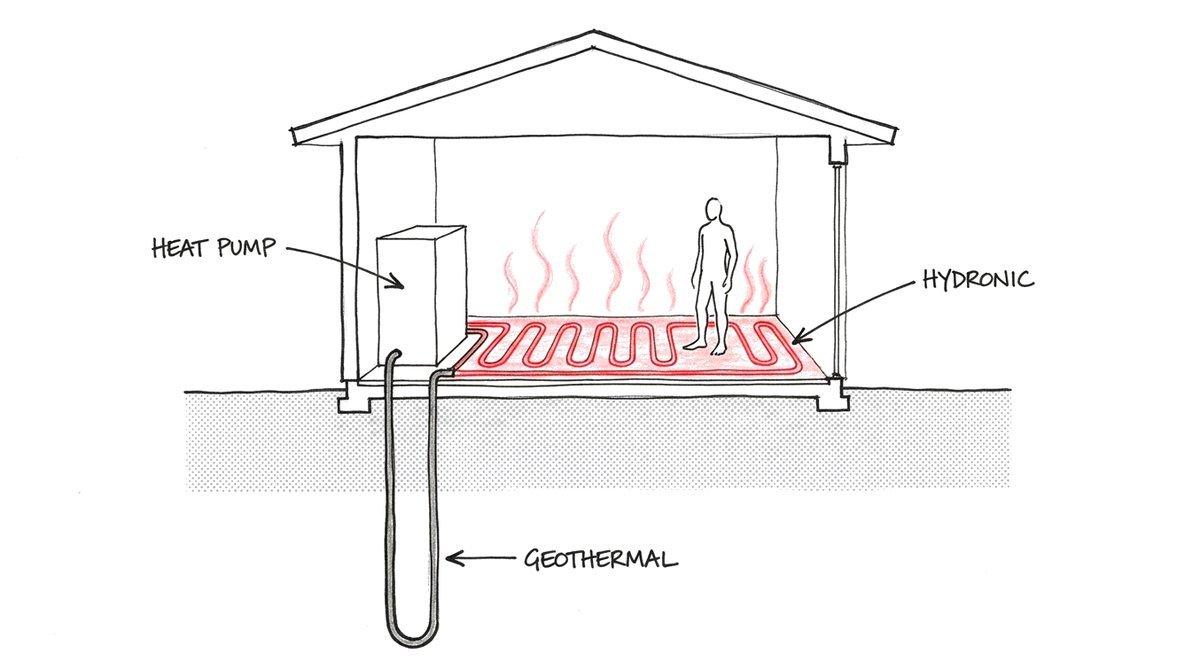
People often ask us which is better, geothermal or hydronic, and it’s an easy mix-up to make. Both get sold as the efficient option, both involve pipes full of water, and the brochures rarely say where one ends and the other begins. Once you can see the two halves, the decision gets a lot simpler, and so does spotting a quote that’s put the money in the wrong half.
What does each word actually mean?
Hydronic just means heating with water. A heat source warms water, a pump sends it round the house through pipes, and the water gives up its heat on the way: through the floor in floor heating, through slim panels on the wall with radiators, or through fan coils, which are ducted air conditioning units that run on warm or chilled water instead of refrigerant. The water then comes back to be warmed again.
Geothermal is one of the things that can warm that water. Instead of pulling heat out of the outside air, a geothermal heat pump pulls it out of the ground through a loop of buried pipe, or out of groundwater pumped up from a bore. Think of the ground as the dam and the hydronic system as the plumbing and taps. Nobody asks whether they should have a dam or taps, because you need both, and a good dam is wasted on leaking pipes.
Do geothermal and floor heating suit each other?
Very well, and it’s mostly about temperature. Any heat pump works more efficiently the less it has to lift the heat, so it’s at its best making lukewarm water rather than hot. A well-designed heated floor runs on water at about 30 to 35 degrees, which is exactly what heat pumps like. Ask the same heat pump for 55 degree water and its efficiency can halve.
That’s why geothermal and floor heating are such a natural pair. The ground gives the heat pump a warmer place to start than winter air, and the floor asks for a modest temperature at the end, so the lift in between is short at both ends. Radiators work too, at a somewhat higher temperature, as long as each one is sized for the room. And the same heat pump can run in reverse in summer, sending chilled water to fan coils and cool water to the floor, though floor cooling on its own handles only about a quarter of what a typical Perth house needs.
Which do I choose first?
The delivery, every time. How you want to be heated depends on the house: in a new build on a slab, floor heating is usually the answer; in a finished home, radiators bring the same kind of warmth without lifting the floors. Once that’s settled, the heat source is chosen to suit it. For most Perth homes that’s an air-source heat pump, and geothermal only where the site earns it, which we go through in geothermal or an air-source heat pump.
Phil’s version of the same rule is that “you need to start not with the heat pump but you actually need to start with the system”. A quote that leads with the brand of heat pump, or with the bores, and says little about the floor, the insulation under it or the water temperature it’s designed for, has started at the wrong end.
Why can’t a good heat source save a bad floor?
Because efficiencies multiply. Phil’s way of explaining it is that a system is a chain, and its efficiency is the efficiency of each link multiplied together. Our geothermal cost article works through his numbers and tells the story of a house where this went badly wrong.
Here’s what it means for this question, in round numbers. Take the best a ground-source heat pump can do, about five units of heat for every unit of electricity, and feed it into a floor built so badly that half its heat goes into the ground instead of the room. You end up with about 2.5. Now take a good air-source heat pump at about 3, feeding a well-built floor that delivers 80% of its heat to the room: about 2.4. The geothermal owner has paid for the drilling and ended up roughly where the air-source owner started.
Half is not an exaggeration, either. A heated slab with no insulation under it and no thermal break at its edge can lose up to 70% of its heat into the ground and out through the edges. That insulation goes in before the concrete is poured and can never be added afterwards, which is why the floor deserves the first and most careful look.
 10 min
Other questions people ask us about geothermal and hydronic
Is geothermal floor heating cheaper to run than air-source floor heating?
Yes, when both are built properly: up to about 40% cheaper on our Perth projects, less on a mild site. Whether that saving pays for the ground connection is a separate sum, and on most suburban sites it doesn’t.
Can I switch my hydronic system to geothermal later?
Often, because the pipes in the floor don’t care where the warm water comes from. What decides it is the water temperature the floor or radiators were designed for. A system designed around hot water from a gas boiler may need bigger radiators before any heat pump, air or ground, can run it efficiently.
Do I need a plant room for geothermal?
The heat pump lives indoors, along with its tanks, pumps and valves, so it needs a dedicated space. A small heating-only system needs far less than a large one doing heating, cooling, hot water and a pool, which on one of our jobs filled a space about six metres long. Our article on how much room the plant needs has the detail.
Where to go from here
If you’re building or renovating in Perth or the south-west, the 5-minute quote gives you your options in writing within 3 working days, each with its price and a modelled running cost, and you don’t need plans to start. Tell us in your notes if you’re weighing up geothermal. If you’re still getting to grips with how a heated floor works, floor heating, explained covers it in one page, and geothermal, straight does the same for the ground.