
Are solar hot water panels worth adding to hydronic heating?
The short answer
On most Perth homes, no. Solar hot water panels make most of their heat in summer, when nobody needs heating, and very little on the cold winter mornings when a floor or radiators need it most. A house’s heating can need 10 to 20 kilowatts or more on a cold morning, far more than a roof collector gathers. Phil’s advice is to spend the money on solar power panels and a heat pump instead, which can heat in winter and cool in summer from the same roof. The exception is a house with a pool, where the summer surplus has somewhere useful to go.
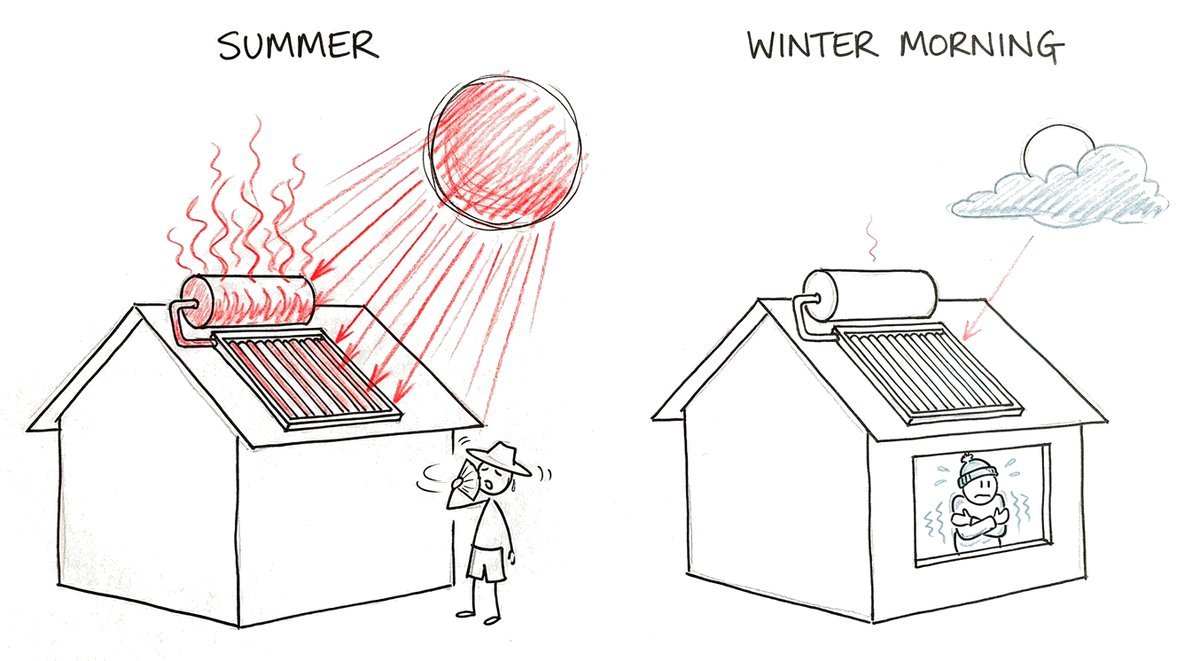
It’s a natural idea: the sun heats water for free, a hydronic system runs on warm water, and it seems a shame not to join the two. Plenty of Perth roofs already carry a solar hot water panel for the taps, and people ask us whether an expansion of it could run their radiators or floor. The idea is sound, and the timing is what lets it down.
Why doesn’t solar hot water suit heating?
Because the sun and the heating keep different hours. Perth’s cold is a morning cold: the Bureau of Meteorology’s Perth station averages 8.1 degrees overnight in July, and the house needs its heat from about 6 in the morning and again in the evening. A solar collector works best in the middle of the day, and in winter the sun sits low and the days are short. So the panel does its best work when the house needs least, and its worst when the house needs most.
The other problem is size. Phil’s comparison is blunt: a house’s heating might need 10, 15 or more than 20 kilowatts on a cold morning, and a large house 50, while a solar hot water collector gathers only a small fraction of that over a whole winter day. To make a real dent you’d need a roof full of collectors and a very large insulated tank to store the heat until morning, and on an ordinary home that rarely, if ever, pays for itself.
What happens to all that summer heat?
In summer the same panels make far more hot water than any house can use, and a heating system has nowhere to put it. Spring and autumn are much the same, with a full tank on a warm afternoon and nothing to heat until the next cold morning. You end up paying for collectors that sit idle or overheat for most of the year.
That’s also why the one exception works. If you have a pool, the summer surplus can go into the pool instead of being wasted, and the collectors earn their keep through the warm months. That’s the only case where we suggest adding solar hot water panels to a hydronic system.
What works better than solar hot water?
Phil’s view, put simply: “It’s better to put that money into a solar power system, like solar PV, and then use a heat pump.” Solar power panels make electricity, and electricity can go anywhere. A heat pump turns each unit of it into three or more units of heat, so the same patch of roof does more heating than a hot water collector could.
It works through the year. On a sunny winter day the heat pump can run on your own power and warm the floor or a tank in the afternoon, and the floor gives that warmth back into the evening. In summer the same panels run the cooling. Whatever is left over runs the rest of the house, instead of being sold back to Synergy for about 2 cents a unit in the middle of the day. Our article on running floor heating on rooftop solar goes into how much of the heating the roof can really carry.
Solar power can’t heat a house on its own either, because the heat is still needed when the sun isn’t up. What makes the difference is storing the day’s energy, in the floor, in a tank of hot water or in a battery, so it’s there at 6 in the morning. Phil calls a hot water tank a thermal battery: the bigger the tank, the bigger the battery.
 3 min
3 min
When does solar hot water still make sense?
For the taps, it can do a fine job, with its booster covering the cloudy winter days. If you already have a solar hot water system for your showers and kitchen, there’s no reason to pull it off the roof because you’re adding heating. Leave it doing that job and heat the house separately.
For heating, the cases are narrow: a house with a pool to take the summer heat, or a very large home that uses heat all year round, for a pool and spa as well as hot water, where the sums are worth running properly. On a standard Perth home, the money does more as solar power panels.
Other questions people ask us
Can I connect my existing solar hot water system to radiators or floor heating?
Generally not. The water you drink and shower in has to be kept separate from heating water, the tank is made to store water at tap temperatures, and a collector sized for showers can’t keep up with a house. Keep it for the taps.
Can radiators run on solar power?
Yes, through a heat pump. The radiators run on warm water from the heat pump, and the heat pump can run on your rooftop solar whenever it’s producing, with the grid covering the rest. Our article on running radiators on a heat pump explains how the panels are sized for it.
Do I need a battery to heat with solar?
Not necessarily. A heated floor and a hot water tank both store heat, which is the cheapest kind of battery. An electric battery helps carry more into the night, and we look at how far it goes in whether solar and a battery will run your heating through a winter night.
Are evacuated tubes better than flat panels for heating?
Evacuated tubes lose less heat on a cool day than flat panels do, but they share the same problem: the most heat in summer, the least on winter mornings. The choice of collector doesn’t change the answer for heating.
Where to go from here
If you’re building or renovating in Perth or the south-west, the 5-minute quote gives you your options in writing within 3 working days, each with its price and a modelled running cost, and you don’t need plans to start. Mention your solar panels, and your pool if you have one, in the notes so we can work them in. If you’re not ready for that, one system for the whole home shows how heating, cooling, hot water and a pool can share the same heat pump and the same roof.