
What maintenance does hydronic heating need?
The short answer
Very little, and none of it is under the floor. The pipes in the floor need no routine maintenance at all. The heat pump or gas boiler, with the pumps, valves and pressure vessel beside it, needs a service about every two years, or every year if its warranty asks for that: the technician checks the water pressure and the water itself, cleans the filter, checks the expansion vessel and looks at how often the machine is starting and stopping. Radiators need dusting. Some systems we installed 15 to 20 years ago are only now getting their first service, and they still run.
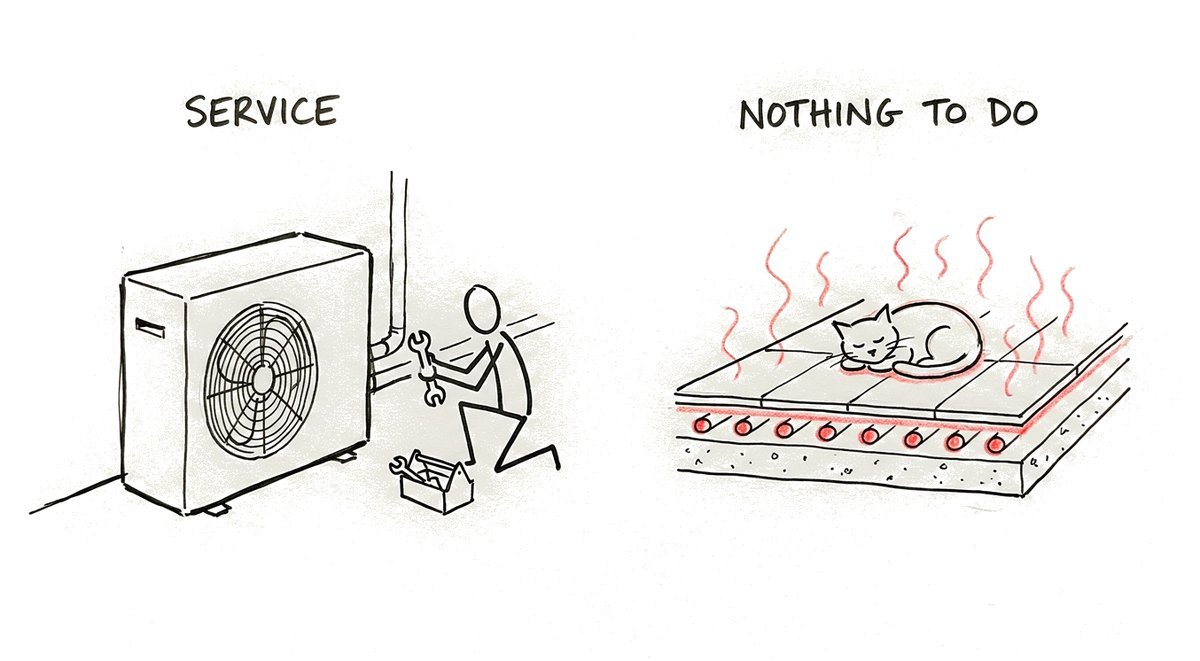
Most people ask about maintenance for one of two reasons. Either they’ve owned a ducted system, with filters to wash and a service every year, or they’re uneasy about water pipes buried in the floor. The good news is that the part you can’t reach needs nothing, and the part that does need looking after is out in the open, where it’s easy to get at.
Do the pipes in the floor need any maintenance?
No. Floor heating pipe is a sealed loop of plastic with the same water going round and round it, and it has no moving parts and nothing to wear. It’s rated for 50 years under its standard’s test conditions, and at the gentle temperatures a floor runs at, it will outlast most houses. A pipe in a floor only leaks if something cuts or punctures it, which is why every loop is pressure-tested before the concrete goes over it and kept under pressure while the other trades work.
The one thing to look after is the paperwork. The pipe layout is photographed and documented as it’s installed, so keep that plan with your house papers and check it before anyone drills into the floor, for a new kitchen, a door stop or anything else.
What gets checked at a service?
The service is about the machine that makes the heat and the water that carries it. These are the checks on our own service list, and each reading is written down so the next visit can see if anything is drifting.
| What’s checked | Why it matters |
|---|---|
| Water pressure | A pressure that keeps falling means water is escaping somewhere, and it’s best found early. |
| Water quality and inhibitor | Clean water with the right protective additive keeps the pumps, valves and heat pump free of sludge and corrosion. |
| Strainer or magnetic filter | Cleaned out, so dirt is caught before it reaches the heat pump or boiler. |
| Expansion vessel | This small tank takes up the water’s expansion as it warms. When it loses its charge, the pressure swings and the system can stop with a fault. |
| Starts against running hours | A machine that keeps switching on and off wears faster and costs more to run, and the count shows it. |
| Pipework and insulation | A look over everything visible for leaks and damaged insulation. |
We also ask how the house has felt. If one room has been cooler than the rest, the flow to its loop can be adjusted at the manifold, with nothing dug up. On newer systems we can check how the heat pump is running remotely as well, without a visit.
Is servicing a heat pump different from servicing a gas boiler?
Both need it, and we install and service both. A heat pump gets the checks above, and every few years its outdoor coil gets a proper clean so it can keep pulling heat out of the air. A gas boiler gets the same water-side checks, plus a combustion test with a flue gas analyser to make sure it’s burning cleanly and safely, a check that its condensate drain runs freely, and every few years a clean of the combustion chamber.
In Perth a heat pump usually comes out ahead on running cost, which is why it’s what we suggest first. If you have a gas boiler, or you’d rather have one, it simply goes on the same service schedule.
How long the machine lasts depends a lot on what you buy. Phil has seen cheap heat pumps give out in about five years, while a good one, sized and sited properly, is made to run for 20 to 25. Servicing won’t turn the first into the second, but it does help the second get there. We look at lifespans in how long hydronic heating lasts.
What can I do myself?
Not much is needed, and most of it is common sense. Keep the heat pump able to breathe: don’t let plants grow over it or stack things against it, because a smothered heat pump works harder and costs more. If your system has a pressure gauge, glance at it at the start of winter, and book a service if it keeps dropping. Dust radiators like any other furniture. If one is warm at the bottom and cool at the top, there’s probably air trapped in it, which is a quick job at a service.
And switch the heating on a few days before you need it at the start of the season. If anything isn’t right, you’ll find out on a mild day in May rather than the first cold morning in June.
What about geothermal systems?
The ground loop of a closed geothermal system is sealed plastic pipe buried where nothing disturbs it, with only fluid moving through it, so it needs nothing, and the heat pump is serviced like any other. Open-loop systems, which pump groundwater up one bore and back down another, need more attention. Some Perth groundwater carries iron, and where it meets air, iron bacteria can grow into a reddish-brown sludge that clogs the pipes and the heat exchanger.
The controls matter too. Phil once found two bore pumps on another installer’s system running around the clock, using more power than the heat pump itself, because nothing told them to switch off. A good first service catches that kind of thing. We compare the two kinds of system in heating and cooling with bore water.
Other questions people ask us
How often should hydronic heating be serviced?
About every two years, so every second year, usually. If your heat pump’s warranty asks for a yearly service, as some makers’ longer warranties do, follow the warranty. The warmer months are the best time to book it, so the system is checked before you need it.
Do you service systems you didn’t install?
Usually, yes. We look at the system first to check what it is and whether parts are still available. Older or unusual systems can have limits, but most can be serviced, upgraded or replaced.
Do radiators need anything extra?
Very little: a dust now and then, and letting out trapped air if a radiator goes cool at the top. If you’d like them a different colour, see can I paint my radiators.
What happens if a pipe in the floor is damaged?
It can be repaired. A hit during the build shows up straight away, because the pipes stay under pressure. Later on, the as-installed plan shows where the pipes run, which is why it’s worth keeping.
Where to go from here
If you’re planning a new system in Perth or the south-west, the 5-minute quote gives you your options in writing within 3 working days, each with its price and a modelled running cost, and you don’t need plans to start. Our questions answered page covers warranties and what comes with every system we install.