
Why does floor heating feel warmer at a lower setting?
The short answer
Because you feel the floor, walls and furniture around you as much as the air. Your body trades between 50 and 60 percent of its heat with a room by radiation, so when the surfaces are cold you keep losing heat to them even if the air is warm. A heated floor warms those surfaces and warms you directly, so you’re comfortable with the air a little cooler. In one radiator-heated Fremantle home the owner keeps the setting at 19 degrees, and it feels perfectly warm.
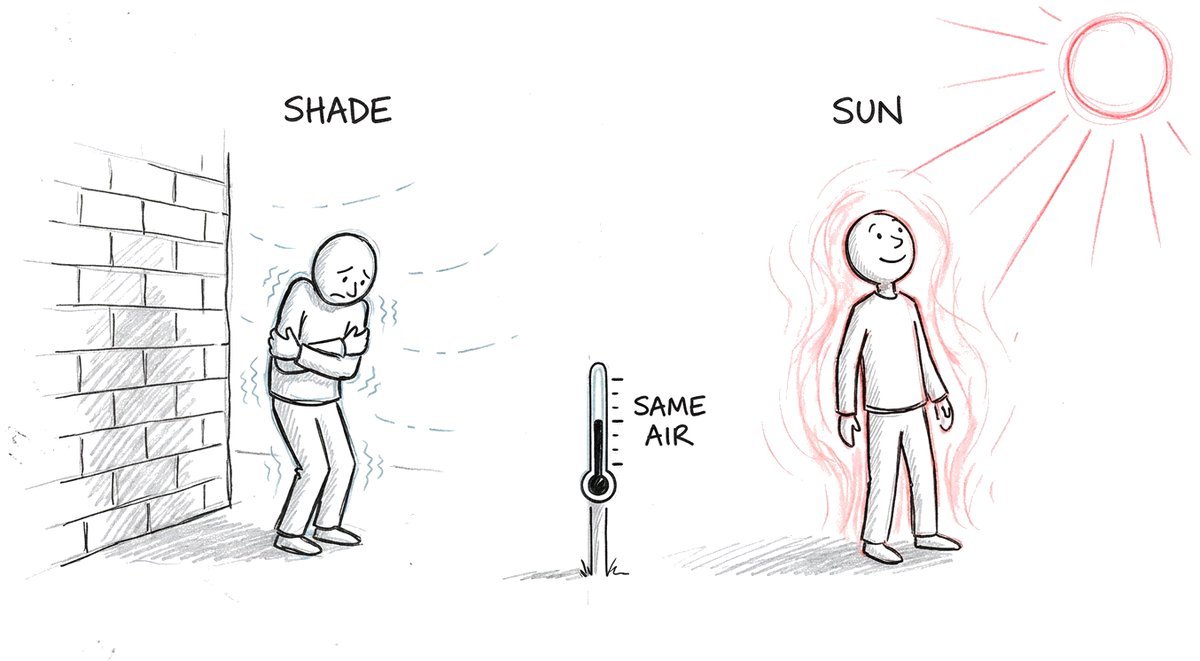
Most of us have learned to judge warmth by the number on the thermostat, because that’s how air conditioning works. So it surprises people that a house with floor heating can sit a little lower and feel better. There’s no trick in it, and you don’t need any physics to follow it. You already know the feeling from every sunny winter’s day in Perth.
The three ways heat reaches you
Heat gets to you, and away from you, in three ways. The first is touch: stand barefoot on cold tiles and the floor pulls heat straight out of your feet. The second is moving air: warm air rises, cool air sinks, and a fan pushes it around. The third is radiation, warmth that travels straight across a room the way the sun’s warmth reaches you, without needing the air to be warm at all.
The third one matters most. Phil puts it at between 50 and 60 percent of all the heat your body trades with its surroundings, with moving air at about a quarter and touch and sweating making up the rest. That’s why standing in the sun on a cold, still morning feels so different from standing in the shade a step away. The thermometer reads the same in both places. Your body doesn’t.
Why can the air conditioner say 25 and you still feel cold?
Phil calls it the strange thing about air conditioning: the controller says 25 or even 28 degrees and you’re still cold. The air has been heated, but the walls, floor and windows around you might still be sitting at 13 or 15 degrees. Your body keeps radiating heat out to those cold surfaces, so you’re losing warmth faster than the warm air can give it back.
Warm air also rises. Blown in from a vent or a split system, it gathers under the ceiling, and the air down where you sit is the coolest in the room. Most of us respond the obvious way, by turning the thermostat up, and pay for heating the ceiling.
What does a warm floor change?
A heated floor turns the whole floor into one large, gentle heater, running on water at around 25 to 40 degrees, cooler than your hot tap. It warms you directly, the way the sun does, and it warms the walls and furniture, which then give that warmth back. Phil describes it as everything in the room becoming a heater. Once the surfaces around you are warm, you stop losing heat to them, and the air doesn’t need to work as hard.
Phil has a good picture for it: a concrete footpath that has had the sun on it all day still radiates warmth on a cold spring day, and your body loves that kind of heat even with cool air around you.
The clearest example Phil has filmed is an 1895 house in Fremantle with radiators, which work in much the same way. Standing in the living room in winter, he says: “the owner sets the heating to 19°. Now, you might think that’s cold, but it’s perfectly warm.” Compare that with the 25 or 28 on an air conditioner that still leaves you cold.
 6 min
6 min
Does a lower setting mean a lower bill?
A little, and honestly so. A house leaks heat faster the warmer it is inside compared with outside, so being comfortable with the air a bit cooler means a bit less heat walks out through the walls, windows and roof. That’s the main reason a floor built right runs in the same league as a good reverse-cycle system, and sometimes below it.
You’ll read online that floor heating is 30 percent more efficient than other heating. Phil’s view, from years of Australian houses, is that it’s more like 15 percent the way we build here, and only when it’s done right. The comfort only turns into savings if the heat goes up into the room. Without insulation under the floor, up to 70 percent of it can go into the ground instead, and no thermostat setting gets that back. We compare the running costs in hydronic against ducted reverse-cycle.
Why should the thermostat feel the room, not the floor?
Because the floor’s temperature isn’t what you feel. Phil sees thermostats that measure the floor, or that are tucked inside a cupboard or put in a hallway nobody heats, and none of them can judge the room properly. A good room thermostat senses both the air and the radiant warmth around it, from a spot where people actually spend time, so it judges the room the way your body does.
Electric floor heating has to watch the floor’s own temperature, because its cables run hot enough to damage a floor finish. A hydronic floor runs cool enough to be controlled by how the room feels. More on choosing and placing controls in how to control hydronic heating.
Other questions people ask us
What temperature should I set my floor heating to?
There’s no single right number, and the room will feel warmer than the same setting on an air conditioner. Start lower than you’re used to and adjust over the first couple of weeks. Our article on the best temperature for floor heating goes into it.
Will the floor feel hot under my feet?
No. A well-designed floor feels gently warm, never hot, and you notice a comfortable room more than a warm floor. Tiles and stone feel a little warmer underfoot than carpet, because they pass heat to your feet more easily.
Does this work in rooms with high ceilings?
Better than blown air does, because the warmth starts at the floor where you are instead of collecting under a ceiling you never touch. Big windows and very tall rooms still need care in the design, which we cover in heating rooms with high ceilings.
Do radiators warm you the same way?
Mostly. Phil puts a radiator at roughly 50 to 60 percent radiation, with the rest warming the air gently as it rises past the panel. There’s no fan, so it’s still a quiet, even warmth.
Where to go from here
If you’re building in Perth or the south-west, the 5-minute quote gives you your options in writing within 3 working days, each with its price and a modelled running cost, and you don’t need plans to start. If you’d like the bigger picture first, floor heating, explained walks through how the whole system works, and the Running Cost Calculator shows what it costs to run for your floor area.