
Will solar and a battery run my heat pump heating through a winter night?
The short answer
Partly. Perth’s winter sun can run a heat pump in the middle of the day, and a heated floor stores some of that warmth into the early evening, but most of the heat is wanted in the mornings and evenings, when the panels make nothing. A 10 kWh battery, the size the WA rebate is based on, holds less than half of what floor heating in a 200 m² home built right uses on a winter day (our modelled estimate), and it runs the rest of the house too. Solar and a battery will cut what you buy from the grid on winter nights; they won’t end it.
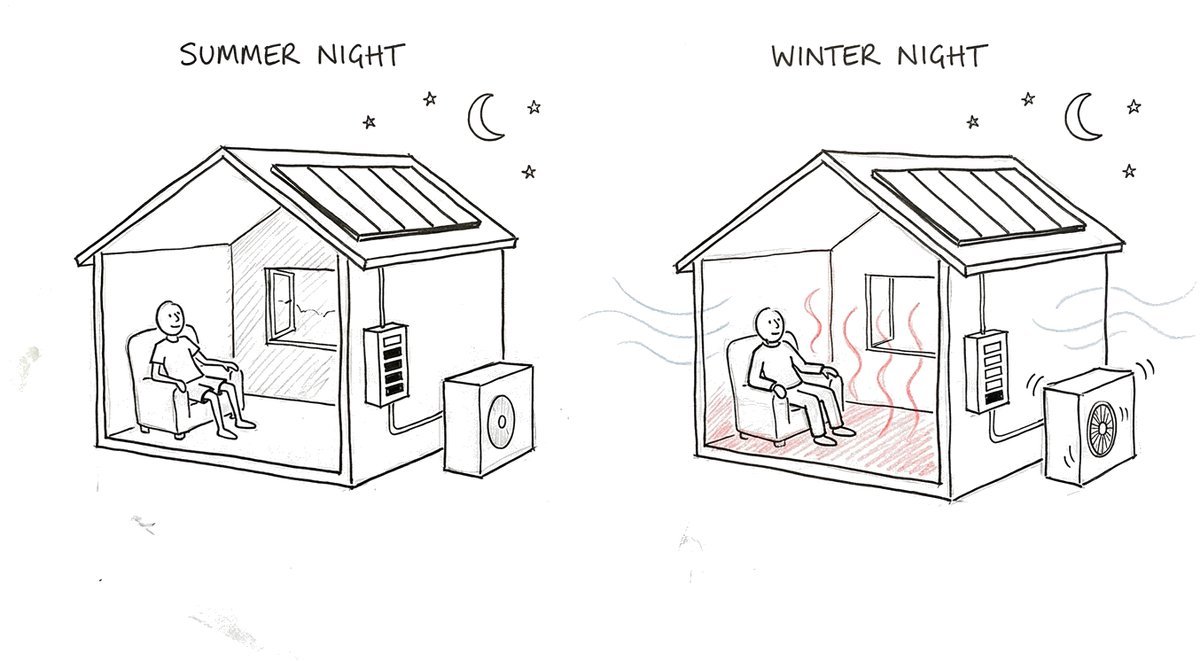
About 40% of households on WA’s main grid already have rooftop solar, according to the Australian Energy Market Operator, and with battery rebates on offer, plenty of people building or renovating ask the next question: if I add a battery, can the heating run on my own power? The honest answer depends on how much heat the house needs, when it needs it, and how much the panels make in July.
When does a Perth house need its heat?
Perth’s cold is a morning and evening cold. July nights average about 8 degrees at the Bureau of Meteorology’s Perth station, and by lunchtime the day is often pleasant. So the heating works hardest on cold mornings and through the evening, which is exactly when the panels are dark or barely producing. As Phil says, in winter the heat is needed in the mornings and the evenings, when the sun isn’t shining.
How much do the panels make in winter?
A lot less than in summer. A late-June day in Perth has about four hours less daylight than a December one, the sun sits low, and July brings runs of grey, wet days. The middle of a clear winter’s day is still useful, and that’s where a heat pump does its best work on solar, because each unit of solar power becomes about three units of heat. With the right controls, a heat pump can pick up spare solar as it happens and turn it into warmth in the floor or hot water in the tank.
That beats sending it to the grid. Under WA’s buyback scheme for Synergy customers, power you export earns 2 cents a unit between 9pm and 3pm, or 10 cents between 3pm and 9pm, while the same unit bought back costs about 33 cents on the standard home tariff. But panels sized for an ordinary household won’t also cover a winter heating load, and in a wet week they may barely cover the house.
Can the floor store the midday heat?
Some of it, and that’s one of the best things about floor heating. Run the heat pump through the middle of the day while the panels are producing, and the floor and the room soak up warmth they give back slowly after the sun goes down. A big hot water tank does the same for tap water, heated a little hotter when there’s spare solar. Phil describes a large heated tank like this: “that tank is behaving like a thermal battery. And so, the bigger the tank, the bigger the battery.”
A floor isn’t a night storage heater, though. Phil’s experience is that a floor warmed at midday carries a house for a few hours, and by around 8 at night, sometimes earlier, the heating needs to come back on, because unless the house is very well insulated it keeps losing heat. That part of the night is what a battery would have to cover. If you’re on a time-of-use plan, the same idea works without a battery, as we explain in running floor heating on cheap midday power.
What does a 10 kWh battery actually cover?
Here’s the arithmetic for a typical case. Our modelled running cost for floor heating in a 200 m² Perth home built right is about $240 a winter month at Synergy’s 33.26 cents a unit, which works out to something over 20 units (kilowatt-hours) of electricity a day through the cold months. A battery with 10 kWh of usable storage holds less than half of that, even if it starts the evening full and powers nothing else.
In practice it also runs the lights, the cooking, the television and the fridge through the evening, and on a dull July day it may not fill at all once the heat pump has used the midday sun. So a battery covers part of a winter evening’s heating, and the grid covers the rest. Built cheaply, the same floor uses about two and a half times as much (about $601 a winter month, modelled), and no home battery comes near that. The easiest kilowatt-hour for a battery to cover is the one the house never needs.
The battery rebates, checked October 2026
If you’re buying a battery anyway, the help is real. The WA Residential Battery Scheme gives Synergy customers up to $1,300 off (Horizon Power customers up to $3,800), with the maximum based on 10 kWh of usable storage. You join your retailer’s virtual power plant, which lets you sell stored power back at busy times, and households with a combined income under $210,000 can take a no-interest loan of up to $10,000. The state expects the scheme to run until 2027.
It comes on top of the federal Cheaper Home Batteries Program, which takes around 30% off a battery of up to 14 kWh, gives less support for capacity above that, and steps down over time. Rules change, so confirm both before you sign anything. Our article on rebates for heat pumps in WA lists every scheme we checked.
 13 min
Other questions people ask us
Should I buy a bigger battery for the heating?
Think twice. Capacity above 14 kWh gets less federal support, and a battery is only useful if the panels can fill it, which is hardest in July, exactly when the heating needs it most. Ask your solar installer to model your winter days, not your summer ones, before you choose the size.
Would a gas boiler be better for night-time heating?
A gas boiler doesn’t care about the sun, and we install them if you’d prefer one. On running cost a heat pump usually comes out ahead in Perth even on bought power, which is why we suggest it first, with solar as a bonus rather than the plan.
Can the heat pump run straight off the panels without a battery?
In daylight, yes. With the right controller it uses spare solar as it’s produced, warming the floor or the hot water tank instead of exporting the power for 2 cents. After dark it runs on the grid, or on whatever the battery has left.
Where to go from here
If you’re building or renovating in Perth or the south-west, the 5-minute quote gives you your options in writing within 3 working days, each with its price and a modelled running cost, and you don’t need plans to start. Tell us about your solar and any battery in the notes. To see how heating, hot water and solar can work as one system, read our page on whole-home systems, and our article on running floor heating on rooftop solar covers the daytime side in more detail.