
Can I run my floor heating on cheap midday power?
The short answer
Partly, and Perth is a good place to try. Synergy’s Midday Saver plan prices power cheapest between 9am and 3pm and dearest between 3pm and 9pm, and solar you export outside the evening peak earns just 2 cents a unit. A heated floor can soak up warmth in the cheap hours and give some of it back into the evening, so more of the heat pump’s work happens when power is cheap and the air outside is warmest. It won’t carry the house through the night, though, and the cold start to the day still runs on power bought before 9am.
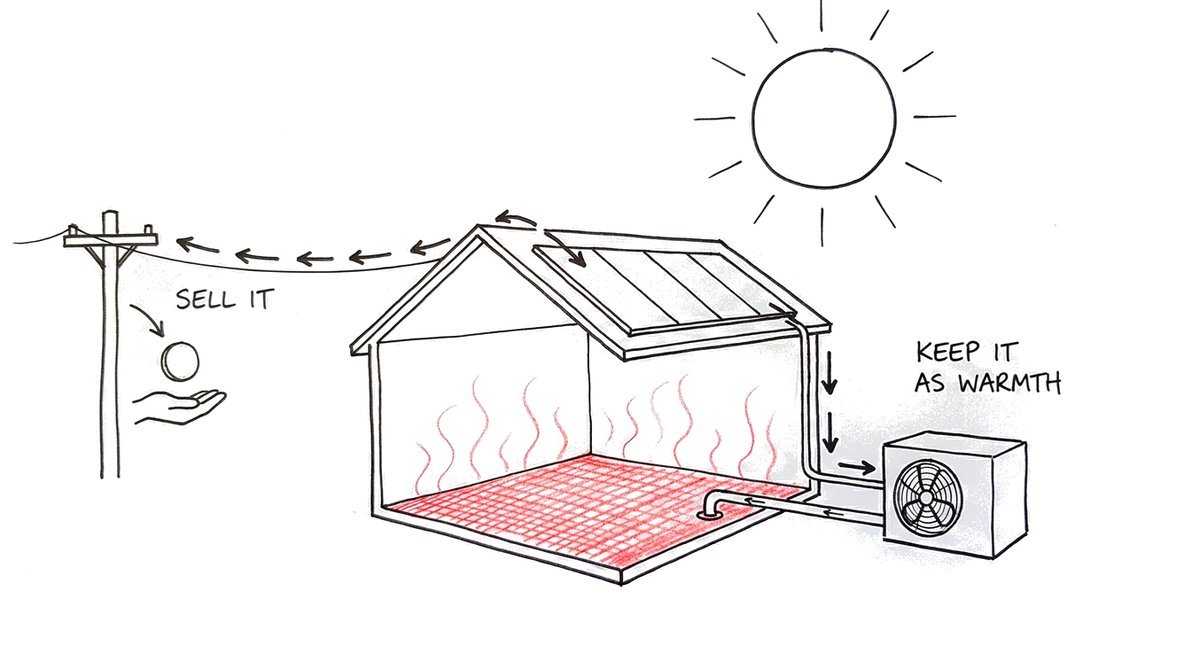
Plenty of Perth households with solar know the feeling: the panels pour power into the grid at lunchtime for next to nothing, and then you buy it back at full price to cook dinner. A heated floor looks like the obvious place to put that midday power, because concrete holds heat. It’s a good idea with real limits, and the limits have more to do with the floor and the house than with the tariff.
How does Synergy’s Midday Saver plan work?
It’s a time-of-use plan with three prices a day. On Synergy’s Midday Saver, power is cheapest from 9am to 3pm, dearest from 3pm to 9pm, and the overnight hours from 9pm to 9am sit in between. It needs an advanced (smart) meter. The ordinary A1 home tariff, by comparison, charges 33.26 cents a unit at every hour of the day from 1 July 2026. We don’t quote the Midday Saver rates here because they change each July, and Synergy publishes the current ones.
The plan rewards moving power use into the middle of the day and charges more in the evening, for the whole house: the oven, the dryer and the television after work all land in the dearest hours. Whether it suits you is a question about your household, not only your heating.
Solar owners have a second price to keep in mind. Under the state’s buyback scheme, Synergy pays 2 cents a unit for solar exported outside 3pm to 9pm, and 10 cents inside that window. Every unit your heat pump uses at lunchtime is one you aren’t selling for 2 cents, and some of the warmth it makes is still in the floor after dark, when power costs the most.
Why does a heated floor suit cheap midday power?
Because concrete stores heat. Phil calls a big tank of warm water a thermal battery, and a heated slab works in much the same way: put warmth into it through the middle of the day and it gives it back slowly over the hours that follow. A battery on the wall stores electricity; a heavy floor stores warmth, and you’re standing on it anyway.
The heat pump has an easier job at midday as well. The Bureau of Meteorology’s Perth station averages 18.5 degrees on a July afternoon against 8.1 overnight, and Phil’s way of putting it is that it’s much easier to pull heat out of 20 degree air than out of 7 degree air. So heat made at midday can be cheaper twice over: cheaper power, and more heat out of every unit of it.
How long will a warm floor carry the house?
A few hours, not a night. Phil’s experience is that a floor warmed through the day helps well into the evening, and then by about 8pm, sometimes earlier, the room has cooled enough that the heating needs to come back on. The better the house holds its heat, the longer the floor carries it, which is one more reason the walls, ceiling and glass matter as much as the heating.
The mornings are the hard part. As Phil says, “when you need the heat is when the sun isn’t shining, usually. So in winter it’s in the mornings and in the evenings.” By 6am the floor has been giving its warmth away since the middle of the afternoon, so the warm-up before breakfast runs on overnight power whatever plan you’re on. On Midday Saver that’s the in-between price, which is better than the evening peak, but it isn’t the cheap one.
Does it matter how the floor is built?
More than anything else here. A heavy floor stores more and a light one responds faster, and the same concrete can’t do both. A heated slab on the ground, 100 to 125 millimetres thick, takes about 45 minutes to start giving out warmth and holds plenty, so it carries midday heat further into the evening. A thin insulated screed starts in 15 to 30 minutes and follows Perth’s swings between a cold morning and a mild afternoon, but it holds less and needs topping up sooner. We compare them in three ways to heat a floor.
Either way, the store needs insulation under it. A slab with nothing underneath stores heat in the ground as well as the room, and in the worst cases up to 70% of the heat goes down and out, so charging it at midday mostly warms the sand. The mass that helps is mass with insulation under it and around its edge.
There’s a ceiling on how hard you can charge it, too. More heat into the floor at midday means a warmer room in the afternoon, and Perth’s July afternoons are often mild already. Overdo it and you’re opening windows at 2pm, throwing the stored warmth away before dinner.
How do you set floor heating up for midday power?
With controls that plan around the cheap hours, rather than a timer and hope. Run the floor a little warmer between 9am and 3pm so it carries more into the evening, ease off as the peak starts, and top up only as much as the house needs before bed. Phil does the same in reverse in summer, using spare solar to cool the house a degree further in the afternoon so less cooling is needed later. A controller that reads your solar output can follow a cloudy day; a fixed timer can’t.
What nobody can honestly promise is a saving. How much of your heating moves into the cheap hours depends on the floor, the house, your solar and the way you live, and the morning and evening heat still costs what it costs. Our modelled estimate for a well-built 200 m² floor on an air-source heat pump is about $240 a winter month at the flat A1 rate, and shifting part of that into cheaper hours lowers it by an amount that’s different in every house.
Other questions people ask us
Is Midday Saver worth it with floor heating?
It can be, if the floor stores heat well, the house holds it, and the rest of your evening use isn’t heavy. If you cook, wash and run the heating hard between 3pm and 9pm anyway, the dearer peak can cancel out the cheap middle of the day. Look at a winter bill before you switch.
Do I need solar panels to use cheap midday power?
No. Midday Saver is a grid tariff, so the cheap hours apply with or without panels. Solar adds a second reason to use power at midday, because what you export then earns so little.
Would a home battery do the same job?
A battery stores electricity, and it can run the heat pump after dark, including the morning warm-up if it’s big enough. Whether one will carry heat pump heating through a winter night is a sizing question we go through in solar, a battery and winter heating.
Where to go from here
If you’re building in Perth or the south-west, the 5-minute quote gives you your options in writing within 3 working days, each with its price and a modelled running cost, and you don’t need plans to start. If you’re on Midday Saver or have solar, say so in your notes. If you’re still working out what heating would cost to run at all, the Running Cost Calculator shows the built-right and built-cheap numbers for your floor area, and our article on solar and floor heating covers the panels.