
How long does floor heating take to warm up – and should I leave it on?
The short answer
Once it’s in its winter rhythm, a floor heated in a thin insulated screed starts giving out warmth within about 15 to 30 minutes of a call for heat, a heated slab on the ground within about 45 minutes to an hour, and a heated upstairs slab only after many hours. On the first cold days of the season everything takes longer: from stone cold, a 50 mm screed needs about five to six hours to come fully up to temperature. So don’t wait until you feel cold to switch it on. Run it on a timer that starts before you get up, and let the timer run the season.
Phil calls this one of the most common questions we get, and it’s a fair one if you’ve only ever had a split system that blows warm air the moment you press the button. Floor heating runs on a different clock. How quickly it responds depends almost entirely on how much concrete it has to warm before the warmth reaches you, and that’s decided when the floor is built.
Why does a heated floor take time to warm a room?
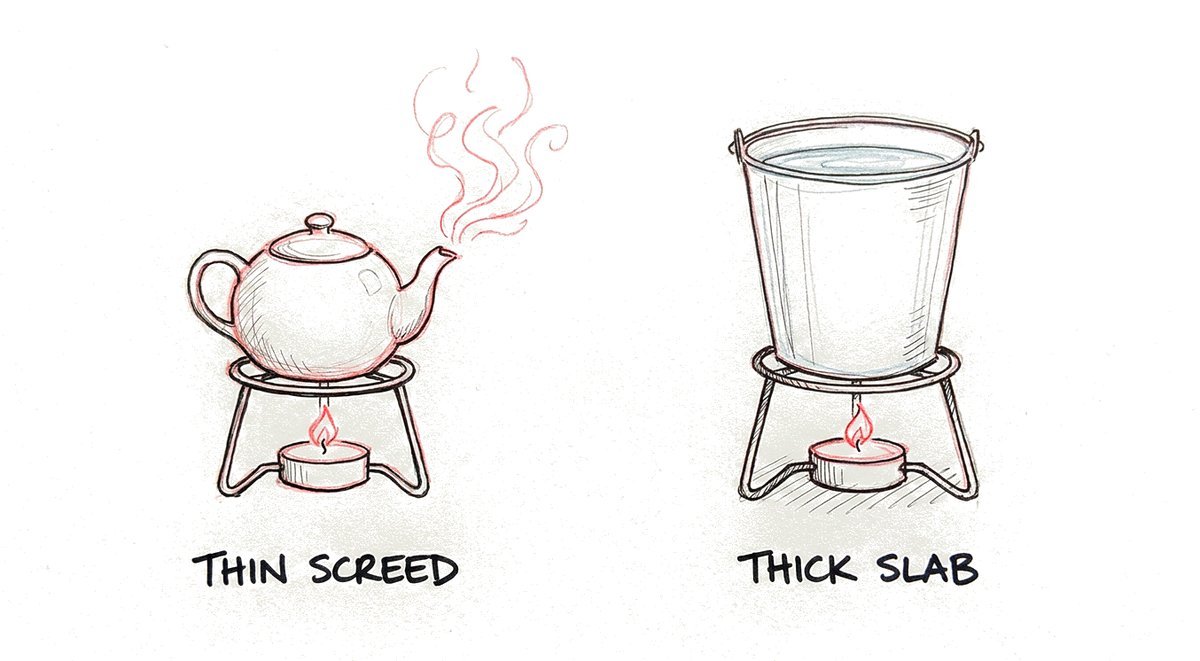
Because the heat has to fill the floor before it comes out of it. Warm water runs through pipes in the concrete, the concrete soaks up the heat, and only once the floor is warmer than the room does it start giving warmth back. The more concrete there is, the longer that takes. It’s an old picture of ours, but it still works: put a tea candle under a teapot and it soon steams; put the same candle under a bucket of tea and not much happens.
Phil sums it up in one line: “the less thermal mass you have the quicker the reaction time”. It works in the other direction too. A heavy floor takes just as long to cool down once it’s warm, and in Perth that matters as much as the warm-up.
How long does each kind of floor take?
| How the floor is heated | Starts giving out warmth |
|---|---|
| Pipes in a thin insulated screed | about 15 to 30 minutes |
| Pipes in a slab on the ground (100 to 125 mm) | about 45 minutes to an hour |
| Pipes in a suspended slab, upstairs or over a garage | many hours, often days |
Those times are for a system in its winter rhythm, with the walls, the furniture and the floor itself already warm. The first cold days of the season are different, because the floor heating has to warm everything in the house before you feel much. From stone cold, a 50 mm screed takes about five to six hours to come fully up to temperature.
We’ve worked the numbers for a 100 m² floor on an 8 kW heat pump: about 5.5 hours for an insulated screed, and over 28 hours for a thick suspended slab, which weighs about five times as much. After a few days the system finds its rhythm and the shorter times apply.
Why does warm-up time matter so much in Perth?
Because our winter days swing hard. The Bureau of Meteorology’s Perth station averages 8.1 degrees overnight in July and 18.5 in the afternoon, and a cold morning is often followed by a bright, mild day. A floor that responds in half an hour can follow that: warm for breakfast, easing off as the sun comes in. A thick slab can’t. Phil’s warning about heated suspended slabs is that they keep pushing out heat long after you want them to, when it might be 26 degrees outside. You end up with the windows open, paying to heat the street.
That’s one reason we like an insulated screed and advise against heating a suspended slab at all. A heated slab on the ground, insulated underneath and at the edge, sits in between, and it suits plenty of single-storey Perth homes. We compare the options in three ways to heat a floor.
 4 min
4 min
Should I leave floor heating on all the time?
Not around the clock, and not switched on and off by hand either. The way to run it is on a timer that follows your day. Phil’s advice is to use “a programmable thermostat that you can set to your lifestyle”: warm when you get up, off while you’re at work, back on before you get home. With a screed that works beautifully, because it can go from off to warm in well under an hour.
The heavier the floor, the earlier the timer has to start, and the less sense it makes to switch it off for short gaps. A well set-up system knows how long each area takes to warm and starts it early enough, and its thermostat reads the room you’re in rather than the floor. At the start of the season, switch the system on a few days before the first real cold snap rather than on the morning itself, so the house can catch up. After that, leave the timer alone.
Does a heated floor keep the house warm after it switches off?
For a while, and that’s the useful side of mass. A screed laid on insulation is quick enough to follow the day and heavy enough to carry some warmth on into the evening after it switches off. A thick uninsulated slab stores far more, but it stores it everywhere, including the ground underneath, and gives it back on its own schedule. The mass that hurts is the mass with nothing under it.
Stored warmth is also what makes cheap daytime power useful. Synergy’s Midday Saver plan prices power between 9am and 3pm well below the evening peak, and a floor that soaks up heat in the middle of the day gives some of it back after the sun goes down. We go through it in running floor heating on cheap midday power.
Other questions people ask us
Will turning the thermostat up make it warm faster?
No. The floor gives out heat at its own pace, so a higher setting won’t make it warm any sooner. It just means the room overshoots later in the day. If the house isn’t warm when you get up, start the timer earlier instead.
Does carpet or timber slow it down?
A little. Carpet and timber hold back some of the heat, so the room takes a bit longer to respond than it would over tiles. The system is designed around your floor coverings if it knows them before construction starts. We cover this in which floor coverings work best.
Is electric floor heating faster?
Usually, because electric mats are thin and sized to warm a small floor quickly, which is why they suit a single bathroom. Across a whole house they cost far more to run, two to five times more per hour by Phil’s reckoning.
Why does the house feel slow to warm in the first week of winter?
Because the floor heating is warming the walls, the ceiling and the furniture as well as the floor, and they all start cold. Give it a few days and it settles into its rhythm.
Where to go from here
If you’re building in Perth or the south-west, the 5-minute quote gives you your options in writing within 3 working days, each with its price and a modelled running cost, and you don’t need plans to start. If you’re still deciding how the floor should be built, the Slab Pour Deadline Checker shows how long you have before that choice is made for you.