
What temperature should underfloor heating be set at?
The short answer
Set the thermostat for the room, not the floor. Start at about 20 degrees in the living areas and adjust a degree at a time over the first winter; because floor heating warms you mostly by radiation, many people end up comfortable at a lower setting than they’d use with an air conditioner. The floor itself should feel gently warm, never hot. And the water in the pipes, the temperature that decides your power bill, should be only 30 to 35 degrees on a well-designed system, cooler than your hot tap.
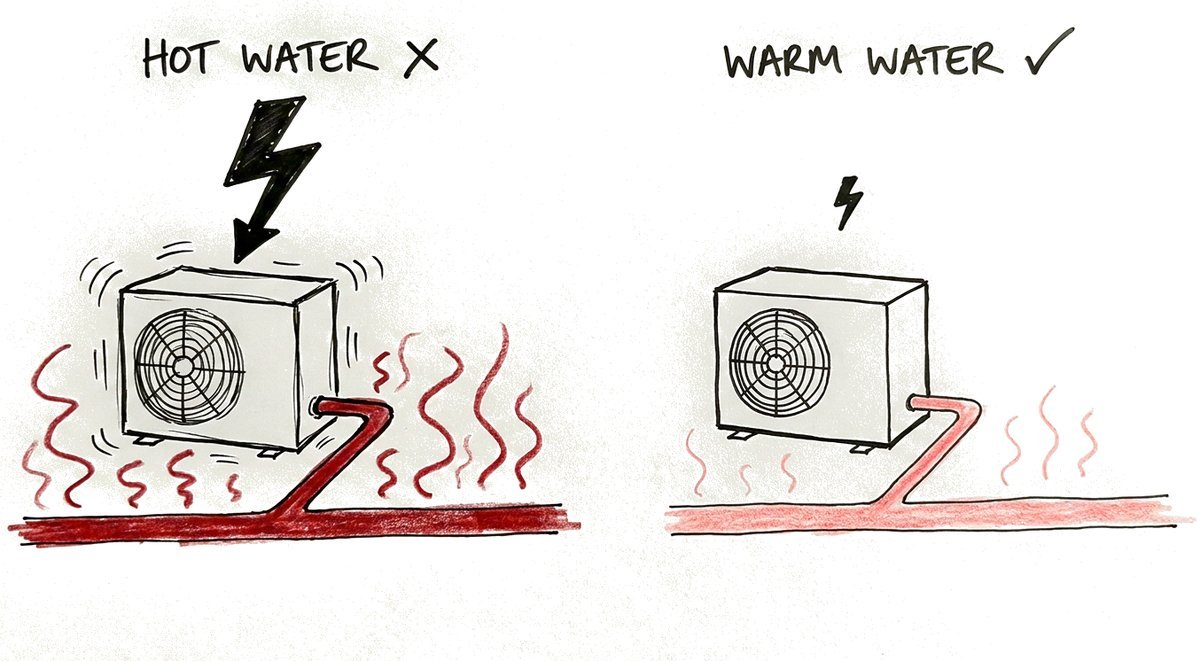
There are really three temperatures in a heated floor, and most of the confusion online comes from mixing them up. The thermostat setting is the temperature of the room. The floor surface is what your bare feet feel. And the water running through the pipes is what the heat pump has to make, which is where the running cost is won or lost. Here they are one at a time.
What should I set the thermostat to?
The thermostat measures the room, and the room is the number you set. That sounds obvious, but a lot of systems get it wrong by putting the sensor in the floor. As Phil puts it, “the temperature of the floor does not equal the temperature that you and I feel in the room.”
A floor can be quite warm while the room is still cool, so a good thermostat sits on a wall in the room it controls, reading both the air and the warmth coming off the surfaces around it. One tucked in a linen cupboard or a room that isn’t heated will run the system when it doesn’t need to, or not when it does.
Start at about 20 degrees in the living areas and give it a few days to settle, then adjust a degree at a time. Most people like the bedrooms cooler. Expect to fine-tune over the first winter, and after that it’s set and forget: on in May, off in spring.
Floor heating also changes the number that feels right. With air conditioning, the air can read 25 or even 28 degrees and you still feel cold, because the walls and the floor around you are cold and your body keeps losing heat to them. A warm floor warms those surfaces too. Phil filmed in an 1895 house in Fremantle heated by radiators and a heated floor, where “the owner sets the heating to 19°. Now, you might think that’s cold, but it’s perfectly warm.” Why it works that way is in why floor heating feels warmer at a lower setting.
How warm should the floor feel?
Gently warm, and on a mild day you may hardly notice it at all. Phil describes the heat from a well-designed floor as so low and so spread out that you can’t really feel it as heat, it just feels natural. On a cold July morning, tiles and polished concrete feel pleasantly warm under bare feet, and carpeted rooms feel less so, though the room is just as warm. A floor that feels hot is usually a sign of an electric mat, which tends to run the surface hotter over a smaller area, or of water that’s hotter than it needs to be.
There’s a reason a floor never needs to be hot. It’s warming a very big surface, the whole floor, so it can work at a far lower temperature than a gas heater in the corner, which Phil points out has to run at 90 or 100 degrees to reach the far side of the room.
The flip side is that a floor can only put so much heat into a room before its surface would get uncomfortably warm. Rooms that lose a lot of heat, like a wall of glass or a double-height void, show up in the heat-load calculation and are dealt with at the design stage, before anyone is standing on a hot floor.
Bathrooms are the one place people like the floor noticeably warm. That’s handled in the layout: in our floors the pipes usually go closer together in a bathroom than in the living areas, so the tiles give out a little more heat at the same water temperature.
What temperature should the water be?
This is the number that matters most, and the one you never see. On a well-designed floor running on a heat pump, Phil’s figure is 30 to 35 degrees, and on a mild day it can drop to 25 or 27 because the system turns the water temperature up and down with the weather inside and outside. That’s lukewarm. Your hot water system stores water at 50 degrees or more.
The reason it matters is the heat pump. In Phil’s words, “it’s much easier for the heat pump to produce 30 or 35° water than it is 50 or 55° water.” His example is a good heat pump on a well-designed system delivering about five units of heat for each unit of electricity at 35 degree water, and only about two and a half at 55.
Same machine, twice the electricity for the same warmth. It’s one of the reasons the same floor can cost two and a half times as much to run when it’s built cheaply, as our Running Cost Calculator shows in modelled estimates for your floor area.
Plenty of floors still run hotter, at 45 or 50 degrees, because that’s how it was done 30 or 40 years ago with gas boilers, when the extra heat didn’t cost much. With a heat pump it costs a lot. So the one question Phil says to ask anyone quoting your floor heating is what water temperature the system is designed for. For a floor, 30 to 35 is the right answer; 45 or 50 is a red flag. Radiators are different: they’re smaller than a floor, so they need warmer water, typically 45 to 55 degrees, and they’re sized room by room to keep that as low as possible.
 12 min
What about floor cooling in summer?
The same floor can run cool water in summer, and there the rule turns around: the water has to stay warm enough. Think of a cold drink taken out of the fridge on a humid day, which is wet on the outside within minutes. A floor cooled below the dew point does the same, and a wet floor is slippery and can damage finishes. A well-designed system watches the temperature and humidity and mixes the water so it stays just above that point.
Even then, a cooled floor in Perth covers only about a quarter of the cooling a typical house needs, so it works alongside air conditioning rather than instead of it. More on that in will floor cooling make my floors wet.
Other questions people ask us
Should I turn the heating down at night or when we’re out?
A timer that lowers it overnight or while you’re at work is fine, as long as it’s set to bring the house back up before you wake or come home. How far ahead depends on how your floor is built, which we cover in how long floor heating takes to warm up. Switching it fully on and off like an air conditioner suits a heated floor badly.
What temperature should a heated bathroom floor be?
With hydronic heating you still set the room, and the closer pipe spacing under the tiles is what makes the floor feel warmer. An electric mat in a small bathroom is different: its thermostat has to read the floor, because the cable runs hot enough to overheat the tiles if nothing stops it.
Can I turn the water up to heat the house faster?
You can, but you pay for it. Hotter water makes the heat pump work much harder for every unit of heat, and a heated floor still warms the room gradually whatever you send through it. If a house only gets warm with hot water, something in the design is short, and that’s worth finding out.
Where to go from here
If you’re building in Perth or the south-west, the 5-minute quote gives you your options in writing within 3 working days, each with its price and a modelled running cost, and you don’t need final plans to start. If you’re comparing quotes already, ask each one the design water temperature, and the Quote Comparison Decoder shows what else a quote should spell out in writing.