
How do I control hydronic heating – thermostats, apps and smart home?
The short answer
Day to day, you hardly control it at all. A well set-up hydronic system runs on a few wall thermostats, often one per level, that measure how warm the room actually feels and run on a timer, so the house is warm before you get up and before you get home. You set it at the start of winter, fine-tune it in the first season and then leave it. A phone app is handy for a holiday home or for checking in from work, and the system can be linked to your solar, but nothing you tap on a screen makes the floor warm faster.
People ask about controls in two quite different moods. Some want the house to look after itself so they never think about it again. Others already have a smart home and want to know whether the heating will talk to it. The good news for both is that hydronic heating is easier to live with than anything you switch on and off, as long as its few controls are put in the right places and set up properly at the start.
What does a hydronic thermostat do?
It measures the room and decides when the system should run. A good one senses both the air temperature and the warmth radiating from the floor and walls, which together are what your body feels. It also runs on a weekly timer, and Phil’s advice is to set that timer to your life: warm when you get up, lower or off while the house is empty, and back on before you get home.
Behind the thermostat, the heat pump does its own quiet adjusting. Rather than sending out the same water all winter, a well set-up system lowers the water temperature on mild days and raises it on cold ones, according to how warm it is inside and out. That’s where much of the efficiency comes from, and none of it needs you.
Where should the thermostat go?
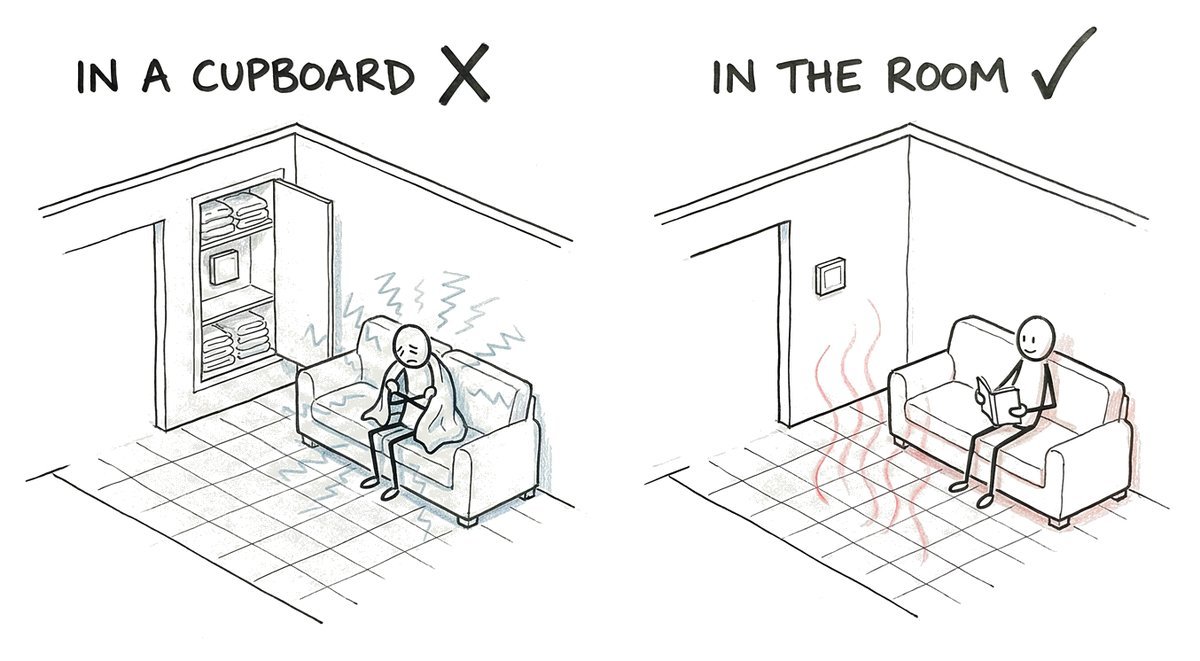
In the part of the house it’s heating, where you live. It sounds obvious, yet Phil names thermostat placement as one of the most common mistakes he sees. The first version is a thermostat that senses the floor instead of the room. As Phil says, “the temperature of the floor does not equal the temperature that you and I feel in the room,” so a floor sensor can report that all is well while you sit in a cool room. Electric floor heating is the exception: its cables run hot, so it has to sense the floor to stop it overheating.
The second version is hiding it. Thermostats end up in linen cupboards, in hallways that aren’t heated, or behind doors, because nobody wants a box on the living-room wall. Then the thermostat measures the cupboard, and the house is heated to suit the cupboard. In one of his videos Phil points to a good spot, on a wall between a bedroom and a bathroom in the zone it controls, where it can feel the warmth the floor gives off.
 4 min
4 min
How many thermostats do I need?
Fewer than you’d think. When Euroheat goes back to homes years after they were built, people who had six, eight or ten zones have usually ended up with every thermostat set the same, switching on and off together, because a well-built floor is background warmth that nobody fiddles with. Each extra zone means another thermostat, more cabling and more parts at the manifold, and Phil’s view is blunt: “the simpler the system, the better.”
So we usually suggest one zone per level in a two-storey home, and one or two for a large single-storey one. A spare room doesn’t need its own thermostat at all, because its loop can be turned off at the manifold, like a tap, and opened again when someone comes to stay. If you want rooms at really different temperatures, our article on setting a different temperature in each room covers how.
Why not switch it on and off like air conditioning?
Because a heated floor is slow and steady by design. A thin insulated screed starts to warm a room in 15 to 30 minutes and a heated slab on the ground takes about 45, so switching it on when you feel cold means you’re always catching up, and turning the thermostat right up doesn’t speed it along. A timer that starts the heat before you need it does the job far better, and the floor keeps giving back warmth for a while after it switches off. There’s more on this in how long floor heating takes to warm up.
That’s why a good system is set and forget. You set it up once, adjust it a little during your first winter to get the feel right, and after that you switch it on in May and off again in spring. When we hand a system over, we visit, show you how it works and set the controls to suit your household, and we check how it’s performing through the first heating season.
Do I need an app or a smart home system?
You don’t need one, but it can be handy. A Wi-Fi thermostat lets you check and change the heating from your phone, and for a holiday home down south that’s the feature that matters most: you turn the heating on before you leave Perth, and the house is warm when you arrive.
On a bigger system the internet connection works for us too. The heat pump can send an alert if something looks wrong, so a service can be planned before it becomes a breakdown, and we can look at how the system has behaved over its first twelve months and tune it. In Phil’s words, “we’re not just coming in slapping a system together, turning it on, wiping our hands clean and hoping for the best.”
What an app won’t do is make the system more efficient on its own. On hot water heat pumps Phil calls the app “a complete gimmick”, because a good heat pump is efficient and you just let it do its own thing, and heating is much the same. If you find yourself opening the app every morning, the timer probably needs setting differently.
Whether a thermostat links to your smart-home hub or voice assistant depends on the model, so raise it before the controls are chosen rather than after. A full building management system is overkill for a home. The household version is one properly programmed controller that runs the heat pump, the floor, the hot water and perhaps the pool together, and it only earns its place when one machine is doing several jobs. A simple system with one heat pump and a couple of zones is well served by basic controls.
Other questions people ask us about controls
Can I control each room from my phone?
You control each zone rather than each room, and yes, a Wi-Fi thermostat can be adjusted from your phone. Rooms you rarely use are turned off at the manifold instead, which costs nothing and never needs an app.
Can the heating run on my solar panels?
Yes, and the controls are what make it work. A simple timer can run the heat pump in the middle of the day, but a controller that reads your actual solar surplus does it far better, because it can see when a cloud passes. The floor then gives some of that midday warmth back into the evening. See running floor heating on cheap midday power.
Will a smart thermostat lower my bills?
The part that saves money is a timer that matches your day, and every decent thermostat has one. Beyond that, the bill is decided by how the system was built: the insulation under the floor, the water temperature and where the heat pump sits. No thermostat can make up for those.
Do radiators have the same controls?
Much the same. A radiator system runs from a thermostat or two in the heated part of the house, the same as a floor, with a valve at each radiator.
Where to go from here
If you’re building or renovating in Perth or the south-west, the 5-minute quote gives you your options in writing within 3 working days, each with its price and a modelled running cost, and you don’t need plans to start. Mention any solar on the roof, or a smart-home system you want the heating to work with. If you’re still getting your head around how it all fits together, floor heating, explained is the short version.