
Will floor cooling make my floors wet? Condensation, dew point and humidity explained
The short answer
Only if it’s run colder than the air’s dew point, and a properly controlled system isn’t. Like a cold drink sweating on a warm day, a floor colder than the dew point pulls water out of the air. The answer is a control system that measures temperature and humidity, works out the dew point as it changes, and mixes the floor water to stay just above it. Floor cooling can’t take moisture out of the air itself, so on humid days the floor does less and the air conditioning or a dehumidifier does more.
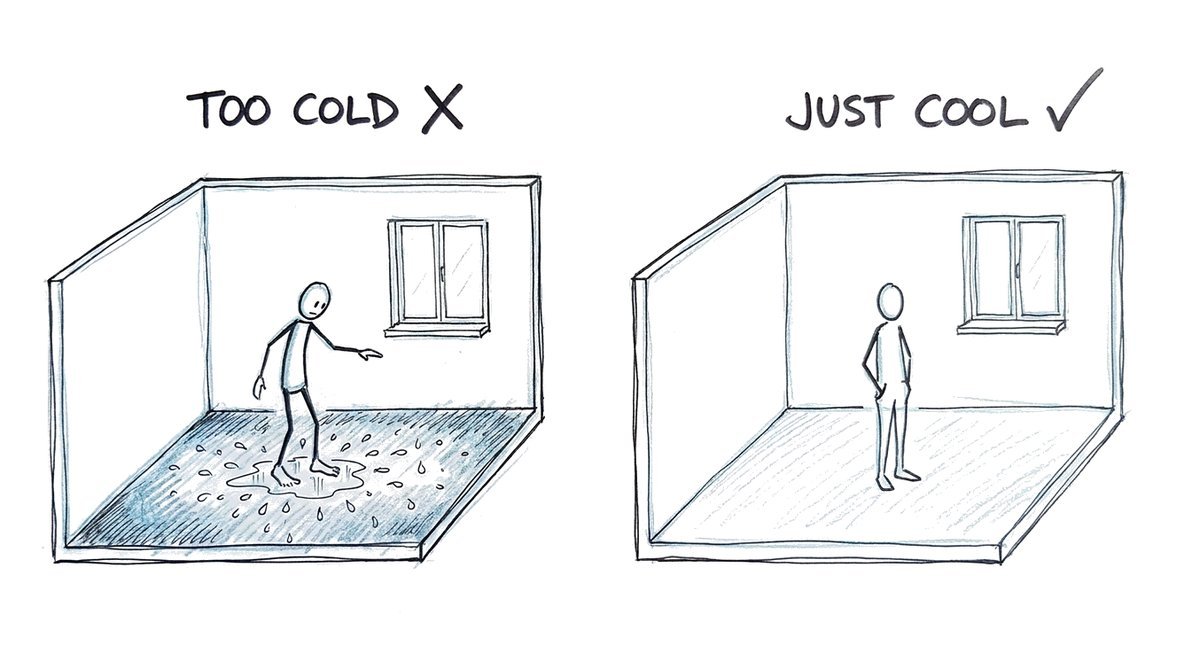
Anyone who’s seen water run down a cold glass can picture what might happen to a cooled floor, and it’s a fair worry. Water on tiles is a slip waiting to happen, and it can mark timber, swell skirting boards and, left long enough, grow mould. The good news is that condensation on a cooled floor follows a simple rule, and a system designed around that rule stays dry.
Why would a cool floor get wet?
Phil starts with something everyone has seen: “when you take a cold drink out of the fridge on a warm day. After a few minutes, you’ll notice that it’s basically wet on the outside.” Nothing leaked out of the glass. The water came from the air.
Air always carries some water as invisible vapour, and warm air can carry more than cool air. Cool the air enough and it can’t hold all of it any more, so some settles out on the coldest surface it touches. The temperature where that starts is called the dew point. The more humid the day, the higher the dew point climbs. On a dry Perth afternoon it can be well below any floor temperature you’d ever run. On a sticky evening it can rise high enough that a floor which was fine at lunchtime starts to sweat.
Relative humidity, the percentage on a weather report, is simply how full the air is compared with the most water it could hold at that temperature. You don’t need to track it yourself. The controls do, and they turn it into the one number that matters for the floor: the dew point.
What happens if a floor does get wet
A floor cooled without regard to the dew point can collect a film of moisture, and in a bad case, small puddles. Phil lists what follows: someone can slip and hurt themselves, floor coverings and furniture can be damaged, skirtings can suffer, and over time mould can grow. A well-run system is designed so that none of it happens, which is why the control side of floor cooling matters more than the pipes.
How installers deal with condensation
There are three ways we see it handled. The simplest is to run the floor water warm enough that it never gets near the dew point. That works, but it gives away most of the cooling, because the floor ends up barely cooler than the room.
The second is to put a sensor in the floor and switch the cooling off when the surface gets close to the dew point, while sending the same water temperature through the floor the rest of the time. It stays dry, but it shuts down on exactly the hot, sticky afternoons when you wanted it most.
The way we do it has two parts that can work together. First, the controls measure temperature and humidity inside and outside all the time, so they always know where the dew point is, and they mix the floor water to sit just above it. As the dew point moves, the water temperature moves with it. On one of our Dalkeith systems the floor water is blended to around 18 degrees, higher or lower depending on the humidity in the house, while the air conditioning on the same system runs on water at about 10.
Second, on humid days the controls take moisture out of the air, with a dehumidifier or with the air conditioning side of the system. Drier air has a lower dew point, so the floor can run cooler and do more of the work without getting wet.
Can floor cooling control the humidity in my home?
No, and it’s better to know that before you build. A floor kept safely above the dew point can’t take water out of the air, because no water ever settles on it. That’s the job of something with a surface colder than the dew point and a drain to carry the water away, which is what the coil inside an air conditioner or a dehumidifier is.
So in a hydronic system it’s the air conditioning side that looks after humidity. That’s one reason we pair floor cooling with air conditioning on one heat pump and one set of controls. The floor does the quiet background cooling, and when the air gets sticky the air conditioning comes on, dries the air and lets the floor keep working. It’s also part of why floor cooling covers only about a quarter of the cooling a standard Perth house needs, as we explain in can floor cooling replace air conditioning.
What this means for a Perth house
Perth’s summer heat is mostly dry heat, which suits floor cooling well. On a dry afternoon the dew point sits low, and the floor can run nicely cool. The days to design for are the humid ones, when the floor has to back off and something else has to carry the load. A system designed only for a dry afternoon will either sweat or shut down on those days.
When you compare quotes, ask one question: how does this system know where the dew point is? If the answer is a fixed water temperature, expect a floor that barely cools. If it’s a floor sensor that switches off, expect it to stop on the days you need it. If the controls measure humidity, adjust the water and can call on dehumidification, you’re talking to someone who has thought about it. Our whole-home systems page explains how heating, cooling and their controls are designed as one job.
Other questions people ask us about condensation
Does floor heating cause condensation in winter?
No. A heated floor is warmer than the air, so water never settles on it. In winter, condensation forms on the coldest surfaces in the house, usually windows and outside walls.
Will a dehumidifier let the floor cool more?
Yes. Drier air has a lower dew point, so the floor water can run cooler without any moisture settling. That’s why the dehumidifying step and the floor cooling are controlled together.
Can I just turn the floor cooling down further on a hot day?
Not safely by hand, because you can’t see the dew point. The controls should set the water temperature, and the air conditioning should take over when the floor has done all it safely can.
Does it matter what floor covering I have?
Tiles and polished concrete cool best and show any moisture quickly, which is why the dew point control matters most under hard floors. Thick carpet cuts the cooling down a lot, so there’s less to gain from cooling under it.
Where to go from here
If you’re building in Perth or the south-west, the 5-minute quote gives you your options in writing within 3 working days, each with its price and a modelled running cost, and you don’t need plans to start. Mention floor cooling in your notes so we include the controls it needs. If you’re still deciding whether a floor can do your cooling at all, read floor heating and air conditioning in the same house first.