
Can one system heat, cool, make hot water and warm the pool?
The short answer
Yes. One heat pump, with a small plant room, can run the floor heating and cooling, the air conditioning, the tap hot water and the pool, designed as one system. The clever part is heat recovery: in summer, the heat the air conditioning pulls out of the house goes into the hot water and the pool instead of being blown into the sky. It costs more to design and build than separate machines, so it pays where there’s plenty to share, usually a larger home with air conditioning and a pool. For an everyday house, a separate hot water heat pump is often the cheaper answer.
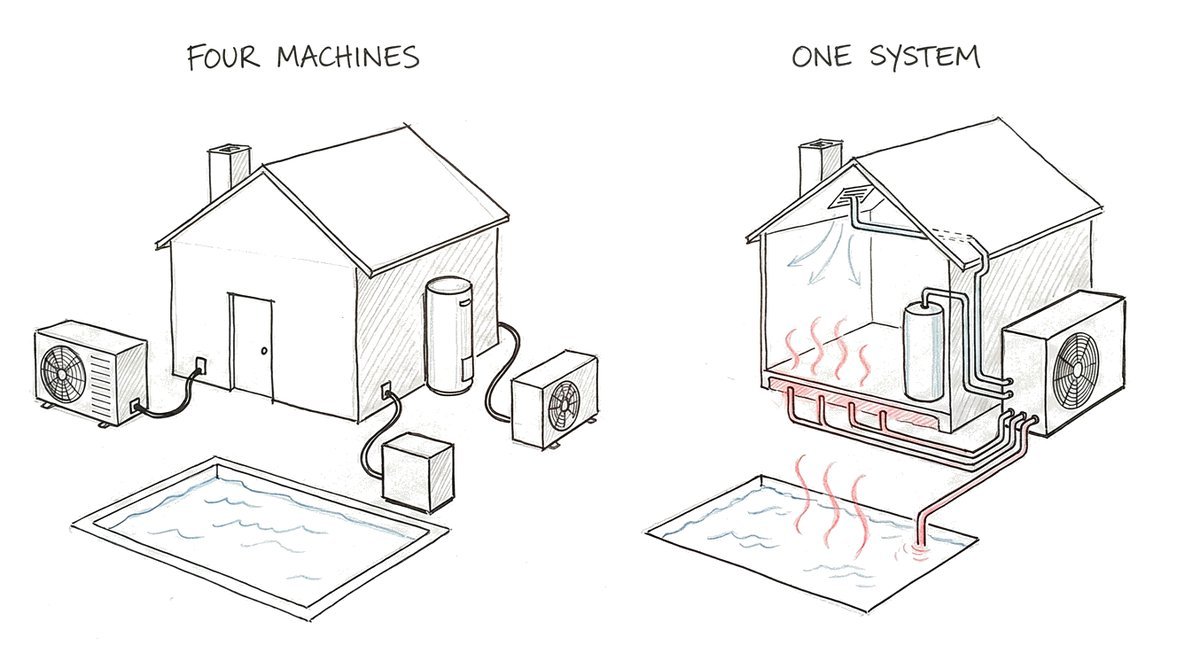
Walk down the side path of a well-equipped new Perth home and you’ll count the machines: an air conditioning unit, a heat pump for the floor heating, a hot water unit, a pool heater by the pool. Each one was quoted separately and put in by a different trade, and none of them knows the others exist. On a summer afternoon the air conditioner is throwing heat out over the fence while the pool heater a few metres away burns power to make heat for the pool. That’s the problem one system sets out to fix.
What does “one system” actually mean?
One heat source, usually a heat pump, sometimes a geothermal one, makes warm water and cool water, and sends each where it’s needed at the temperature that job wants. On a Dalkeith house Phil shows on video, three large tanks sit in the plant room: one for tap hot water at around 65 degrees, one for heating and one for cooling. From there, separate circuits run to the floor, to the air conditioning, to a few radiators, to the pool and even to a cellar, each with its own pump and mixing valve.
The air conditioning in a system like this looks the same as ordinary ducted air con, with a fan coil unit, ducts and grilles in the rooms. The difference is that it’s fed with chilled water from the central heat pump instead of having its own outdoor unit. One control system runs the lot and sets priorities. Hot water comes first, because nobody notices if the floor heating pauses for five minutes, but everyone notices a cold shower.
Heat recovery: using the heat you were throwing away
An air conditioner cooling a house is moving heat from inside to outside. That’s why the outdoor unit blows warm air in summer. One way to picture it is a car that could collect its own exhaust and use it to drive further. A heat-recovery system catches that heat and puts it to work. It goes into the hot water tank first, then the pool, and only when both are full does it get rejected to the air or the ground.
Small things come out of it too. On one job, recovered summer heat runs through the bathroom towel rails for an hour after the morning and evening showers, just warm enough to dry the towels. And because the tanks store heat, they can be charged in the middle of the day while the solar panels are producing, then drawn on in the evening. Phil calls them a thermal battery, and his rule is simple: “the bigger the tank, the bigger the battery.”
None of this makes the system free to run. The heat pump still uses electricity, and in winter the pool has nothing to recover from. But in summer the pool is getting heat from work the system was doing anyway, which is where the payback comes from. On the right project, with a pool and real cooling demand, we’ve seen heat-recovery systems pay back in as little as about four years, and on others it’s closer to fifteen. Our article on warming a pool with air conditioning heat goes further into the pool side.
What else you gain from one system
Fewer machines, for a start. One central plant replaces the row of units down the side path, and in Phil’s example the plant footprint drops from about 10 square metres to about 5. The power supply can be smaller too, because the jobs never all need full power at the same moment. Separate units that might add up to 60 to 100 amps of supply can come down to perhaps 32 with one central unit deciding where the energy goes.
The bigger gain is that the parts stop working against each other. With separate machines, the pool heater can run flat out in spring while the heating system next to it sits idle, each doing its own job without knowing about the other. One control system sees all of it. That’s what our whole-home systems page means by designing the load as one calculation.
 5 min
What’s the catch?
The price. Phil doesn’t dress it up: “combining all of your building services into one central plant will cost you more initially”. It takes more design, more planning and more work on site to make the parts cooperate, and that time costs money.
So it isn’t for every house. Of the Dalkeith system, Phil asks the question himself: “Should everybody do this system? And the short answer is no.” It makes sense there because of the pool, which soaks up the recovered heat. Take the pool away and, as Phil says, the numbers probably stop working, and simpler separate systems are the better buy.
Hot water is the clearest case. A hydronic heat pump can make the hot water, through a special tank with a coil inside, but that tank usually has to sit indoors and costs more. Stand-alone hot water heat pumps are mass-produced and many attract federal rebates, so for an everyday house two separate heat pumps usually cost less. We go through that choice in can one heat pump do my heating and my hot water. Whichever way it’s done, the hot water should have an electric backup element that comes on by itself if the heat pump ever stops.
Can it work in an existing home?
Parts of it can, and the best time is when something big is being replaced anyway. In an 1895 Federation home in Fremantle, we put radiators in the original rooms, floor heating in the new extension and the bathroom, and a heated towel rail, all running from one heat pump. That’s one system in a house that’s more than a century old.
Recovering air conditioning heat into a pool is easiest when the air conditioning runs on the same water system as everything else. That’s simplest in a new build or a major renovation, when the air conditioning, hot water and pool heating are all being chosen at once. If you’re replacing them one at a time, tell whoever quotes the first one what’s coming next, so it can be chosen to fit.
Other questions people ask us about whole-home systems
Is the pool heating free?
In summer, the heat itself comes from the house’s cooling, so the pool costs very little extra while the air conditioning is running. It isn’t free to run overall, and a pool can’t be kept warm through a Perth winter on recovered heat.
Do I need geothermal for heat recovery?
No. Heat recovery works with an ordinary air-source heat pump too. Geothermal is a separate choice about where the heat comes from, and it pays only on the right site.
Is “waste heat” the same as “heat recovery”?
In a home, yes. Both mean using heat one machine would otherwise throw away, most often the heat the air conditioning pulls out of the house in summer.
What happens if the one heat pump stops?
The hot water switches to its backup element automatically, so the showers stay hot. Heating or cooling can wait a few hours for a repair, which in Perth is an inconvenience rather than an emergency.
Where to go from here
If you’re building or renovating in Perth or the south-west, the 5-minute quote gives you your options in writing within 3 working days, each with its price and a modelled running cost, and you don’t need plans to start. Tell us about the pool, the air conditioning and the hot water in your notes, and we’ll show you whether one system or separate ones make more sense. If you’d like the sums first, what whole-home heating, cooling and hot water cost covers what drives the price.