
How much does it cost to install central heating, cooling and hot water in Perth?
The short answer
There’s no honest price per square metre for central heating and cooling, because a whole-home system is built around your house, the jobs it has to do and what heats the water. What we can give you straight is the running cost: in a well-built 200 m² Perth home on an air-source heat pump, the heating runs at about $240 a winter month, against about $601 for the same floor built cheaply (both modelled estimates). Designing everything as one system costs a little more to put in than separate machines, and gives back less plant and heat shared between the jobs.
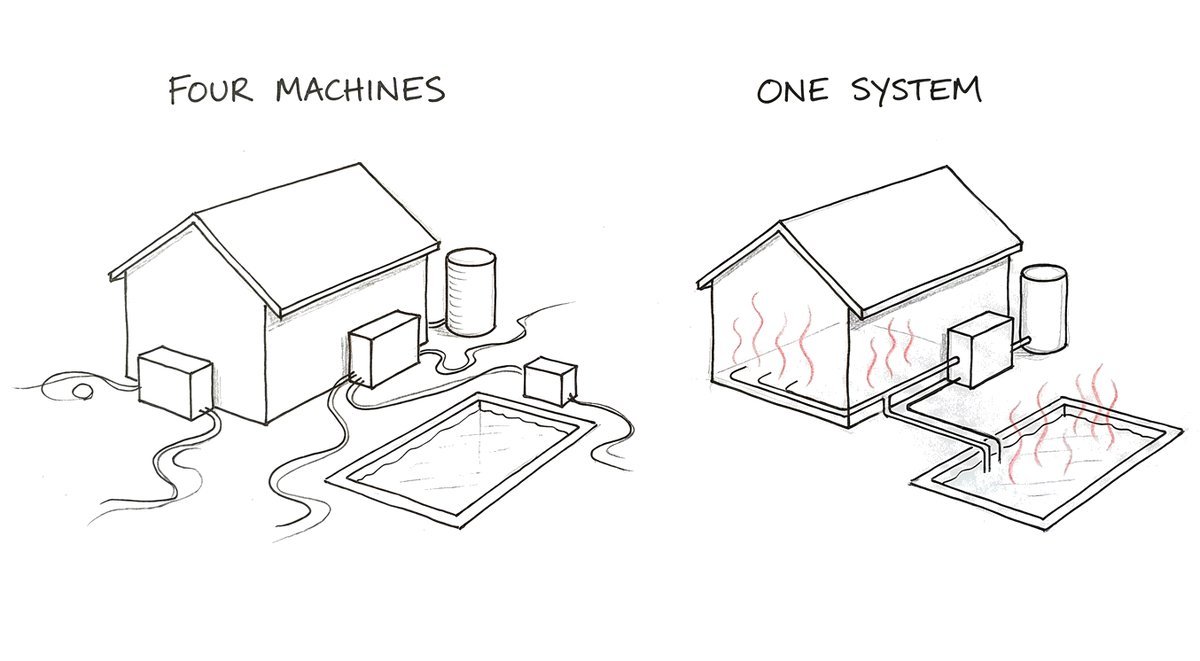
“Central heating” means different things to different people. To some it’s ducted gas, to others radiators in every room, and to many people building in Perth it now means one system that keeps the house warm in winter, cool in summer and the showers hot all year. That last kind is what this article is about. We won’t put a typical price on it, because no two of these houses are alike, but we can show you what moves the number and what it costs to run.
Why isn’t there a price per square metre?
Because two houses of the same size can need very different systems. One faces north with deep eaves and good insulation; the other has a wall of west-facing glass under a high raked ceiling. The heat each room needs depends on how much glass it has, which way it faces, how well it’s insulated and how high the ceiling is, and a well-designed system is sized room by room from those answers.
Then there’s the list of jobs. Heating alone is one thing; heating, cooling, tap hot water and a heated pool is four jobs, and how they’re combined changes both the price and the running cost. A price per square metre hides all of that, which is why a cheap one tells you so little.
What drives the price
| What you’re deciding | Why it moves the price |
|---|---|
| Which jobs the system does | Heating only, or heating plus cooling, tap hot water, a pool or spa, towel rails and fresh-air ventilation. Each adds plant, pipes and controls. |
| New build or existing home | In a new build, floor heating goes in before the slab is poured. In a finished house it’s usually radiators, which leave the floors alone. |
| Size, storeys and how well it’s built | A bigger, glassier or leakier house needs more heat. Upstairs needs its own heat, because little of the warmth from a heated floor makes it up the stairs. |
| What heats the water | An air-source heat pump or a gas boiler, or geothermal, where reaching the ground is the big extra. |
| How the house is cooled | Floor cooling covers only about a quarter of a typical Perth house’s cooling, so a fan coil or ducted air system does the rest. |
| How the plant is put together | Separate machines, or one designed system with shared controls, as below. |
Among heat sources, geothermal is the widest swing, because the bores or trenches cost far more than the heat pump itself; our article on what geothermal costs sets out when the ground earns that back.
Separate machines or one system?
Most houses end up with a pile of machines never designed to work together: an air conditioner on one wall, a heat pump for the floor on another, a hot water unit round the back and a pool heater by the pool. Phil’s case for one designed system starts with space, with fewer machines and, in his example, a plant footprint of about 10 square metres coming down to around 5. The power supply can be smaller too, because one plant decides where the energy goes: separate units might add up to 60, 80 or even 100 amps, where one system might manage on 32 or less.
Then the machines stop working against each other. In summer, the heat your air conditioning pulls out of the house can go into the pool or the hot water tank instead of into the sky, so you aren’t paying to make the same heat twice. Our article on one system for heating, cooling, hot water and the pool goes into how that sharing works.
The catch, in Phil’s words, is that “it actually costs a little bit extra”, because it takes more planning and more work on site to put together properly. So it earns its keep when there are several jobs to do. If all you need is heating and hot water in an everyday house, Phil’s advice is usually two separate heat pumps, one for the heating and a standard hot water heat pump, because the hot water units are mass-produced, cheaper, and can attract federal rebates.
 5 min
What it costs to run
Heating is where the winter bill goes, so these are our modelled running costs for heating a home through a winter month on an air-source heat pump, at Synergy’s July 2026 home rate of 33.26 cents a kilowatt-hour. The gap between the two columns is the engineering: insulation under the pipes and around the slab edge, the right floor build-up, and a heat pump sized and placed properly.
| Heated area | Built right | Built cheap |
|---|---|---|
| 150 m² | about $181 a month | about $451 a month |
| 200 m² | about $240 a month | about $601 a month |
| 250 m² | about $301 a month | about $752 a month |
| 300 m² | about $361 a month | about $902 a month |
All modelled estimates, not promises: your house, your thermostat and next year’s tariff will move them. Over twenty winters the gap on a 200 m² home comes to about $36,100. Cooling, hot water and a pool add their own running costs on top, and sharing heat between them is how a whole-home system keeps those down.
We install gas boilers as well as heat pumps. On running cost a heat pump usually comes out ahead in Perth, so it’s what we suggest first, and if you’d rather have gas, we’ll design and install a gas boiler. Our comparison of gas boilers and heat pumps goes through the choice.
What a whole-home quote should show you
Whoever you ask, a quote worth comparing shows the options side by side, each with its price and its modelled running cost. It says what’s included and what the price assumes, and it says who is answerable for the whole house reaching temperature, instead of each trade for its own box. If a quote is a list of machines with a total at the bottom, ask how each one was sized. Our Quote Comparison Decoder helps you line two quotes up.
For a big new build there’s an earlier step, if you want it. The Comfort Guarantee Roadmap ($1,450) does the engineering for your house before you commit, with its modelled running cost, and the fee is credited in full to the build. It’s optional, and you never need it to get a price.
Other questions people ask us
Is central heating gas or electric?
Either. In a hydronic system the water can be heated by an electric heat pump or a gas boiler, and we install both. In Perth a heat pump usually costs less to run, so it’s what we suggest first, but the choice is yours.
Can I do it in stages?
Yes, as long as it’s planned as a whole. The heat source has to be sized for everything it will eventually do, so design the full job even if you build it in stages, and add the pool or the cooling later without replacing what’s there.
Can solar panels run it?
Partly. A heat pump can do much of its work in the middle of the day while the panels are producing, storing warmth in the floor or in a tank for the evening. Solar lowers the bill, but it can’t make up for a system that leaks heat.
Where to go from here
If you’re building or renovating in Perth or the south-west, the 5-minute quote gives you your options in writing within 3 working days, each with its price and a modelled running cost. You don’t need plans to start: without them the price comes as a range from your answers, and when plans arrive you get an updated proposal that says what changed. If you’re not there yet, the Running Cost Calculator shows the built-right and built-cheap numbers for your floor area, and whole-home systems has the one-page version.