
How much does hydronic floor heating cost to install in Perth?
The short answer
There’s no honest single figure, because your house sets the price. Four things drive it: the heated floor area, what makes the heat, whether the pipe goes into an insulated screed or straight into the slab, and the controls, and behind all four sits how much heat the house loses. It costs more to put in than ducted reverse-cycle air conditioning, but built right it runs in the same league: about $240 a winter month for a 200 m² Perth home, against about $601 built cheaply (both modelled estimates). A real price for your house comes from a written quote, and you don’t need final plans to ask for one.
It’s the question we’re asked more than any other, and until now the answer on this page was a table of prices. We’ve taken it down. A price per square metre assumes that every house of the same size needs the same system, and they don’t, so the figure ends up too high for some houses and too low for others. What we can give you straight is what sets the price, what the system will cost to run, and what a good quote should show you.
Why isn’t there a price per square metre?
Because the size of the floor tells you only part of the job. Phil explains that most systems are sized with a rule of thumb, so many watts of heat for every square metre of floor, which he calls a guess with experience. It works most of the time. A proper heat-load calculation does it the long way: it puts the walls, roof, floor and windows of your actual design into software and works out the heat the house gains and loses for every hour of the year, room by room.
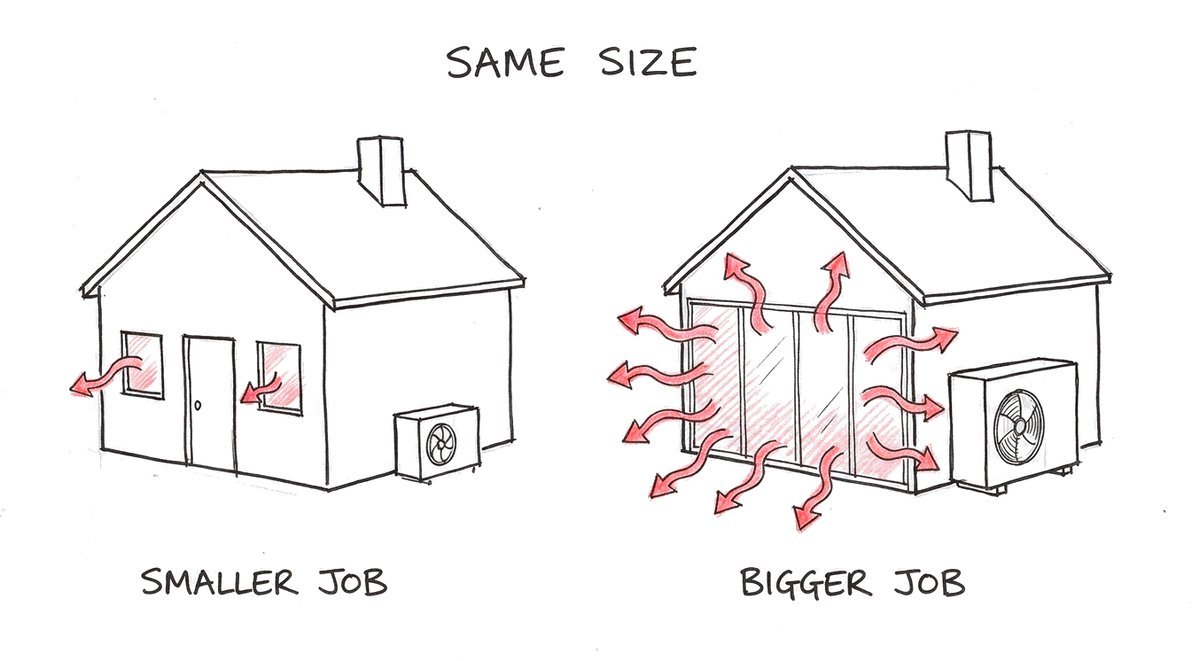
When Phil’s team does that, the answers can be a long way from the rule of thumb. A very well-insulated house can need a fraction of the heat the rule assumes, and a room with a wall of glass can need well over it. Size the first one by the rule and you pay for a bigger heat pump than it will ever use. Size the second one by the rule and that room never quite gets warm.
Two houses of the same size can be a smaller job and a bigger one, and the price follows the job. There’s more on how it’s done in what a heat-load calculation is.
What drives the price of floor heating?
The floor area matters, but less than you’d think, because the pipe is the cheap part. A bigger floor means more loops and a bigger manifold, the box on the wall where the loops start and finish. The bigger costs sit elsewhere.
The heat source is usually the largest single item. An air-source heat pump is what we suggest first for most Perth homes, and Phil’s advice is to stay away from the bottom-tier units, which in his experience can be loud and wear out in about five years, in favour of a good mid-range or premium one. A gas boiler usually costs less to put in, and we install those too, but in Perth it generally costs more to run.
Geothermal sits at the other end: on our Perth projects the heat pump has been about 20% dearer than an air-source one, and the connection to the ground indicatively $30,000 to $150,000 on top, which is why we explain when geothermal pays off before anyone commits to it.
Then there’s how the floor is built. Pipe in an insulated on-ground slab is the simpler build. Pipe in a separate insulated screed, a layer poured over the main slab, adds a step and some material, but once it’s in its winter rhythm it starts warming the room within about 15 to 30 minutes of being asked for heat, against 45 to 60 for a slab, and it keeps the heat out of the structure. Either way, the insulation under the heated layer and down the slab edge belongs in the price, because the building code requires the edge insulation and the running cost depends on both.
Last come the controls and the extras. A simple controller costs less than a properly programmed one, though Phil recommends the better one. Every extra zone with its own thermostat adds wiring and parts on every loop, which is one reason we keep zones to a few. And if the same heat pump is also going to cool the house, make the hot water or heat the pool, that costs more up front than heating alone, in exchange for fewer machines around the house.
Is it dearer than ducted air conditioning?
To put in, yes, and Phil doesn’t pretend otherwise: “the hydronic heating systems aren’t cheap. Let’s be honest, they are pretty expensive.” Ducted or split reverse-cycle air conditioning is the cheaper way to heat a house, and it cools in summer as well. What floor heating buys you is the kind of warmth, a warm floor and even, quiet heat with no air blowing, and built right it costs about the same to run as a good reverse-cycle system. Built cheaply, it can cost more to run than the aircon it was meant to replace.
Electric floor heating is the other comparison. Phil puts it at up to half the price of hydronic to put in, and two to five times more per hour to run. For a single small bathroom that trade makes sense, and we’ll say so. For a whole house it doesn’t, and our article on what floor heating costs to run shows why.
What should a floor heating quote show you?
Price and running cost, side by side, for every option. The price alone hides the most expensive difference between two systems, which is how much heat each one loses into the ground every winter. On a 200 m² floor, the gap between built right and built cheap comes to about $36,100 over twenty winters (a modelled estimate). A quote that can’t tell you what its system will cost to run hasn’t done the sums that decide it.
It should also say, in writing, whether a heat-load calculation was done, what insulation goes under the pipe and down the slab edge, what water temperature the floor is designed for, which heat pump and where it will sit. Phil has three quick tests for any installer, us included: look at their past jobs and talk to the owners if you can; ask the design water temperature, where 30 to 35 degrees is right for a floor and 45 or 50 is a red flag; and be wary of anyone keen to sell you a thermostat in every room.
His view is that a much lower price usually means something has been left out. A standard installation covers the physical steps, not the engineering that makes those steps count.
Finally, it should be clear who is responsible if a room doesn’t warm up. Phil tells the story of a beach house at Eagle Bay where one plumber laid the floor heating, another did the hot water and a third company fitted the heat pump. It only half worked, and each trade pointed at the next. We sent an engineer, a technician and an electrician who between them knew every part, and it was working properly that day.
 3 min
Other questions people ask us
Why is one quote so much cheaper than another?
Usually because it’s quoting a different system: pipe in a bare slab with no insulation under it, a heat pump sized by rule of thumb, no thermal breaks. On paper the two can look almost identical. We go through the usual gaps in why one floor heating quote is so much cheaper, and the Quote Comparison Decoder checks a quote you already have.
Can I save money now and add floor heating later?
Not in a slab. The insulation under the pipes and around the slab edge, and the pipes themselves, go in before the concrete is poured and can’t be added afterwards. If you’re building, the decision has a deadline, and it’s earlier than most people expect.
Is a gas boiler cheaper than a heat pump?
Usually to buy, and usually not to run in Perth. We install both, and we’ll show you the two running costs side by side so you can weigh them up. If you’d rather have gas, we’ll design it properly.
Where to go from here
If you’re building or renovating in Perth or the south-west, the 5-minute quote gives you your options in writing within 3 working days, each with its price and a modelled running cost, and you don’t need final plans to start. Without plans you get a range from your answers, and when the plans arrive the proposal is updated and says what changed; the fixed price comes once the drawings are final and we’ve seen the site. If you’re not at that point yet, the Slab Pour Deadline Checker shows how long you have before the slab decides for you.