
What geothermal heating costs in Australia, and when it pays off
The short answer
A geothermal system costs more than an ordinary air-source heat pump in two places. The heat pump itself is usually about 20% dearer, and then there’s the connection to the ground – the bores or trenches – which on our Perth projects has run, indicatively, from about $30,000 to $150,000, depending on the size of the system and the site. In return it’s cheaper to run: up to about 40% less than air-source on our projects, and less than that on a mild site. Whether the saving ever earns back the drilling depends on your site, and on how well the rest of the system is built.
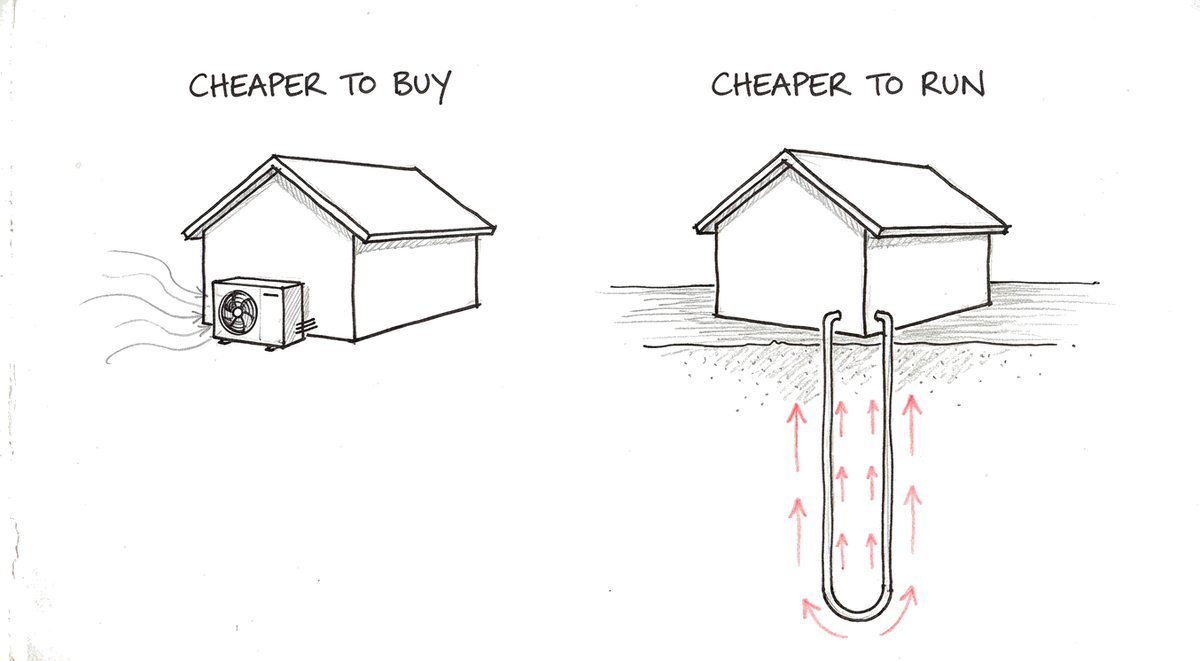
When someone tells us they want geothermal, the first thing we ask is why. The answer is nearly always some version of “because it’s the most efficient”, “because it’s the cheapest to run” or “because it’s the greenest thing we can do”, and most of that is true. It just doesn’t make geothermal the right buy for every house, and the price is where that shows up first.
Where the extra money goes
A geothermal heat pump isn’t very different from the air-source kind you see on the side of houses. Both use a little electricity to move a lot of heat. What differs is where the heat comes from. An air-source unit pulls it out of the outside air through a fan, and a geothermal unit pulls it out of the ground through a loop of buried plastic pipe filled with fluid.
Getting that pipe into the ground is the expensive part, and every hole is priced by the ground it goes through. On a big rural block the pipe can run through long trenches at least a metre and a half deep, below the reach of the seasons. In the south-west we’ve done jobs where the loop took up half a paddock. A suburban block has no room for that, so the pipe goes straight down into drilled bores instead, which take up almost no space and cost more per metre.
Perth has a third option that most of the country doesn’t. The city sits on an aquifer that stays at around 20 degrees all year, and where it can be reached, groundwater can be pumped up one bore, have its heat taken out and go back down another. It’s an excellent heat source. It also needs a groundwater licence, a second bore to return the water, and a design that copes with Perth’s iron-rich water, so it isn’t a shortcut.
Why the ground is worth paying for at all
Think of a heat pump as a lift that carries heat up into your house. On a cold Perth morning the outside air might be around 5 degrees, so the heat has a long way to climb before it’s useful and the lift burns more electricity getting it there. The ground a few metres down sits around 15 to 20 degrees all year, so the climb is short. That shorter trip is the whole saving.
In numbers, a good air-source heat pump turns one unit of electricity into about three units of heat, and a ground-source one can reach up to about five when it’s feeding a floor at low water temperatures. For every dollar on the power bill, that’s roughly three dollars of warmth against up to five. It works in summer too. Cooling means throwing heat out of the house, and it’s much easier to throw it into 20 degree ground than into 35 degree air.
The catch for Perth is our mild winters. A good air-source heat pump already does very well here, much better than it would in Canberra or northern Europe, so the gap the ground closes is smaller than the brochures suggest.
When it pays back, and when it never will
There are three situations where we’ve seen geothermal earn its keep. The first is a pool. Heat-recovery geothermal can take the heat your air conditioning pulls out of the house in summer and put it into the pool instead of the sky, and on the right project that has paid back in as little as about four years. The second is a site where noise or space matters: there’s no fan unit outside and nothing to hear over the fence. The third is groundwater within reach, for the reason above.
Outside those, the sums get hard. We once modelled a project where the extra cost of going geothermal would have taken about 150 years to earn back. We recommended an air-source heat pump and walked away from the dearer sale.
One number shows why. A well-built floor heating system in a 200 m² Perth home, running on an air-source heat pump, costs about $240 a month in winter to run (a modelled estimate at Synergy’s July 2026 rate). Take a slice off that, even a big one, and you can see why the drilling has to be cheap or the site special before the arithmetic works.
The part that decides your bill either way
A few years ago we were asked to look at a house with a geothermal heat pump and 10 kilowatts of solar on the roof. The owner expected bills near zero. In the first summer, with no heating running at all, the bills came in at $500 to $600 a month just to make hot water. By winter they were over $1,000 a month, and every contractor who’d worked on the house blamed one of the others.
The geothermal side was working. The money was leaking out somewhere nobody had looked: a loop of hot water pipe running around the house so the taps ran hot straight away, cast into the slabs and walls with no insulation on it. The water came back 11 or 12 degrees colder than it left, around the clock. The owner had paid for one of the most efficient heat sources there is and connected it to a hole in the bucket.
Phil puts it the old way: the chain is only as strong as the weakest link. Efficiencies multiply. A heat pump working at 300% feeding a floor that delivers 80% of its heat to the room gives you a 240% system. Put the same heat pump on a badly built floor that delivers 50% and you own a 150% system. Same heat pump, same bores, and 60% more electricity for the same warmth.
 8 min
Questions people ask us about geothermal
Is a geothermal system noisy?
There’s no fan unit outside at all, and the bores are silent. The heat pump sits indoors or in a plant room. Phil recorded one running so you can hear it for yourself.
Do the pipes in the ground wear out?
The loop is sealed plastic pipe buried where nothing disturbs it, with only fluid moving through it, and it’s made to last for decades. The heat pump is the part that gets serviced, the same as any heat pump.
Can geothermal cool the house as well?
Yes. Cooling means pushing heat out of the house, and on a Perth summer afternoon the ground is a far better place to push it than 35 degree air.
Will solar panels make it free to run?
Solar lowers the bill, but it can’t fix a system that leaks heat. The house in the story above had 10 kilowatts on the roof. Get the system right first, then let the solar do its job.
How to find out for your site
The honest answer for any particular house comes from three numbers: what the bores will cost on that ground, what the system will save at today’s power prices, and how many years one takes to pay for the other. If a quote for geothermal can’t show you that arithmetic for your site, ask for it before you sign anything.
If you’re building or renovating in Perth or the south-west, our 5-minute quote gives you your options in writing within 3 working days, each with its price and a modelled running cost. Mention geothermal in your notes so we know what you’re weighing up. For the one-page version of all this, see geothermal, straight, and if there’s a pool in the plans, read how pool heating fits in.