
Can I heat and cool my home with bore water? Open loop and closed loop geothermal explained
The short answer
Yes, in many parts of Perth you can. An open loop pumps groundwater up one bore, takes heat out of it in winter or puts heat into it in summer, and sends the same water back down a second bore. Perth’s aquifer stays at about 20 degrees all year, which makes it an excellent source for a heat pump. It needs a groundwater licence, a return bore and water clean enough not to clog the system, and Perth’s groundwater is often iron-rich. Where it isn’t suitable, a closed loop circulates fluid through sealed pipes in the ground and never touches the water.
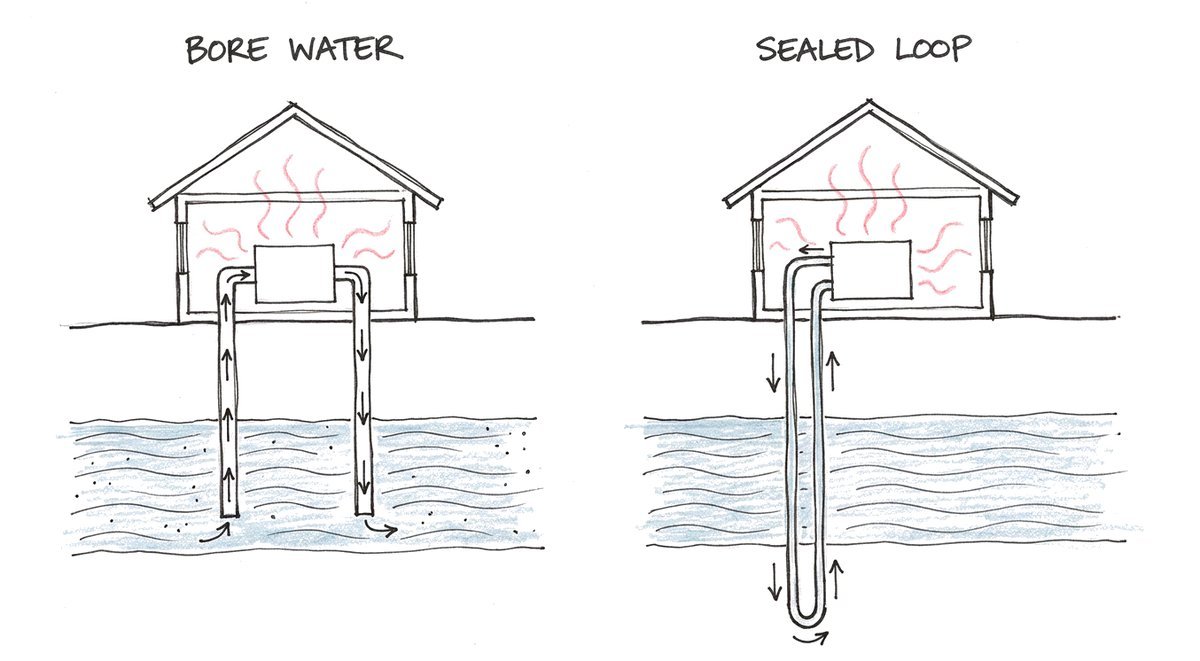
Perth sits on water. Plenty of Perth households already have a garden bore, and once people learn that the water down there stays warm through winter, the next question is whether it could heat the house. It can, and it’s one thing Perth has that most of the country doesn’t. It also comes with a licence, a second bore and a water test, and the water test sometimes says no.
How does heating with bore water work?
A heat pump works like a lift carrying heat into your house. The colder the place it collects the heat from, the further the heat has to climb, and the more electricity the lift uses. On a cold Perth winter morning the outside air might be around 5 degrees. The ground a few metres down sits around 15, and Perth’s groundwater around 20, so a heat pump drawing on bore water has a short, easy climb. Phil’s verdict on the aquifer, standing in a Dalkeith plant room: “20°, what a great energy source.”
It works for cooling too. Cooling means pushing heat out of the house, and on a 40 degree afternoon it’s far easier to push it into 20 degree water than into the hot air outside, where an ordinary air conditioner has to dump it.
The water itself never enters the house system. It comes up the first bore and passes through a plate heat exchanger, a stack of thin plates with the groundwater on one side and the house’s own clean water on the other. Heat moves across the plates, the two waters never mix, and the groundwater goes back down the second bore a little cooler in winter or a little warmer in summer. The aquifer only lends its warmth.
What’s the difference between an open loop and a closed loop?
An open loop uses the groundwater directly, as above. A closed loop never touches it. A long loop of plastic pipe is sealed and buried, either down a series of drilled bores or, on a big rural block, along trenches at least a metre and a half deep, and a fluid goes round and round inside it. Only heat passes through the pipe wall.
| Open loop (bore water) | Closed loop (sealed pipe) | |
|---|---|---|
| What’s in the ground | Two bores, water up one and back down the other | Sealed pipe in bores or trenches |
| Where the heat comes from | Groundwater at about 20 degrees | The ground around the pipe, about 15 degrees |
| Paperwork | Groundwater licence and a return bore | Lighter, as no water is taken |
| Main thing to check | Water quality, especially iron | Enough pipe in the ground |
Closed loops are far more common around the world, because most places don’t sit on an aquifer like Perth’s. Here, where the groundwater is suitable, an open loop can be the cheaper way to reach the ground; at the Dalkeith house in Phil’s video, a closed loop could have done the job, but it would have cost more. Where the water isn’t suitable, the closed loop is the safe choice.
What can go wrong with bore water?
Mostly the water. Some of Perth’s groundwater carries iron and iron bacteria, and when that water meets air in the pipes, the bacteria multiply into a reddish-brown sludge that clogs the pipes and the heat exchanger. Phil filmed one rescue job where exactly that had happened. His advice is blunt: “make sure you know what the groundwater quality is in your area if you’re going to go open loop”. If it isn’t good, use a closed loop, or an air-source heat pump.
On a good site the upkeep is small: at Dalkeith the water is almost clear, and the only regular job is flushing a little sand out of the filter once a year. That difference between two Perth sites is why the water is tested before anything is designed.
The pumps are the second thing. On the same rescue job, two bore pumps had been left running 24 hours a day, so the owner’s monitoring showed the bores using more electricity than the heat pump itself. Two pumps were a good idea, one working and one in reserve, but they needed a controller to take turns and to run only when the heat pump asked for water.
The third is size. A ground connection too small for the heat pump makes the whole system work harder, and leaving out a bore is an easy way to make a quote look cheaper. We cover the licence, the drilling and the rest in what approvals and safety rules apply to geothermal in WA.
 4 min
Is bore water heating worth it for my house?
It can be, on the right site. On our Perth projects, ground or groundwater source has run up to about 40% cheaper than air-source, less on a mild site, and cheaper is never free.
Against that, the heat pump costs about 20% more and the ground connection has run, indicatively, from about $30,000 to $150,000. The sums only tend to work when there’s a pool to take the summer heat, when there’s no room or no tolerance for an outdoor unit, or when good groundwater is easy to reach. We once modelled a project where the extra cost would have taken about 150 years to earn back, and recommended an air-source heat pump instead.
There are quieter benefits too. The equipment lives indoors, protected from the weather and silent from the street, and a well-built geothermal system can be expected to last 20 to 25 years. Outdoor condenser units near the coast, in suburbs like Cottesloe, Scarborough and Trigg, have been known to fail after about 7 years. The full arithmetic is in what geothermal heating costs in Australia.
Other questions people ask us about bore water
Can I use my existing garden bore?
Usually not as it is. A garden bore is sized and placed for watering, while a heating system needs a matching return bore, steady flow and a water test. The licensing is different too: the exemption that lets most garden bores run without a licence is written for gardens, so check with the Department of Water and Environmental Regulation using its licence guide.
Does an open loop use up groundwater?
No. The same water goes back down the return bore. Only its temperature changes, a little.
Can bore water heat my pool as well?
Yes, and the best version uses heat recovery: in summer, the heat taken out of the house by the cooling goes into the pool instead of back into the ground. See heating a pool and spa with your home’s system.
Is a closed loop worse than an open loop?
It works with slightly cooler ground than the aquifer and can cost more to put in, but it takes no water and doesn’t care about iron. On a site with poor groundwater it’s the better choice.
Where to go from here
If you’re building or renovating in Perth or the south-west, the 5-minute quote gives you your options in writing within 3 working days, each with its price and a modelled running cost. Mention bore water or geothermal in your notes, and we’ll tell you whether your site suits it or an air-source heat pump would do the job for less. The one-page version is geothermal, straight.