
What approvals and safety rules apply to geothermal heating and cooling in WA?
The short answer
It depends which kind you mean. An open loop pumps Perth’s groundwater up one bore and back down another, and that needs a groundwater licence from the Department of Water and Environmental Regulation and a return bore. A closed loop takes no water, so its paperwork is lighter, though the bores still have to be drilled and placed properly. A ground-source heat pump burns nothing, so there’s no flame or flue in the house. The real risks are a ground loop that’s too small, groundwater that clogs the system and hot water with no backup.
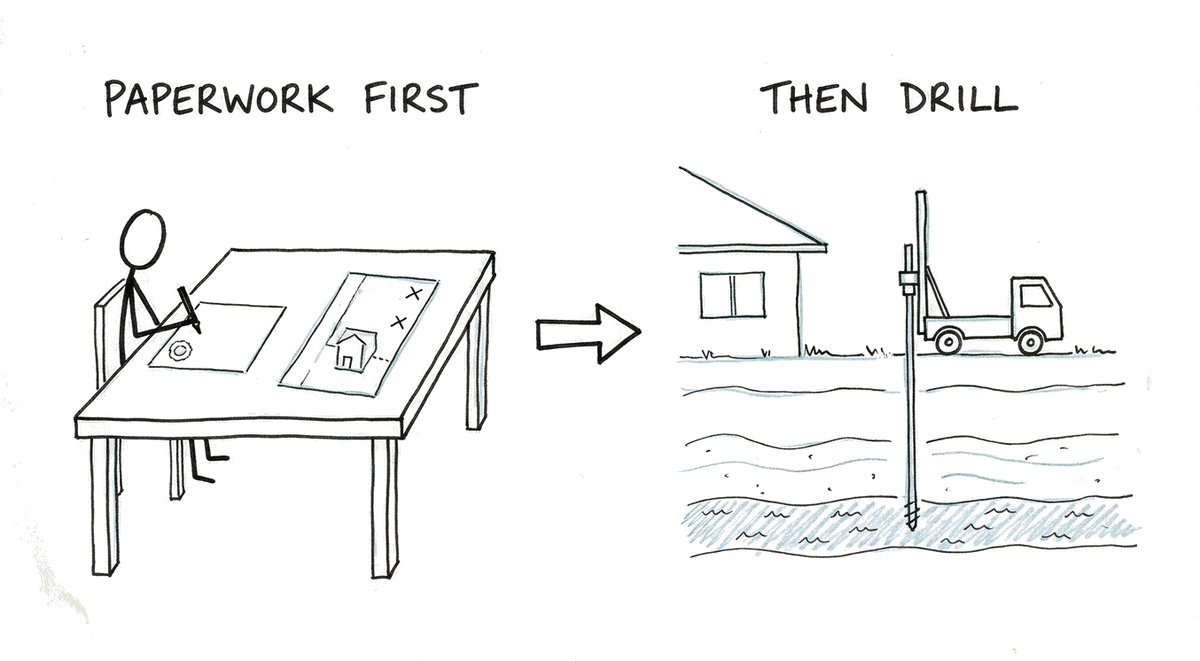
Most people who ask about safety with geothermal are picturing something dramatic: hot rocks, high pressure, steam. A geothermal system for a house is much quieter than that. It’s a heat pump that swaps heat with the ground or the groundwater a few metres down, where the temperature sits around 15 to 20 degrees all year. The approvals and the risks are real, but they’re ordinary ones, and almost all of them are settled before anyone drills.
Does geothermal need approval in WA?
For an open loop, yes. Water in the ground is managed by the state under the Rights in Water and Irrigation Act 1914, and the Department of Water and Environmental Regulation publishes a one-page guide, do I need a licence to take groundwater or construct or alter a bore. In a proclaimed groundwater area, taking water or building a bore needs licensing unless the water is only for household use, fire fighting, stock or a garden under about half an acre. Using groundwater to heat and cool a house needs a groundwater licence and a return bore, so the water you take out goes back into the ground.
A closed loop takes no water. Sealed plastic pipe runs down a bore, or along a trench on a big block, with fluid circulating inside it, and only heat passes through the pipe wall. The bores still go down through the same ground, so ask the department, or whoever is designing the system, whether your bores need a licence to construct. The guide covers bores as well as water.
People also ask whether there’s a building-code chapter for geothermal. The rules that apply are the ones above, plus the licensed electrical and plumbing work any heat pump needs. The house itself still has to meet the same energy rules as every new WA home, which moved to the 7-star standard on 1 May 2025.
Where does the water go?
Back where it came from. In an open loop the groundwater comes up one bore and passes through a plate heat exchanger, a stack of thin metal plates with the groundwater on one side and the house’s own water on the other. The two never touch. Heat moves across the plates, and the groundwater goes back down the second bore a little warmer or cooler than it came up.
Keeping the two apart matters. The house side runs on clean, treated water that looks after the heat pump and the pipes for decades. The groundwater only lends its warmth. It’s also why the return bore is part of the licence and not an optional extra: the aquifer gets its water back.
What actually goes wrong
The water itself is the first thing to check. Perth’s groundwater is often rich in iron, and on one rescue job Phil filmed, iron bacteria in the water met air in the pipes and turned into a reddish-brown sludge that clogged the pipes and the heat exchanger. His advice is to find out the groundwater quality in your area before choosing an open loop, and if it isn’t good, to go closed loop or use an air-source heat pump instead.
On a good site it’s easy: at the Dalkeith house in one of Phil’s videos, the water is almost clear, and the only regular job is flushing a little fine sand out of the filter once a year. Two Perth sites can be that different, which is why the water test comes before the design is settled.
The second is a ground connection that’s too small. Each bore can only move so much heat, and leaving one out makes a quote cheaper. On the hottest and coldest days an undersized loop can’t keep up, the heat pump trips out on its safety switch to protect itself, and much of the rest of the time it runs inefficiently. The third is controls. On the same rescue job, two bore pumps had been left running 24 hours a day, using more electricity than the heat pump itself, because nobody had fitted a controller to run them only when needed.
The one that hurts most is hot water. On another job, a previous contractor’s geothermal system made all the house’s hot water with no backup, so every time the heat pump stopped, the showers went cold. Phil’s rule is simple: “there should always be a redundancy measure for your hot water”. In practice that’s an electric element in the tank that comes on by itself only if the heat pump stops.
 3 min
Is drilling on a house block safe?
It’s routine work, but it needs planning. Before anyone digs, the underground services on and around the block should be located; Before You Dig Australia is the free service for that. The rig needs a way in, so the bores are best drilled before the landscaping goes in, and ideally while the site is still open for the build.
Ask who is drilling, how the bores will be sealed so water can’t run between layers of the ground, and how the loop will be pressure-tested before it’s covered over. A good answer to each is a sign the rest of the job will be done with the same care.
How long does it take to install?
The order matters more than the days. First comes the design, including the payback sums that tell you whether geothermal suits your site at all. For an open loop, the water test and the licence come next, and they take time, so start early. Then the drilling, then the plant room fit-out alongside the rest of the build, and last the commissioning, when the controls are tuned and the system is checked running.
Plan the space too. The heat pump and its tanks usually live indoors, in a plant room out of the weather. A big heat-recovery plant room like the one at Dalkeith takes roughly 6 metres by 2.5 to 3 metres, and a simpler system much less. In return there’s no fan unit outside at all, nothing for the neighbours to hear, and the equipment runs about as loud as a fridge.
Other questions people ask us about geothermal
Is a geothermal system safe to have in the house?
Yes. Nothing burns, so there’s no flame, no flue and no gas line. The heat pump is a sealed electrical machine, and the ground loop is sealed pipe buried where nothing disturbs it.
Can I use my garden bore?
Not without checking. A garden bore is built for watering, and the exemption that lets most garden bores run without a licence is written for gardens. A heating system also needs a return bore, steady flow and water clean enough not to clog the heat exchanger. We explain the rest in can I heat and cool my home with bore water.
Who should install it?
Someone who designs both ends of the system, the ground side and the house side, and who also installs air-source heat pumps, so they have no reason to push geothermal where it doesn’t pay.
Is it worth the extra cost?
Sometimes. On our Perth projects the ground connection has run, indicatively, from about $30,000 to $150,000, and it pays back only on the right site. What geothermal costs in Australia shows when it does.
Where to go from here
If you’re building or renovating in Perth or the south-west, the 5-minute quote gives you your options in writing within 3 working days, each with its price and a modelled running cost. Mention geothermal in your notes, and we’ll tell you honestly if an air-source heat pump would serve you better. For the one-page version, read geothermal, straight.