
Is geothermal worth it, or will an air-source heat pump do?
The short answer
For most Perth homes an air-source heat pump will do, and it’s what we recommend most often. Geothermal equipment costs about 20% more, and the connection to the ground has run, indicatively, from $30,000 to $150,000 on our Perth projects. In return it’s up to about 40% cheaper to run, less on a mild site, and in Perth’s mild winters that saving often never pays for the drilling. It’s worth it where a pool can soak up the heat taken out of the house in summer, where an outdoor unit isn’t acceptable, or where good groundwater is in reach. In a small home or a tiny house, almost never.
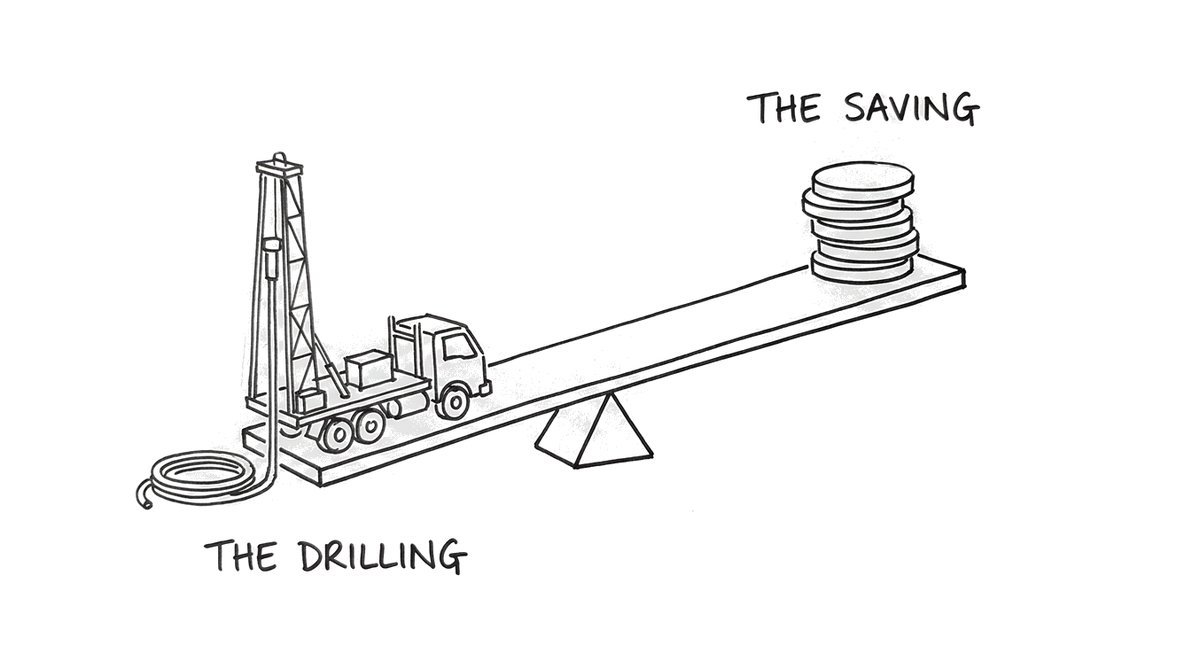
We design and build geothermal systems, and we still talk more people out of them than into them. That surprises people, because geothermal has a reputation as the most efficient heating money can buy, and on paper it often comes out ahead. Whether it’s the right buy is a different question, and the answer depends on your site, your house and what you want the system to do. Phil’s own answer, standing in the plant room of one of the most elaborate geothermal systems we’ve built: “Should everybody do this system? And the short answer is no.”
How good is an ordinary air-source heat pump in Perth?
Very good, here. A good air-source heat pump turns one unit of electricity into about three units of heat by pulling warmth out of the outside air. A ground-source one can do better, up to about five when it’s feeding a floor at low water temperatures, because the ground is warmer than the air on a winter morning. In northern Europe that difference is worth chasing. Here, a July night averages about 8 degrees, so a well-chosen air-source unit is working in conditions it handles easily.
Air-source machines have also come a long way. The good ones are efficient and quiet, and as long as they’re sited where they can breathe, a well-designed system comes close to a geothermal one for much less money. Siting matters more than most people think: squeezed into a corner or boxed in behind a fence, any heat pump can lose up to half its efficiency, which can cost you more than the ground would ever have saved.
When is geothermal worth it?
On our projects the ground has earned its keep in three situations. The first is a house with a pool and a lot of cooling. A heat-recovery system takes the heat it pulls out of the house in summer and puts it into the hot water and the pool, so the pool is heated with energy you’d otherwise throw away, and on the right project that has paid back in as little as about four years.
The second is a site where an outdoor unit isn’t acceptable, because of the neighbours, the looks or the space: a geothermal heat pump lives in a plant room or garage and makes no noise outside. The third is a site over Perth’s aquifer, where groundwater at around 20 degrees can be pumped up one bore and returned down another, with a licence and the right water.
Outside those, the arithmetic is usually against it. We once modelled a project where the extra cost would have taken about 150 years to earn back, recommended an air-source heat pump, and walked away from the dearer sale. Our geothermal cost article goes through where the money goes and how to work out the payback for your site.
Is geothermal worth it for a small home or tiny house?
Almost never. A small, well-built home uses little heat to begin with, so even a big percentage saving is a small amount of money. For scale, a well-built floor heating system in a 150 m² Perth home runs at about $181 a winter month on an air-source heat pump (a modelled estimate at Synergy’s July 2026 rate), and a tiny house uses a fraction of that. Whatever slice the ground could take off a bill that size is small change next to the cost of drilling.
For a small home we’d point you to an air-source heat pump, sited well. In a compact, very well-insulated house, a single reverse-cycle air conditioner may keep you comfortable for less money still, and we’d tell you so.
What about rural blocks and off-grid homes?
Rural land changes the sums a little. With room to dig, the loop can go into trenches about a metre and a half deep instead of drilled bores, and on some of our south-west jobs it has filled half a paddock. A dam can sometimes serve as the heat source as well. That can bring the cost of the ground connection down, though it still has to be sized properly.
Off the grid, every unit of electricity comes from your own panels and batteries, and heating is needed most on winter mornings and evenings, when the sun is weakest. A more efficient heat pump means less generation and storage to buy, and that saving sits next to the cost of the ground loop. It’s a case for modelling both options side by side before deciding.
How does it compare with ducted air, electric heaters and the rest?
Geothermal is a heat source, the same as the outside air is for an ordinary heat pump, and it can feed almost anything: a heated floor, radiators, or ducted air conditioning through fan coils that run on chilled and heated water. So the honest comparison is between where the heat comes from, and that’s what the table below does.
| Geothermal heat pump | Air-source heat pump | |
|---|---|---|
| Cost to put in | About 20% more for the equipment, plus the ground connection | Lower |
| Cost to run | Up to about 40% less on our Perth projects, less on a mild site | The baseline |
| Outside | Nothing to see or hear | A fan unit that needs open air |
| Inside | A plant room or garage space | Less |
| Expected life | About 20 to 25 years, sheltered from the weather | Outdoor units about 10 to 15, less near the coast |
Electric heaters, panel heaters and electric floor mats are a different league again. They turn each unit of electricity into one unit of heat, where any heat pump, air or ground, turns it into about three or more. That’s why an electric mat makes sense for one small bathroom and very little sense for a whole house.
What goes wrong with geothermal, and how do I avoid it?
The geothermal systems we’re called to fix often have good equipment and the wrong design. One of the most common faults is a ground connection that’s too small, often because a bore was left off the quote to bring the price down, so the heat pump struggles and the owner would have done as well with air-source.
Next come water temperatures set too high for the heat pump to work efficiently, and open-loop systems where nobody planned for the groundwater. On one job, two bore pumps ran around the clock and used more power than the heat pump itself, and iron bacteria in the water had turned to sludge in the pipes.
Phil’s advice is to ask for the payback arithmetic in writing, with its assumptions, and to choose someone who builds air-source systems as well as geothermal, because a contractor who only sells one will always recommend it. And never believe anyone who tells you geothermal will cost nothing to run. It costs less, never nothing.
 11 min
Other questions people ask us about geothermal
Will geothermal cut my power bill to nothing?
No. A geothermal system that costs 60% of what an air-source one would to run still leaves you with 60% of the bill. Solar panels lower it further, but nothing makes it zero.
Does a geothermal system need much maintenance?
A closed loop needs almost none once it’s in. An open loop needs its filter flushed and its water watched, how much depending on the groundwater. The heat pump gets serviced like any other.
Are there rebates for geothermal in WA?
Rebates change, so check what applies when you buy. Our article on rebates for heat pumps and geothermal in WA keeps track.
Where to go from here
If you’re building or renovating in Perth or the south-west, the 5-minute quote gives you your options in writing within 3 working days, each with its price and a modelled running cost, so you can see an air-source option and the alternatives side by side. Mention geothermal in your notes, and the pool if there is one. For the one-page version, read geothermal, straight, or try the Running Cost Calculator to see what the heat pump’s bill looks like for your floor area.