
Is an air-to-water heat pump worth it in Perth?
The short answer
For floor heating or radiators in Perth, usually yes. An air-to-water heat pump takes warmth from the outside air and puts it into the water that heats your floors, turning each dollar of electricity into about three dollars of heat at floor-heating temperatures, and Perth’s mild winters make that job easy. Built right, floor heating in a 200 m² home on one runs at about $240 a winter month (a modelled estimate at Synergy’s July 2026 rate). It costs more to buy than a gas boiler, and it isn’t worth it for one bathroom, or for a small house that one split system already keeps warm.
Heat pumps sound like the new thing, and new things in heating usually come with a sales pitch. People ask Phil why everyone’s suddenly putting them in, and why they can’t just have a gas boiler like their old house had. It’s a fair question with a plain answer, and a couple of honest catches.
What is an air-to-water heat pump?
It’s the same kind of machine as the outdoor half of a reverse-cycle air conditioner, doing a different job. A reverse-cycle unit takes heat out of the outside air and blows it into the room as warm air. An air-to-water heat pump takes heat out of the outside air and puts it into water, and that warm water runs through pipes in your floor or to radiators on the walls. Geothermal is the same machine again, taking its heat from the ground instead.
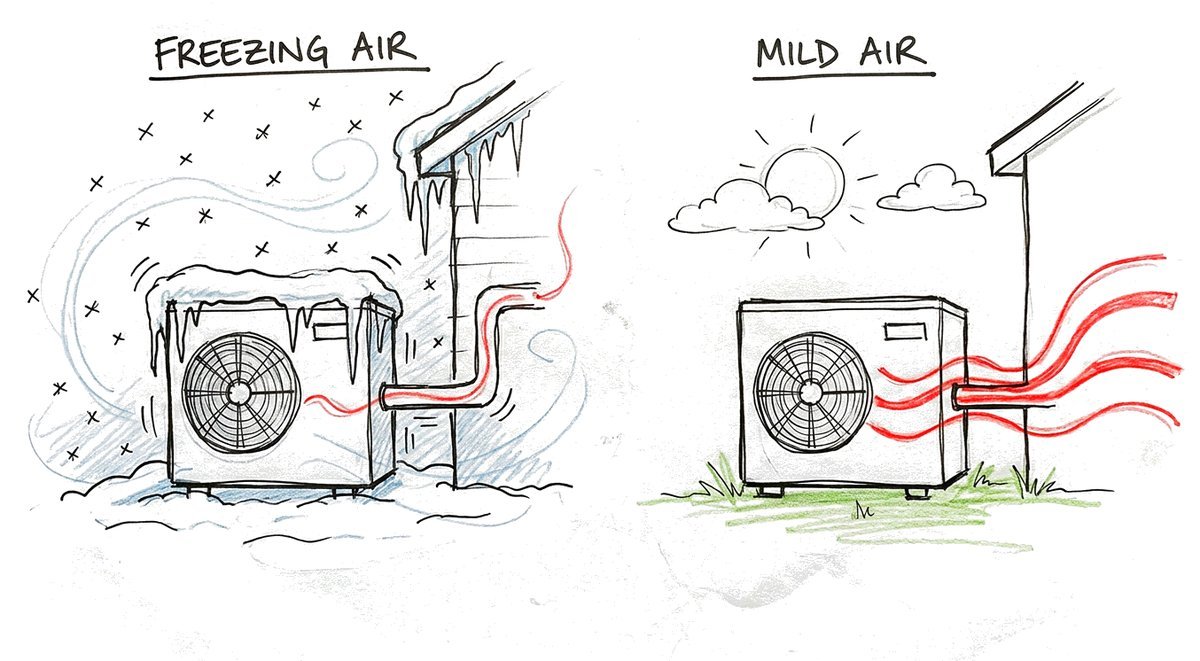
How can cold air give you heat? Phil’s picture is a bathtub. A bath of 5 degree water feels freezing, but because there’s so much of it, it holds far more heat than a mug of boiling water: about thirty times as much, by his figure. A heat pump works like a fridge in reverse. Its fan pushes thousands of cubic metres of cold air past a coil every hour, takes a little warmth from each one, and gathers it into a smaller amount of warm water.
A dollar in, about three dollars of heat out
Heaters that burn gas or run an electric element make heat, and can never get out more than they put in. Electric floor heating turns each unit of electricity into a little under one unit of heat, and the best gas boilers reach about one for one. A heat pump moves heat instead of making it, so it gets more out than it uses. Feeding a well-designed floor, it gives about three units of heat for each unit of electricity, sometimes four on a mild day. Put a dollar of power in, get about three dollars of heat out.
Two things move that number. The first is the outside air: as Phil says, it’s much easier to pull heat out of 20 degree air than 7 degree air. Perth’s July nights average about 8 degrees at the Bureau of Meteorology’s Perth station, which is kind to an air-source heat pump compared with Canberra or Europe. The second is the water. A heat pump makes 35 degree water for a floor far more easily than 55 degree water, which is why a heat pump and a well-designed floor suit each other so well.
What it costs to run in Perth
Our modelled running cost for floor heating in a 200 m² Perth home, on an air-source heat pump at Synergy’s July 2026 home rate of 33.26 cents a kilowatt-hour, is about $240 a winter month built right and about $601 built cheaply. The heat pump can be the same in both. The difference is the insulation under the pipes, the edge of the slab, and where and how the heat pump is installed, and over twenty winters it comes to about $36,100, modelled. The Running Cost Calculator works it out for your floor area.
Gas is cheaper than electricity per unit, so the comparison with a gas boiler isn’t simply three against one. On running cost a heat pump usually comes out ahead in Perth, which is why we suggest it first. Your house, your tariff and how you use the heating all move the numbers, though, so we’d rather show you both on paper than promise one.
What’s the payback against a gas boiler?
The payback comes down to two numbers: how much more the heat pump costs to put in than a gas boiler, and how much less it costs to run each winter. Divide the first by the second and you have your years. Both depend on the house, which is why our quotes give each option its own price and its own modelled running cost, so you can see the payback for your house instead of someone else’s.
A few things tip the balance further. A heat pump can make chilled water as well as warm, so the same machine can cool the house in summer, which a gas boiler never will. It runs on electricity, so it can use your own solar in the middle of the day and store some of it as warmth in the floor. And a heat-recovery heat pump can put the heat it pulls out of the house while cooling into the pool or the hot water, instead of blowing it out of the fan.
None of it runs for free, and Phil is blunt about anyone who tells you a system will cost nothing to run: there are always running costs. If you’d still rather have gas, we install gas boilers too and design the floor with the same care. A boiler makes very hot water easily, where most heat pumps top out at around 55 to 60 degrees.
When isn’t a heat pump worth it?
If you only want one warm bathroom, an electric mat under the tiles costs less to put in, and Phil says so himself. If you’re building a compact, well-insulated home where one reverse-cycle unit keeps you comfortable, that unit is already a heat pump and a good, cheap way to heat a room; hydronic heating won’t beat it on cost per unit of heat. What a floor or radiator system adds is comfort: warmth from the floor you stand on, no blown air and no fan noise inside.
And it isn’t worth it installed badly. A heat pump squeezed into a corner or boxed in behind a fence breathes its own cold air back in and can lose up to 50% of its efficiency. Phil’s rule is short: “Make sure your heat pump can breathe.” Size matters too. An oversized unit switches on and off all day and wears out sooner, and an undersized one runs flat out and never catches up, which is why the size should come from a calculation for your house (more in what size heat pump your house needs).
 6 min
Other questions people ask us
How long does a heat pump last?
Phil’s rule of thumb for an ordinary outdoor unit is 10 to 15 years, and less right on the coast, where salt air shortens its life (see will a heat pump last near the coast). A good unit that can breathe and is serviced every second year sits at the long end. The pipes in the floor outlast several heat pumps.
Is a heat pump noisy?
A good one isn’t. Standing next to one, Phil’s description was “It sort of sounds like a fridge running.” A cheap one, in his words, “sounds like a postie bike doing a burnout”. Buy on a measured sound figure and put it away from bedroom windows, yours and the neighbours’. More in how loud a heat pump is.
Can a heat pump also cool the house?
It can make chilled water in summer, for floor cooling or for ducted air conditioning. Floor cooling on its own covers only about a quarter of what a Perth house needs on a hot day, and for most homes a separate air conditioner is still the cheaper way to cool, so we’d show you both.
Where to go from here
If you’re building or renovating in Perth or the south-west, the 5-minute quote gives you your options in writing within 3 working days, each with its price and a modelled running cost, which is the payback question answered for your house. You don’t need plans to start. If you’d rather read first, our heat pump page covers sizing, siting and hot water, and the Running Cost Calculator shows what the engineering is worth on your floor area.