
What size heat pump does my house need?
The short answer
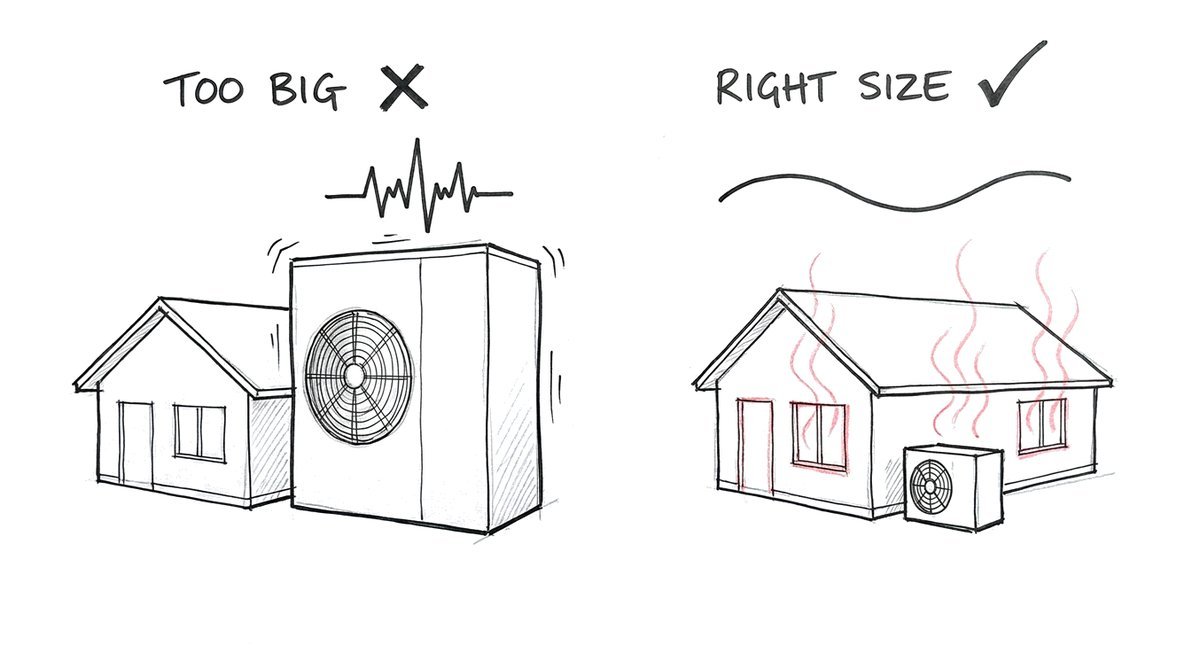
A heat pump should be sized to the heat your house loses on Perth’s coldest mornings, at the water temperature your heating actually runs on, and that comes from a heat-load calculation rather than from floor area alone. Two houses of the same size can need very different heat pumps, because glass, insulation, orientation and ceiling height change how fast they lose warmth. Bigger isn’t safer: an oversized heat pump keeps switching on and off, costs more to buy and wears out sooner. An undersized one runs flat out and still leaves the house short on a cold July morning.
Most people expect heat pump sizing to work like buying paint: measure the floor, look up a chart, buy the matching number. Plenty of sizing tools work exactly that way. It’s a reasonable place to start, and for an ordinary house it often lands close. But a heat pump is the one part of a heating system you’ll pay for every winter for twenty years, so it’s worth knowing what the number should really come from, and what it costs you when it’s wrong in either direction.
Why isn’t floor area enough?
Because a house loses heat through its walls, roof, windows and floor, and floor area only tells you part of that story. A double-brick home with small windows, good ceiling insulation and an insulated slab can need far less heat than a house of the same size with a wall of glass facing west, raked ceilings and a cold slab. On a winter morning both need warming up, but one is a thermos and the other is a cup with no lid.
Phil describes three ways sizing gets done. The first is a guess. The second is a rule of thumb, a set number of watts for every square metre, which is how most heat pumps are sized and which Phil calls a guess with experience: most of the time it’s fine.
The third is a heat-load calculation, where the house goes into software that works out the heat lost and gained through every wall and window, hour by hour, across a whole year of local weather. When we’ve done that, an efficient house has sometimes come out at a fraction of what the rule of thumb said, and a room full of glass well above it. We explain the calculation in what a heat-load calculation is.
What happens if the heat pump is too big?
Oversizing feels safe, but it costs you three ways. You pay more for a bigger machine on day one. Then it short-cycles: it switches on, heats quickly, switches off, and starts again a few minutes later. Every start is the most energy-hungry moment of the cycle, so more starts mean more electricity, and more wear on the compressor and a shorter life.
It’s like doing all your driving in stop-start traffic: the same trip uses more fuel and wears the car out faster than a steady run down the freeway. Modern inverter heat pumps soften the problem, because they can turn their output down, generally to about a quarter of full power. Below that they still have to cycle, so a machine that’s far too big for the house spends its mild days stopping and starting anyway.
And if it’s too small?
An undersized heat pump does the opposite. It runs all day without a break, never quite reaches the temperature you’ve set on the coldest mornings, and your bill shows a machine running flat out. With radiators it often shows up as rooms that stop a few degrees short in July: the house gets through May without complaint, then the first real cold snap arrives and the back bedrooms never quite get warm.
The tempting fix makes it worse. Turn the water temperature up to squeeze more heat out of the system and the heat pump’s efficiency drops sharply. A good heat pump that turns one unit of electricity into about five units of heat at 35 degree water can fall to about two and a half at 55. You end up paying more for the warmth you’re still not getting.
What do Perth’s winters mean for sizing?
Heat pumps are rated at standard test conditions, usually 7 degrees outside air, so the kilowatt figure on the data sheet is what the machine does on a mild winter’s day. The Bureau of Meteorology’s Perth station averages 8.1 degrees overnight in July, which sounds close.
But the mornings that matter drop to 2 to 4 degrees, colder in the hills and the south-west, and on 25 July 2025 Mt Lawley reached 0.3 degrees and Jandakot fell below zero. The colder the air, the harder an air-source heat pump has to work for every unit of heat, so the machine has to be chosen for those mornings, at the water temperature your floor or radiators actually run on.
The flip side is that those mornings are rare. A heat pump sized for the coldest few weeks of the year spends the rest of winter running at about half its capacity, which is exactly why an inverter that can turn down gently matters, and why sizing for the worst morning doesn’t mean buying the biggest machine on the shelf.
Are hot water and pool heat pumps sized the same way?
No, they follow their own rules. A hot water heat pump is sized by how many people live in the house and how much hot water they use each day. It’s a small machine that heats a big tank slowly over many hours, so the tank matters more than the heat pump; our article on replacing gas hot water with a heat pump goes into it.
A pool heat pump is sized by the pool’s volume, the temperature you want and whether you keep a cover on. On one of our jobs we sized the pool side to bring the water up to temperature within about a day when the owners want it for a party, instead of running it all year, because a pool loses much of its heat overnight.
Other questions people ask us about heat pump sizes
What does the kW number on a heat pump mean?
It’s the heat output at the test conditions printed next to it, usually 7 degree air and 35 degree water. Some sellers quote figures measured at 15 or 20 degree air, which make any machine look better. Compare heat pumps only at the same conditions.
Is it the same for a reverse-cycle air conditioner?
The principle is the same. A split system is sized room by room, and an ordinary bedroom sized off the chart will usually be fine. A living room with a wall of west-facing glass or a raked ceiling needs more than its floor area suggests.
Do I need a heat-load calculation before I get a price?
No. The 5-minute quote sizes your options from what you tell us about the house, and the price and modelled running cost of each are based on that. If you want the full room-by-room calculation before you commit, it’s part of The Comfort Guarantee Roadmap for new builds ($1,450) and The Warm Home Plan for existing homes ($490), both optional and credited in full to the build.
Where to go from here
If you’re in Perth or the south-west, the 5-minute quote gives you your options in writing within 3 working days, each with its price and a modelled running cost, and you don’t need plans to start. The more you tell us about the house, the windows and the floors, the closer that first sizing will be. If you’d like to see what a properly sized system costs to run first, the Running Cost Calculator works it out for your floor area, and heat pumps, sized correctly has the short version.