
Should I replace my gas hot water with a heat pump?
The short answer
In most Perth homes, yes, once the gas unit is due for replacement or if hot water is the last thing you use gas for. A heat pump makes hot water from the warmth in the outside air, three to four units of heat for every unit of electricity, and it can run on your midday solar. Listed models earn small-scale technology certificates (STCs) that usually come straight off the price. If your gas unit is working well and you’re keeping gas for cooking or heating anyway, there’s no rush. Wherever it goes, keep a heat pump away from bedroom windows, yours and the neighbours’.
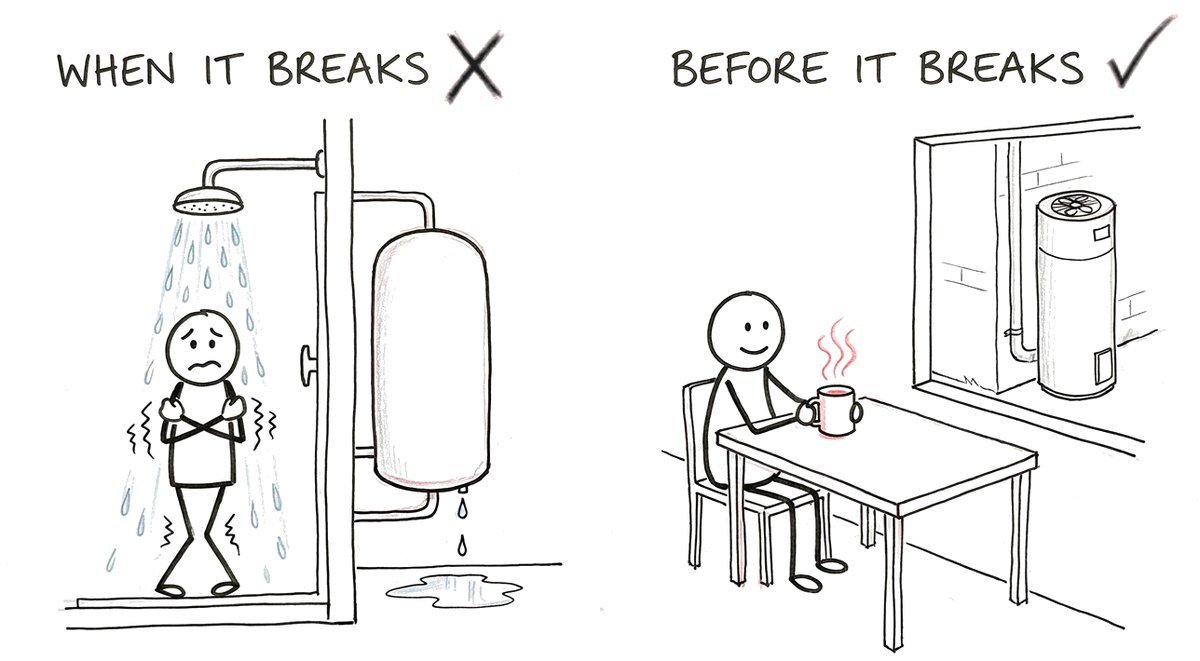
Hot water systems tend to get replaced in a hurry. The old tank starts leaking or the pilot light won’t stay lit, and the quickest fix is the same thing again, bolted into the same spot. If your gas unit is getting on, it’s worth deciding now, while you have time, whether the next one should run on gas at all. We install gas boilers as well as heat pumps, so we’ve no reason to talk you out of gas, and for most Perth homes the answer still comes out in favour of the heat pump.
How does a heat pump make hot water?
It works like a fridge in reverse. A fan draws outside air across a coil, a small compressor collects the warmth from that air, and the warmth goes into a tank of water. Even cold air holds a surprising amount of heat. Phil’s picture for it is a bathtub of 5 degree water: it’s freezing to sit in, yet it holds about 30 times as much heat as a mug of boiling water, simply because there’s so much of it. A heat pump gathers that spread-out warmth and concentrates it.
That’s why it’s so efficient. An electric element turns one unit of electricity into one unit of heat, and a heat pump turns it into three to four. The compressor is small, so it heats the tank slowly over several hours, which suits Perth well: the warmer the air, the less work it does, and our winters are mild.
Will it cost less to run than gas?
In most Perth homes it does, though how much depends on your gas price, how much hot water you use and whether you have solar. Hot water is typically about a quarter of a home’s energy bill, so it’s worth getting right. Solar tips it further. At midday, Synergy pays about 2 cents for each unit you export, and you buy power back in the evening at about 33 cents. A heat pump set to run in the middle of the day heats your water with power you’d otherwise sell for almost nothing.
Phil’s view is that the solar timing is a nice extra, not essential, because a hot water heat pump uses so little power that it doesn’t change the bill much either way. If your unit can be timed easily, do it. If it needs an expensive controller, skip it. And if hot water is the only reason you still have gas connected, switching lets you drop the gas account and its daily supply charge as well.
When does keeping gas make sense?
If your gas unit is working well, there’s no need to rip it out. Replacing a sound appliance early rarely pays, and the right time to switch is when it’s due anyway. If you’re keeping gas for a cooktop or heating, the daily supply charge stays either way, so the saving from switching is smaller.
Gas instantaneous units have real strengths too. They never run out in the middle of a long shower, and they’re a small box on the wall. A heat pump stores its hot water in a tank, so the tank has to be sized for your household, and the unit needs a spot outside with fresh air or a garage big enough to breathe in. A heat pump usually costs more to buy than a like-for-like gas replacement, before the STCs come off. For a big family with a small yard and a gas line that’s staying, gas can still be the sensible call.
Where should the heat pump go?
This is the part people get wrong, usually by putting the new unit exactly where the old gas one was. A hot water heat pump is quiet, but it has a fan and a compressor, and it often runs at night or early in the morning. Western Australia’s noise regulations allow 35 decibels overnight from 10 pm in most suburbs, measured at the neighbour’s property rather than yours, and less if the sound has a whine or drone to it. A unit tucked into a narrow side path, between your wall and the neighbour’s, is a risky spot, because the sound gets trapped and bounces between the two houses.
Phil’s advice is blunt: “definitely don’t put the heat pump next to your bedroom windows or anywhere else that’s noise sensitive”. Beside the laundry is usually the best place, facing the back yard rather than the fence. He has one next to his own laundry: inside the house you can’t hear it, and standing a few metres away it sounds like a decent-sized fridge. Don’t box it in either, because it needs fresh air. A garage can work if it’s big enough, often around 14 to 15 cubic metres of air depending on the maker, though it will cool the garage a little.
What makes a good hot water heat pump?
Start with honest numbers. Efficiency figures only mean something at stated conditions, and for hot water the fair test is about 15 to 20 degree air and 60 degree water, where a good unit manages around 3.8 to 4. Phil doubts any claim above four. For noise, look for a sound power figure tested to a published standard, the lower the better. A number with no test standard beside it may have been measured on someone’s phone.
Then look at what keeps the heat in and the tank alive. Thicker tank insulation holds the heat you’ve paid for overnight, and the pipes and valves outside should be insulated too. Many tanks rely on a sacrificial anode that has to be replaced every few years; some use an electric anode instead, which needs no attention as long as the unit stays plugged in. Finally, ask whether it has a backup electric element. Phil’s rule is that “you should always have redundancy for your hot water”, because you can live without heating for a day, but not without a hot shower.
 9 min
9 min
Other questions people ask us about hot water heat pumps
Is there a rebate for a heat pump hot water system?
Yes, through small-scale technology certificates. The Clean Energy Regulator says the model has to be on its register, under 425 litres, and installed by someone who meets the state’s licensing rules. Most installers claim the certificates for you and take their value off the price.
Do heat pumps work on cold Perth mornings?
Yes. A heat pump works harder the colder the air, but Perth’s winters are mild, and because the tank holds a day’s hot water, the unit can do most of its work in the warmer middle of the day.
Can my heating heat pump make my hot water too?
It can, through a special indoor tank, and it makes sense for some homes. For most, two separate heat pumps cost less. Our article on one heat pump for heating and hot water explains why.
Are cheap hot water heat pumps worth it?
Some are fine, but Phil has heard plenty of stories of cheap units failing within months or a couple of years. Our guide to choosing a hot water heat pump covers what to check.
Where to go from here
If you’re in Perth or the south-west and thinking about hot water as part of a bigger change, heating as well, or getting off gas altogether, the 5-minute quote gives you your options in writing within 3 working days, each with its price and a modelled running cost, and you don’t need plans to start. For the short version of how we size and site heat pumps, read heat pumps, sized correctly.