
How loud is a heat pump, and how do I keep it quiet?
The short answer
A good heat pump sounds like a fridge running: you’ll hear it from a few metres away on a still night, and not at all from inside. A cheap one can sound like a motorbike. So buy on a sound power level that has been tested to a named standard, ideally below 60 decibels for a heating heat pump, and put it where the sound can spread out instead of bouncing between walls. Hot water heat pumps are smaller and usually quieter, and the same rules apply. In most Perth suburbs, WA’s noise rules allow 35 decibels at the neighbour’s place from 10pm.
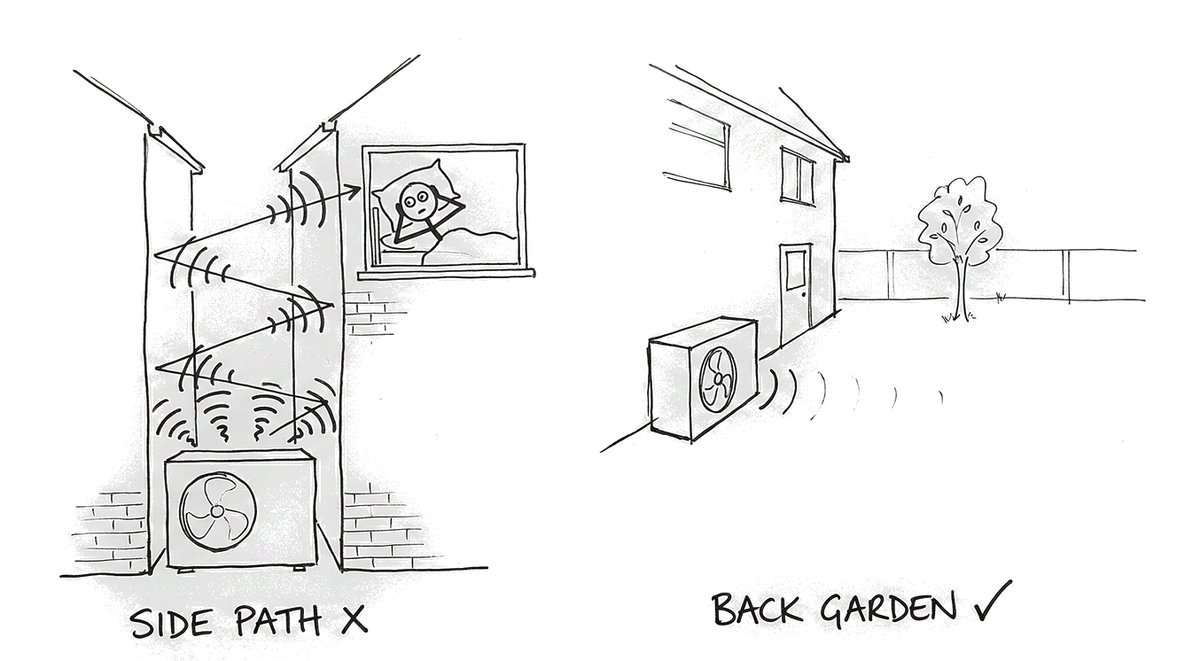
Noise is one of the biggest worries people have about a heat pump. People picture something like an old air conditioner rattling outside the bedroom window, or a neighbour knocking on the door at 11 at night. Both can happen. Neither has to, and the difference comes down to what you buy and where you put it.
What does a heat pump sound like?
Two parts make the noise: the compressor, a motor that spins fast to move the heat around, and the fan that pulls air across the coil. A good heat pump wraps its compressor in acoustic insulation and uses a big fan turning slowly. When Phil switched one on for the camera, his verdict was, “It sort of sounds like a fridge running.” It ramps up and down with the weather, and gets only a little louder when it works hard.
A cheap one is another matter. To save money, some makers squeeze the same output into a box half the size, with the fins packed tight and a small fan spinning fast to force the air through, and leave the compressor bare. Phil’s description of the result: “it sounds like a postie bike doing a burnout.” Many of these units come out of the same few factories with different badges on, so a smart name tells you nothing. In between sit the appliance brands, which sound much like an air conditioner of the same make.
What noise figure should I look for?
Look for the sound power level, and for a testing standard printed next to it. Sound power describes the noise the machine itself makes, so it’s the fair number to compare between models. Sound pressure depends on how far away it was measured, which is why a figure like “55 decibels at 3 metres” with no standard beside it can mean almost anything. A tested figure means a laboratory measured it.
For a heat pump that heats a house, Phil’s rule is a tested sound power level below 60 decibels, and 52 to 58 is good. That gap matters more than it looks. Decibels climb on a curve, and every 10 decibels sounds roughly twice as loud, so a 68 decibel unit sounds about twice as loud as a 58. One surprise: the bigger unit is often the quieter one, because its larger fan can turn more slowly.
 10 min
What are the noise rules in WA?
Outdoor machines in WA have to meet the Environmental Protection (Noise) Regulations 1997. The City of Nedlands’ guide for air conditioner installers spells out what that means in a typical suburb: from 10pm the allowed level is 35 decibels in most suburban areas, and it’s measured at the neighbour’s property, not next to your unit. If the noise has a whine or a drone to it, the limit is treated as 30. A heat pump is the same kind of outdoor machine, and the law puts responsibility on whoever installs it as well as the owner.
That sounds strict, and it is, but it’s very achievable with a quiet unit in a sensible spot. The guide is clear about the spot: location is the most important factor, the side of the house close to the neighbour is the worst, because the sound is trapped and reflected between the walls and the eaves, and facing the back garden is usually best.
Where should it go so nobody hears it?
Away from bedroom windows, yours and the neighbours’, and out of narrow side paths. Facing an open garden, the sound spreads and fades. Against a solid fence with no gaps, between the unit and the neighbour’s window, it drops further, as long as the heat pump still has at least 2 metres of open air in front of its fan to breathe (more in where a heat pump should go). Next to the laundry or a garage wall is usually a good spot.
Like any machine, a heat pump gets a little noisier with age as bearings wear and panels loosen, so leave yourself some margin and have it serviced. If there’s no quiet spot at all, a heat pump can sit inside a plant room, ducted to the outside, with the walls adding another layer of sound insulation.
Are hot water heat pumps noisy?
Less than heating heat pumps, as a rule, because the compressor is smaller. The same advice holds: a tested sound power level below 60 decibels, and 52 to 56 is very good. A good one sounds like a big fridge humming. In the day you won’t notice it over the noise of the street, but at night you will if it sits under a bedroom window, so put it by the laundry or the bathroom instead. Phil has one beside his own laundry and can’t hear it from inside the house. We cover the rest of what to look for in how to choose a hot water heat pump.
Other questions people ask us
Is a geothermal heat pump quieter?
Much quieter, because there’s no fan outside. The heat pump sits in a plant room, and a well-insulated one is close to silent: on a Dalkeith job Phil took the case off so you could hear the compressor, then closed it, and the sound was gone. The pumps and pipes need the same care, because cheap pumps and badly laid pipes can hum and rush. As Phil says, “Spend a little bit extra to make it a smooth silent system and then you enjoy the benefits for 20 to 25 years.”
Does a heat pump get louder when it’s working hard?
A little. A good inverter heat pump runs at part speed most of the time and ramps up on the coldest mornings, and even then it’s only slightly louder. A cheap on-off unit goes from silence to full noise every time it starts.
Can I build a box around it to keep it quiet?
Not a closed one. A heat pump needs fresh air, and boxed in it loses up to 50% of its efficiency. A solid fence or wall between it and the neighbours, with open air in front of the fan, is the way to cut noise without choking it.
Is a heat pump louder than a split system?
A mid-range heating heat pump sounds about like an air conditioner of the same make, and a premium one is quieter. The figure to compare is the tested sound power level on each data sheet.
Where to go from here
If you’re building or renovating in Perth or the south-west, the 5-minute quote gives you your options in writing within 3 working days, each with its price and a modelled running cost, and you don’t need final plans to start. If noise is a worry, say so in the notes and tell us about any bedrooms close to the boundary, so the heat pump’s spot goes into the design. Our heat pump page explains how we choose and site one.