
Can you put a heat pump in a garage, and where should it go?
The short answer
Not an ordinary air-source heat pump in a closed garage. It takes its heat from the air, and in a closed room it soon breathes its own cold air back in, loses up to 50% of its efficiency and works itself harder for less. It can go inside a garage or plant room if it’s ducted to the outside, with fresh air coming in through one duct and the cold air leaving through another, and that has to be planned before the walls go up. Ground-source and water-source heat pumps and gas boilers can go inside.
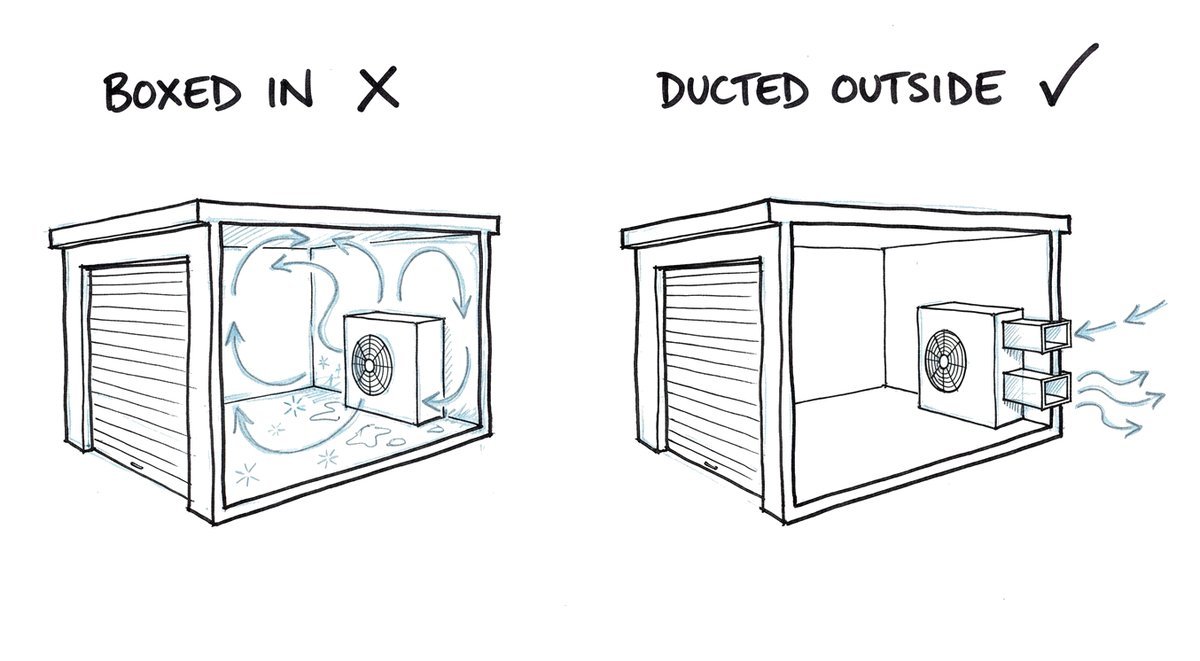
Nobody buys a heat pump for its looks. It’s about the size of a large air conditioner’s outdoor unit, and on a beautiful new house the natural instinct is to tuck it away in the garage, a store room or a little nook where no one will see it. It’s one of the questions we’re asked most, and the answer decides a good share of what the system will cost to run.
Why can’t an air-source heat pump just sit in the garage?
An air-source heat pump harvests heat from the air around it. Its fan pulls outside air across a coil, takes some of the heat out of it, and blows the air out again a few degrees colder. Outdoors that cold air drifts away and fresh air takes its place. In a closed garage it has nowhere to go, so the heat pump breathes the same air over and over, each time a little colder. In Phil’s example the whole room drops to around 5 degrees, or lower, surprisingly quickly.
The heat pump can’t tell the difference between a cold morning and a cold garage. As Phil puts it, “It starts thinking, “Geez, it’s getting colder out here,” even though it’s not. It’s only cold in that little pocket.” So it ramps up its compressor and fan and works harder for less heat. A heat pump boxed in like this loses up to 50% of its efficiency, and all that extra work shortens its life too.
The same thing happens outdoors when a heat pump is squeezed behind a fence or into a corner between two walls. The cold air hits the fence and gets sucked straight back in. A garage is only the most extreme version of the same mistake.
How do you hide a heat pump inside properly?
You duct it. The heat pump sits in the garage or a plant room, and two ducts run through the wall to the outside: one brings fresh air in through a weatherproof grille with insect mesh, and the other sends the used cold air out somewhere else, well away from the intake. The heat pump never breathes the room’s air at all, so it works as well as it would on a slab in the garden.
There are bonuses. Inside, the heat pump is out of the rain, the sun and the salty air, which matters near the coast, and the walls around it add another layer of sound insulation. It’s how homes in Europe usually do it: the heat pump or boiler lives in a plant room, the laundry or the garage, ducted or flued to the outside, and lasts longer for it. The catch is that it takes more planning and more room than standing a unit on a slab outside, plus the ducts and grilles, so it has to be in the design before the walls go up.
 5 min
Where should a heat pump go outside?
Somewhere it can breathe. Behind and beside the unit it needs the gap the maker asks for, usually a few hundred millimetres. In front of the fan it needs at least 2 metres of open air, so the chilled air it blows out can drift away instead of being drawn back in. Phil’s own rule is short: “Make sure your heat pump can breathe.”
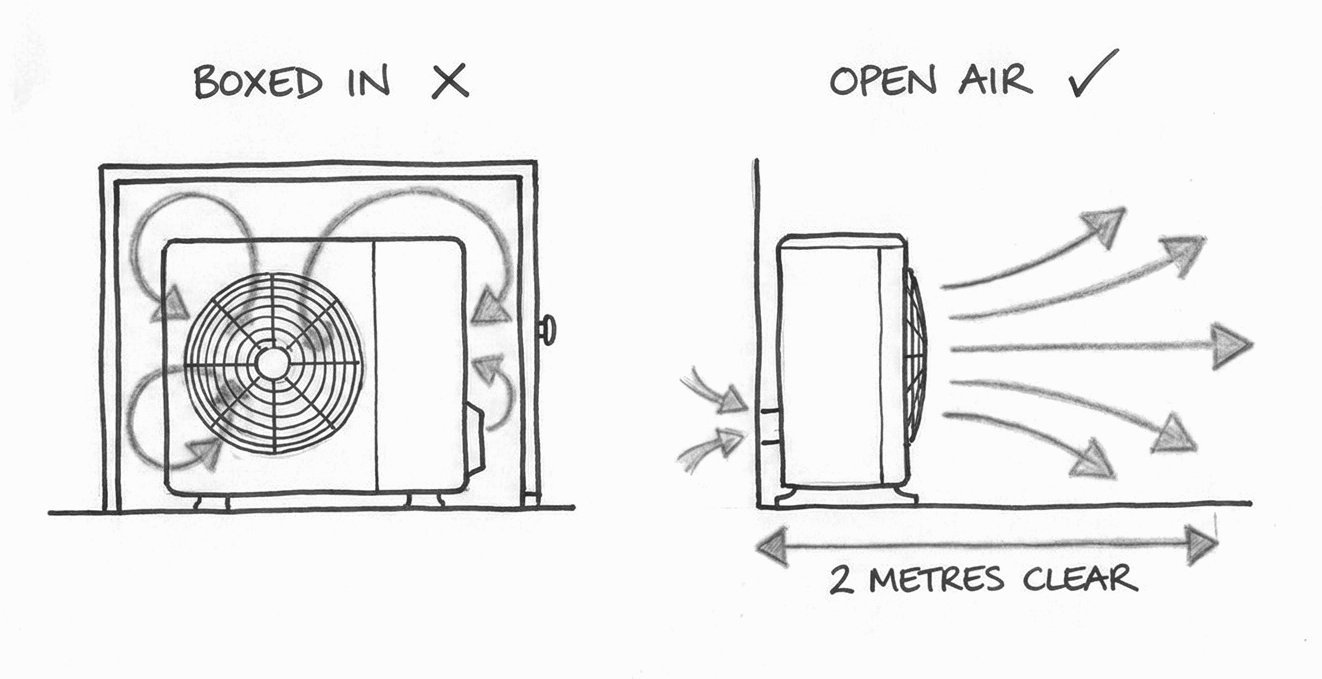
Then think about who has to listen to it. A good heat pump sounds like a fridge running, but on a still night you’ll still hear it under a bedroom window, and so will the neighbours. A narrow side path between two houses is the worst spot of all, because it traps both the cold air and the sound. We go through the noise side in how loud a heat pump is and how to keep it quiet.
Finally, it should be part of the plan. We site the heat pump in the design, before walls go up or fences go in, because that’s the only time it can be put in the right place without an expensive re-route. If you’re building, our article on how much room the heat pump, tank and manifold need helps you leave space for it.
What about a gas boiler or a geothermal heat pump?
Both can go inside. A ground-source or water-source heat pump takes its heat from the ground or from bore water through pipes, and doesn’t trade air with the room at all, so a garage, a basement or a plant room suits it well. A condensing gas boiler can go inside too, in a laundry or plant room, with a flue taking the exhaust gases out through the wall or roof.
In Australia we’re used to hanging boilers on an outside wall, and with our mild winters that’s fine. Inside, a boiler loses less heat from its own casing and is out of the weather, so it lasts a little longer, as long as the flue is planned in from the start.
Other questions people ask us
Can a heat pump be installed indoors?
Yes, if it’s ducted to the outside or it’s a ground-source or water-source heat pump. An ordinary air-source unit standing in a closed room won’t work properly.
Can I put a screen around it to hide it?
A screen can work if it leaves the gaps the maker asks for and stays well clear of the front of the fan, so the cold air can blow away. A screen that closes the heat pump in turns it into the boxed-in unit above.
Will a heat pump in the garage be quieter?
A ducted one usually is, because the walls around it add a layer of sound insulation. You may still hear a little at the duct openings, so those belong away from bedroom windows too.
Will it last longer inside, especially near the coast?
Out of the weather and the salt air, it should. Outdoor units close to the ocean take a beating, and we look at how to give them a long life in whether a heat pump will last near the coast.
Where to go from here
If you’re building or renovating in Perth or the south-west, the 5-minute quote gives you your options in writing within 3 working days, each with its price and a modelled running cost, and you don’t need final plans to start. If you’d like the heat pump hidden away, say so in the notes so the ducting goes into the design. For the one-page version of how we size and place heat pumps, see our heat pump page.