
Will a heat pump last near the coast?
The short answer
It can, if it’s chosen and placed for the salt. Salt air settles on the outdoor unit’s coil and corrodes it, and Phil has seen ordinary outdoor units fail after about seven years in Cottesloe, Fremantle, Scarborough and Trigg, where 10 to 15 years is normal further inland. A unit with a coated coil, placed out of the direct sea breeze but still free to breathe and checked at each service, gives you the best chance of the long end. A heat pump inside a plant room, or a geothermal system, avoids most of the problem, and the pipes in your floor aren’t affected at all.
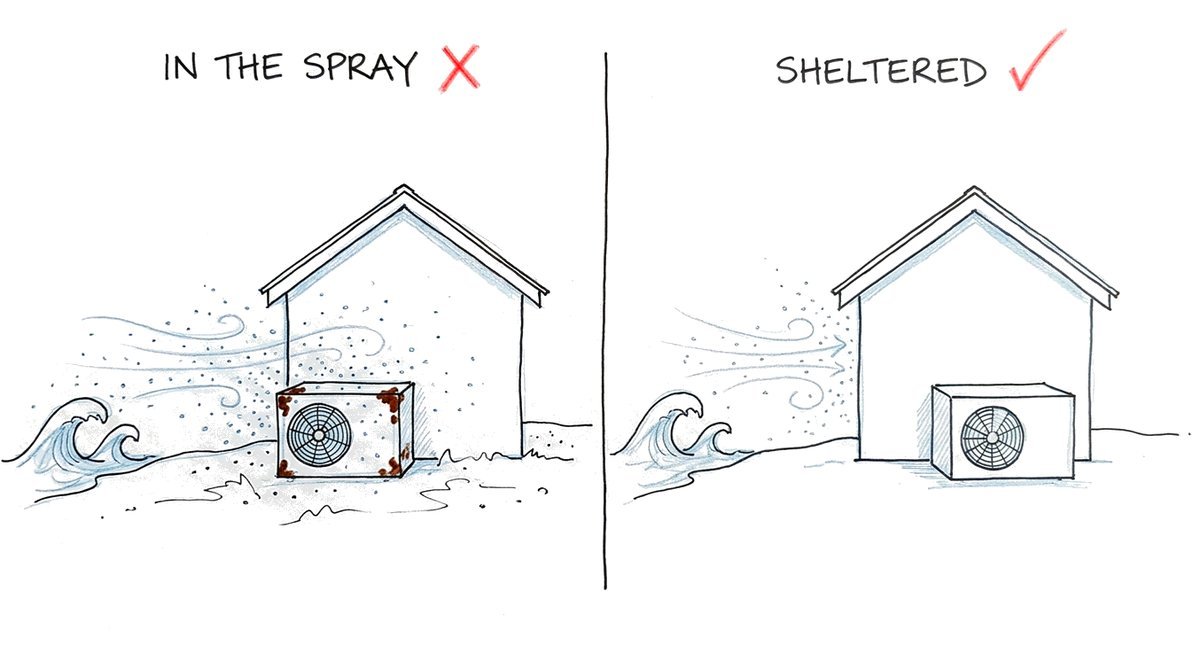
If you live within sight of the ocean, you already know what salt does to the car, the outdoor furniture and the screws in the deck. An outdoor heat pump stands in that same air all year. What follows applies to any heat pump with a fan outside, whether it heats your floors, your hot water or your pool, or reuses waste heat from the air conditioning.
What does salt air do to a heat pump?
A heat pump gets its heat by pushing a lot of outside air past a coil: rows of thin metal fins wrapped around small pipes. Near the sea, every cubic metre of that air carries a little salt, and over thousands of hours the salt settles on the fins and the casing and corrodes them. A corroded coil passes heat less well, so the heat pump works harder for the same warmth, until eventually a part fails.
Phil’s experience in Perth is that an ordinary outdoor unit can be expected to last 10 to 15 years, but in coastal suburbs he has seen them fail after about seven, and that’s the gap good choices can close.
How close to the sea is too close?
There’s no single line, but the salt falls away quickly with distance from breaking surf, and the wind decides where it goes. The roofing steel maker BlueScope treats a house within about 100 metres of breaking surf as a very severe marine site and recommends stainless steel for walls within about 500 metres. A unit a few streets back, on the side of the house away from the afternoon sea breeze, has a much easier life than one on the front dune.
Choosing and placing a heat pump on the coast
Ask what protects the coil. Several makers coat the outdoor coil against salt and sea spray, and their installation manuals say how a unit near the sea should be placed and looked after, so read that part first. Phil has customers whose coated hot water heat pumps have run happily for more than ten years in a coastal spot that “gets a bit of a beating from the salt and the elements”.
Then place it out of the direct sea breeze where you can, on the land side of the house or behind a wall or garage that takes the spray first. What you can’t do is box it in to protect it. A heat pump squeezed into a corner or shut behind a fence breathes its own cold air back in and can lose up to 50% of its efficiency. Phil’s rule: “Make sure your heat pump can breathe.” Aim for shelter from the spray with open air in front of the fan.
Some houses have a neater answer. Close to salty water, Phil’s team put an air-to-water heat pump inside a plant room and gave it insulated ducts to breathe through, with weatherproof grilles to the outside, so the machine sits out of the weather and still runs at full efficiency. A geothermal system has no fan unit outside at all, and Phil expects about 25 years from a ground-source heat pump that’s designed and installed right, though it costs a good deal more to put in.
 5 min
Looking after it
We recommend a service every second year for any hydronic system. On the coast, that visit should take a close look at the coil fins, the casing, the fixings and the electrical connections, because that’s where salt does its damage, and cover anything the maker’s manual asks for on a coastal site. The rest of the system doesn’t mind the sea: the floor pipes sit sealed in the slab or screed, full of treated water, and the manifold and controls live indoors.
Other questions people ask us
Does this apply to hot water and pool heat pumps?
Yes. Anything with a fan and a coil outdoors lives in the same salty air, including hot water heat pumps, pool heat pumps and units that reuse waste heat from the air conditioning. The same choices about the coil, the position and the servicing apply.
Is geothermal the answer on the coast?
It solves the salt problem, because there’s nothing outside to corrode, but the bores cost far more than an outdoor unit, so it still has to pay its way on running cost. Our article on what geothermal costs goes through when it does.
Can the heat pump go in the garage instead?
Only if it can get fresh air from outside, through ducts, or it will chill the garage and breathe its own cold air. We cover the options in where the heat pump should go.
Where to go from here
If you live in a coastal suburb of Perth or the south-west, the 5-minute quote gives you your options in writing within 3 working days, each with its price and a modelled running cost. Mention how close you are to the beach in your notes, so the heat pump and its position are chosen for it. Our heat pump page covers sizing and siting in more detail.