
Can one heat pump do my heating and my hot water?
The short answer
Yes. The heat pump that runs your floor heating or radiators can also heat your tap water, through a special tank with a coil inside, so the heating water and the shower water never mix. It usually isn’t the cheaper way, though. The special tank, sensors, pumps and valves cost more than a separate hot water heat pump, which is mass-produced and attracts federal certificates. For most homes we suggest two units, and one machine where every unit of power counts or where it’s part of a single plant that also cools the house and heats the pool. Either way, the hot water needs an automatic backup.
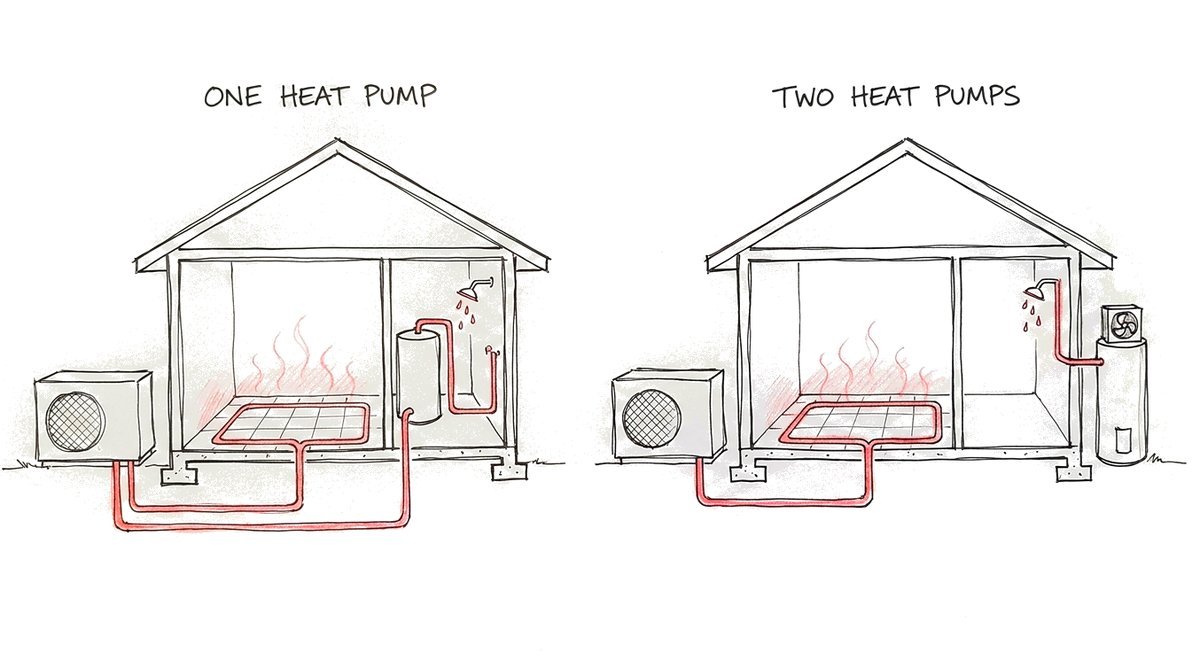
It sounds like it should be simpler. You’re putting a heat pump in for the floors anyway, and a modern hot water system is a heat pump too, so why buy two? Phil says on camera that we get asked this all the time, and the answer surprises most people, because the obvious way usually turns out to cost more.
Can my hot water heat pump run the floor heating?
No, and it’s worth knowing why before anyone suggests it. A hot water heat pump is built to work slowly: a small compressor, often around 1.5 kilowatts of output by Phil’s figure, warming a big tank over many hours. A house on a cold morning needs far more heat, and needs it now. Phil’s rough comparison is that a household’s hot water takes somewhere between a few and twenty units of heat in a whole day, while heating the house can take that much every hour.
The temperatures don’t match either. Floor heating runs on water at about 30 to 35 degrees and radiators at about 45 to 55, while tap water is stored at 60 degrees or more. Tap water and heating water also can’t share the same pipes, because anything that touches the drinking water needs its own approval, and the hot water unit’s warranty wouldn’t cover the job. At a stretch, a hot water unit might warm one tiny room, badly.
How one heat pump does both
The other way round works. A heating heat pump has plenty of capacity, so it can heat tap water through an indirect tank: a storage tank with a coil of pipe inside it. Hot water from the heat pump runs through the coil and warms the water around it, which is what comes out of your shower, and the two waters never touch. The heat pump works less efficiently making 60 degree water than 35 degree water, but in the end about as well as a dedicated hot water heat pump does.
The catch is the tank. The good ones mostly come from Europe, where heating plant lives indoors, so they’re made to sit inside: in the laundry, a cupboard, the plant room or the garage. Phil isn’t keen on the cheaper tanks made to stand outside, which in his experience don’t last long. An indoor tank also loses less heat than one standing outside on a 5 degree night.
Why two heat pumps usually cost less
Phil calls this part counterintuitive. You’d expect the heat pump to be the expensive bit and the rest to be small extras. In practice the special tank, the temperature sensors, the pumps and valves, and the time to put it all together and make it work add up to more than a separate hot water heat pump. Stand-alone hot water heat pumps are made in large numbers, which keeps their price down, and as Phil points out, they’re the ones that attract the federal certificates. We explain how those work in what rebates there are for heat pumps in WA.
Two separate units take up about the same space as one heat pump plus an indoor tank. A stand-alone hot water heat pump can stand outside, or inside a garage that’s big enough for it to draw its air from. So for an everyday house, Phil’s advice is two machines: a big one for the heating and a small one for the hot water. If you’re choosing the small one, his tips for picking a good hot water heat pump are worth reading first.
When one machine is worth it
There are two cases where we’d design one heat pump to do both. The first is a house where every unit of power counts, like an off-grid home, because one machine can be controlled precisely, deciding moment by moment where the energy goes. The second is a bigger plant where the same heat pump also cools the house and heats the pool. A heat pump cooling the house in summer has to put the heat it removes somewhere, and instead of blowing it out of the fan, it can put it into the hot water tank or the pool, so you aren’t paying to make that heat a second time.
One plant also needs a smaller power supply, because not everything has to run at once. If someone’s in the shower, the floor heating can wait five minutes and nobody notices. Phil’s example is a house that would need 60 to 100 amps for a row of separate machines getting by on about 32 from one central unit. The honest downside, as Phil says, is that it takes more planning and more work on site, so it costs more to put in. Our page on whole-home systems covers how that’s designed.
 8 min
8 min
Whichever you choose, plan the backup and the pipes
A house can live without heating for a day or two. It can’t live without hot water. Phil’s team took over a geothermal job from another contractor where every drop of hot water came from the heat pump, so whenever the heat pump stopped, which was often, the hot water stopped too. His rule: “you should always have redundancy for your hot water.” In practice that’s an electric element in the tank that switches on by itself only if the heat pump stops, so you might lose the heating for a day but never the shower.
The pipes matter as much as the machine. Down in Dunsborough, Phil looked at a beachfront house where hot water ran in a loop around the house 24 hours a day, so the taps ran hot straight away. With no tap open, the water left the tank at 50 degrees and came back at 40, because the pipe ran bare through concrete and walls, and the owner was paying more than $700 every summer month for hot water alone. Whatever heats your water, a loop like that needs unbroken insulation and a timer, so it runs at shower times instead of all night.
Other questions people ask us
Can a gas boiler do my heating and my hot water?
Yes. A gas boiler can heat an indirect tank the same way, and we install gas boilers as well as heat pumps. On running cost a heat pump usually comes out ahead in Perth, which is why we suggest it first, but if you’d rather have gas we’ll design it in.
Should the hot water tank go inside or outside?
Inside if you can. Even a well-insulated tank loses some heat, and it loses more standing outside on a cold winter night than in a laundry at 20 degrees. A stand-alone hot water heat pump can go either way, but indoors it needs a decent volume of air around it, so a big garage works better than a cupboard.
Can the same heat pump heat the pool?
It can, if it’s sized for the pool at the design stage. In summer, the heat a heat pump pulls out of the house while cooling can go into the pool instead of into the air. Our pool heating page explains how.
Where to go from here
If you’re building or renovating in Perth or the south-west, the 5-minute quote gives you your options in writing within 3 working days, each with its price and a modelled running cost, and you don’t need plans to start. Mention your hot water in the notes so we can include it. For the bigger picture of heat pumps, sizing and siting, see our heat pump page.