
Gas boiler or heat pump: what should heat my floor heating?
The short answer
For most Perth homes we suggest a heat pump, though a gas boiler is a real option and we install both. A gas boiler turns each unit of gas into a little under one unit of heat, while an air-source heat pump moves three to four units of heat out of the outside air for each unit of electricity. So although gas is cheaper per unit, the heat pump usually costs less to run here. The boiler is cheaper to buy and smaller. The heat pump earns its higher price only on a floor designed to run on warm water rather than hot.
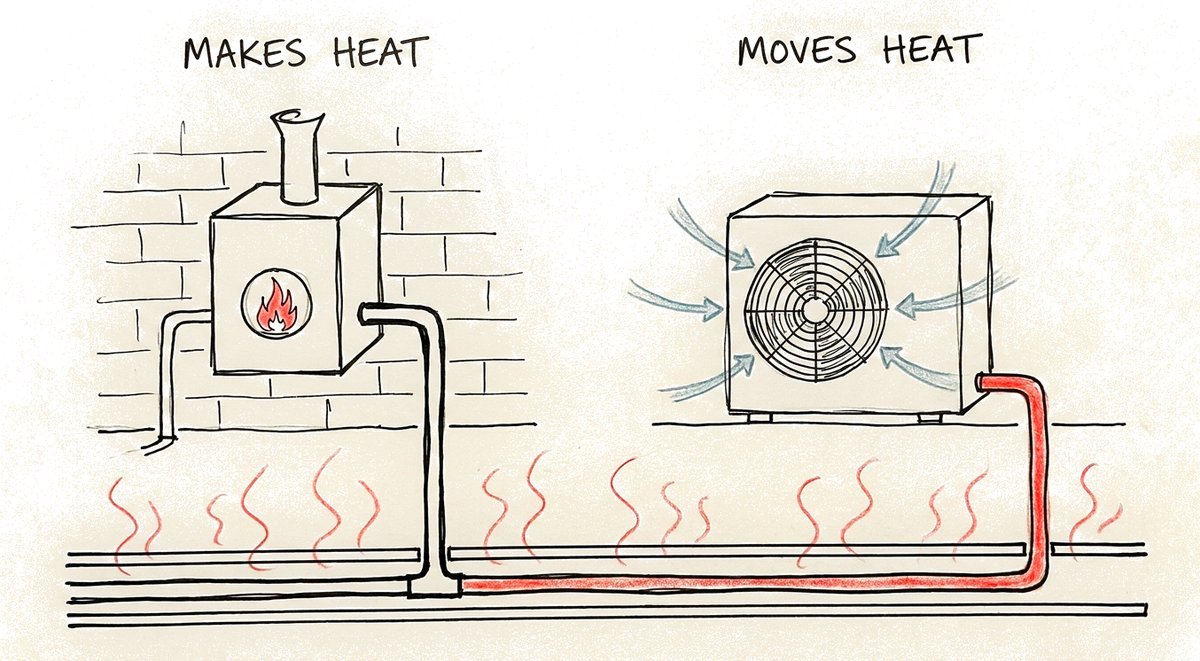
Once people decide on floor heating, this is usually the next question, and it tends to arrive with a sum attached. The heat pump is the dearer of the two, and people want to know whether it’s really that much cheaper to run or whether a gas boiler will do. Plenty of Perth homes have been warmed by gas boilers for decades, and a good one still does the job well. The answer depends on your house, your floor and how long you plan to stay.
What’s the difference between a gas boiler and a heat pump?
A gas boiler works much like the gas hot water unit on the side of many Perth houses, with a few extra parts for a heating system. It burns gas and passes the heat to the water that runs through the pipes in your floor. A modern condensing boiler also catches most of the heat that older boilers lost up the flue, so it turns each unit of gas into about 0.95 units of heat. That’s close to the limit, because no flame can give you more heat than the gas it burns.
A heat pump works the other way round. It uses a little electricity to collect heat that’s already in the outside air, even cold winter air, and concentrates it into the water. It’s the same machinery as a reverse-cycle air conditioner, sending its warmth into water instead of into the room. Phil puts it in dollars: put a dollar of electricity into a good air-to-water heat pump and, on average, you get about three and a half dollars’ worth of heat out. Across a Perth winter a modern unit gives three to four units of heat for each unit of electricity.
Which costs less to run in Perth, gas or a heat pump?
Per unit, gas is cheaper than electricity, which is why gas heating made sense for so long. Phil’s view is that gas boilers were great when energy was cheap, and the sums shifted as gas prices rose and heat pumps got better. A heat pump multiplies every unit of electricity by three or four, and on today’s WA prices that multiplication usually wins, so a well-designed heat pump system generally costs less to run than a gas boiler doing the same job.
For a sense of scale, our modelled running cost for a well-built 200 m² floor on an air-source heat pump is about $240 a winter month, at Synergy’s July 2026 home rate of 33.26 cents a kilowatt-hour. That’s a modelled estimate, not a promise. If you’d like to see the gas side for your own house, ask for a gas boiler option in your quote and its modelled running cost will sit next to the heat pump’s.
Solar tips it further. A heat pump runs on electricity, so it can use the power your roof makes in the middle of the day, which Synergy otherwise buys back for about 2 cents a unit, and a heated floor holds some of that warmth into the evening. A gas boiler can’t use your solar at all. A heat pump can also run in reverse to cool the house if the system is designed for it, while a boiler only heats.
The catch: a heat pump wants warm water, not hot
How far ahead the heat pump comes out depends on something most people never ask about: how warm the water in the pipes has to be. A gas boiler hardly cares: its efficiency drops only a little between 35 degree water and 55 degree water. A heat pump cares a great deal. In Phil’s words, “it’s much easier for the heat pump to produce 30 or 35° water than it is 50 or 55° water.” A good heat pump feeding a well-designed floor at 35 degrees can reach about 500%. Push the water up to 55 degrees and the same machine can drop to about 250%.
A floor that needs hot water to feel warm is usually one that was laid out to a rule of thumb instead of designed: too little insulation underneath, too few loops, pipes too far apart. Phil sees contractors, and even some engineers, treat heat pumps like the old gas boilers and turn the water up until the house feels warm. On a gas boiler that costs a little. On a heat pump it can halve the efficiency you paid for, and that’s the heat pump that never earns back its price.
So the useful question for whoever quotes you is what water temperature the floor is designed for. A well-designed floor runs at around 30 to 35 degrees (we explain why in what temperature floor heating should run at). If nobody can tell you, or the answer for a floor is 50 degrees or more, a gas boiler may honestly be the cheaper machine to feed it, and the floor is the real problem.
 10 min
When is a gas boiler the better choice?
A gas boiler costs noticeably less to buy, because boilers are made in huge numbers, and it’s small. It hangs on a wall outside, or it can go inside in a laundry or plant room with a flue taking the exhaust out, the way European homes usually have it. A heat pump is about the size of a large air conditioner’s outdoor unit and needs open air around it to breathe (where a heat pump can and can’t go), so on a tight site with no good spot for one, a boiler can be the sensible answer.
It can also make sense if the house already has gas and you expect to move on within a few years. A heat pump’s extra cost pays back over time, and Phil’s rule of thumb is that it’s a worthwhile investment if you plan to stay 10 to 20 years. WA isn’t considering a ban on gas, so a boiler you put in now won’t be outlawed. On the other side, if the house would otherwise be all-electric, the gas brings its own connection and a daily supply charge on the bill, and a boiler can’t cool or use your solar.
We install both. On running cost a heat pump usually comes out ahead in Perth, so it’s what we suggest first, but if you’d rather have gas we’ll design and install a gas boiler. Either way the floor gets the same careful design, because that’s what decides whether either machine works well.
How do they compare at a glance?
| Gas boiler | Heat pump | |
|---|---|---|
| How it heats | Burns gas | Moves heat out of the outside air |
| Heat per unit of energy | About 0.95 | About 3 to 4 |
| Price to buy | Lower | Higher |
| Running cost in Perth | Usually higher | Usually lower, on a well-designed floor |
| Minds hotter water | Hardly | A lot |
| Uses your rooftop solar | No | Yes |
| Can cool | No | Yes, if designed for it |
| Space | Small, wall-hung, can go inside | Needs open air around it |
Other questions people ask us
Can underfloor heating run on a heat pump?
Yes, and it’s how almost every floor we design is heated now. Floor heating suits a heat pump better than anything else, because a well-designed floor runs on water at around 30 to 35 degrees, right where a heat pump is at its most efficient.
Is a hybrid heat pump worth it?
A hybrid pairs a heat pump with a gas boiler that takes over on the coldest days. That makes sense where winters are long and bitter. In Perth, a heat pump sized for our coldest mornings handles them on its own, so most homes don’t need two machines, and two machines means two to maintain.
Can I start with a gas boiler and change to a heat pump later?
Yes, if the floor was designed for warm water from the start. The pipes don’t care what heats the water. A floor designed to run at around 35 degrees works well on a condensing boiler today and on a heat pump later. One that needs hot water will keep needing it, whatever you connect.
Can solar hot water panels heat the floor instead?
Not on their own, because they make most of their heat in summer. We go through why, and what works better, in are solar hot water panels worth adding to hydronic heating.
Where to go from here
If you’re building or renovating in Perth or the south-west, the 5-minute quote gives you your options in writing within 3 working days, each with its price and a modelled running cost, and you don’t need final plans to start. If you’d like a gas boiler on the list, say so in your notes and it will sit next to the heat pumps. If you’re not there yet, the Running Cost Calculator shows what a well-built floor costs to run for your floor area, and our heat pump page explains how we size and site one.