
Why is one floor heating quote so much cheaper than another?
The short answer
Usually because the two quotes aren’t pricing the same job. Nearly every floor heating quote covers the physical steps: pipe, manifold, heat pump, thermostat and a pressure test. Where quotes differ is the engineering behind those steps, like the room-by-room heat-load calculation, the insulation under and around the slab and where the heat pump goes, and that part rarely shows on the page. It’s also what sets the bill. On our modelled estimates, a 200 m² floor built right runs at about $240 a winter month, and built the common cheap way, about $601.
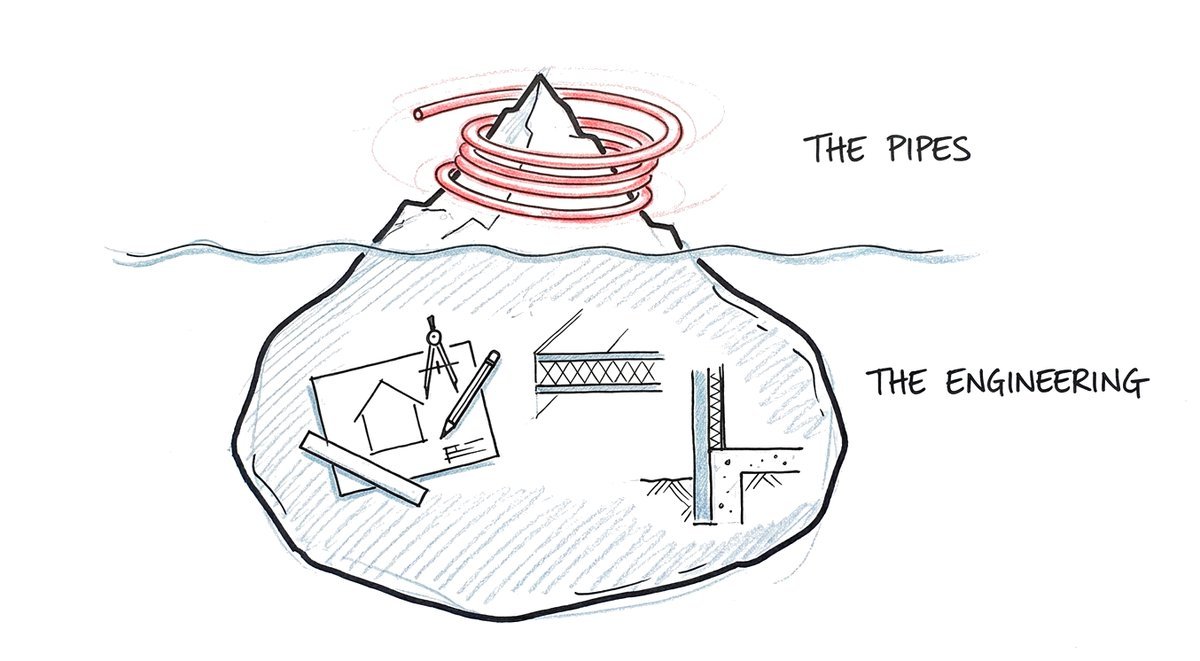
You’ve got two quotes on the kitchen table for the same house, and one is a lot cheaper. It’s tempting to assume the dearer one is padded, or that the cheaper one is a bargain. Sometimes one of those is true. More often the two quotes describe different jobs that happen to use the same words, and the useful thing is to find out where they differ before you choose.
What’s usually missing from the cheaper quote?
Plumbers and other installers do the physical work well: they lay the pipe, connect the manifold, fit the heat pump, put a thermostat on the wall and pressure-test the lot. A standard installation covers those steps. What it often doesn’t cover is the engineering that makes them count, and that work happens at a desk before anyone touches the site, so it’s easy to leave out and hard to notice.
Here are the eight things we’d look for, in writing, in any floor heating quote, ours included. They’re the same eight our Quote Comparison Decoder asks you to tick.
| Ask for it in writing | Why it matters |
|---|---|
| A heat-load calculation for each room | Sizing from floor area alone leaves glassy rooms cold and the heat pump the wrong size |
| The insulation under the slab or screed, with its rating | Without it, much of the heat goes into the ground |
| The thermal break at the slab edge and at any alfresco, garage or pool | A missed edge can push the running cost up to double or triple |
| The heat pump position, with its clearances | Boxed in, it breathes its own cold air and loses up to 50% of its efficiency |
| How the controls are set to the slab’s heat-up time | Otherwise the house is warm at lunchtime instead of breakfast |
| Commissioning and loop-by-loop balancing, with figures | So every room gets its share of the warmth |
| A written performance guarantee | Says who fixes it if a room doesn’t reach temperature |
| The name of the engineer who signs off the design | Someone has to own the numbers |
A quote that includes all eight costs more to prepare and more to build, because most of them are hours of design and site supervision. A quote that leaves them out may simply be pricing a different, smaller job, which is fine as long as you know that’s what you’re buying.
Is the cheaper quote always the worse one?
No, and price on its own tells you surprisingly little. Phil has seen it go wrong both ways: “We’ve seen some systems that have been incredibly cheap and they perform like incredibly cheap systems. And then we’ve seen some incredibly expensive systems which also perform like incredibly cheap systems.” A big price doesn’t buy a good design any more than a small one rules it out.
Some quotes are cheaper for good reasons. On a single-storey home, pipes in a well-insulated slab can cost less than a heated screed on top of it and still work well. A quote with one or two heating zones instead of a thermostat in every room is cheaper, and in our experience usually better, because people with a thermostat in every room end up setting them all the same. The test is whether the difference comes from a sensible design choice or from a step that’s been left out.
Which parts can be cheaper, and which can’t?
The pipe matters less than people think. Most floor heating pipe is made from much the same plastic, and a straight run of it won’t burst on its own. Where pipe systems differ is in the joints, the weak link Phil watches for, so ask what happens if a pipe is ever damaged on site and how it’s repaired.
The heat pump matters more. Our experience is that the cheapest units tend to be the loudest, the least efficient and the shortest-lived, and the difference shows up every winter on the power bill. The insulation, the edge details and the design matter most of all, because they’re poured into the slab. A heat pump can be swapped one day. The floor can’t.
What does a cheap floor cost you later?
A quote is paid once. The running cost is paid every winter you live in the house. On our modelled estimates at Synergy’s July 2026 home rate, a 200 m² floor built right runs at about $240 a winter month, and the same floor built with the pipe in an uninsulated slab and no thermal break runs at about $601. Over twenty winters, that gap comes to about $36,100, and our page on the two builds side by side shows where it comes from.
The bigger cost is that it can’t be fixed. Once the slab is poured, the insulation and the edge details are set for good. Owners of the expensive-to-run version rarely dig it up. They switch it off after the first winter bills.
How to compare two quotes fairly
Put both quotes side by side and ask each installer for the eight items above in writing, even the ones you think are included. Phil’s litmus test is one question: what’s the design water temperature? For floor heating the answer should be around 30 to 35 degrees, and an installer who says 45 or 50, or doesn’t know, is designing it the way it was done decades ago, which costs you more to run on a heat pump.
Then look at their past work, because, as Phil says, “Anybody can say they guarantee it, but the best way to find out is to look at their past jobs.” Ask for a modelled running cost for each option, so you’re comparing what each system will cost to live with as well as what it costs to buy. An installer who has done this work properly will answer all of it within a day or two.
 12 min
Other questions people ask us
Should a quote show what the system will cost to run?
We think so. Working out a running cost needs the same heat-load calculation the design should be based on, so an installer who can’t give you a modelled figure for each option probably hasn’t done that calculation. If one quote covers everything in the table above and costs less, take it seriously.
Can I save money with a cheaper brand of pipe?
A little, and the pipe is rarely where the money is. The joints and the design matter far more than the name on the pipe. Our article on whether the brand matters goes through it.
Is a quote from a plumber good enough?
Plenty of plumbers lay pipe very well. Ask who does the heat-load calculation and who signs off the design, because that’s the part that decides whether your floor ends up nearer the $240 a month or the $601.
Where to go from here
If you’re building in Perth or the south-west and want a second quote to compare, the 5-minute quote gives you your options in writing within 3 working days, each with its price and a modelled running cost, and you don’t need final plans to start. If you already have a quote in front of you, run it through the Quote Comparison Decoder first, and read the mistakes you can’t fix once the slab is poured.