
What’s the best brand of floor heating – and does it matter?
The short answer
There isn’t one, because floor heating isn’t one product. It’s pipe, insulation, a manifold, a heat pump or boiler and controls, put together to a design for your house. The brand matters in two places: the pipe maker’s joints, which end up buried in concrete, and the heat pump, where cheap units tend to be louder, less efficient and shorter-lived. Beyond that, the design decides how warm your house gets and what it costs to run. When a heat pump system disappoints, Phil’s experience is that it’s almost never the manufacturer’s fault.
When you’re about to spend serious money on something you can’t easily replace, asking for the best brand feels like the safe move. It’s how most of us buy a fridge or a car. With floor heating it’s a reasonable place to start and a poor place to stop, because the mistake people are trying to avoid is the one a brand name can’t protect them from.
Why is there no best brand of floor heating?
A floor heating system is a set of parts from different makers: the pipe in the floor, the insulation under it, the manifold that sends water to each room, a heat pump or gas boiler outside, and the thermostats. Nobody makes the best of all of them, and even a complete kit can’t tell you how much heat your living room loses on a July morning. That number comes from a heat-load calculation for your house, and it decides how the pipes are laid, how big the heat pump is and how warm the water has to run.
Phil has watched this play out on rescue jobs. On one in City Beach, the plant room was full of high-quality German equipment and the system had never worked properly. His comment: “you can buy all of the right equipment, the best equipment, say available in the market, but it doesn’t guarantee that you’re going to have a functioning system.”
Does the brand of pipe matter?
Less than you’d think, for the pipe itself. Most floor heating pipes are made from the same kind of plastic, many in the same few factories, and some cost three times as much as others for much the same material. A straight length of any decent one isn’t going to burst. What differs is the joints. If a pipe is ever damaged, it’s repaired with a joint and covered back up with concrete, and the good makers guarantee that joint even buried. Cheaper systems use more basic fittings that might hold for twenty years or might weep in six months.
Because the pipe stays under your tiles for good, we choose the pipe maker for its joints rather than its price. Our article on whether floor heating pipes can leak covers what happens if one is ever hit.
Does the brand of heat pump matter?
Yes, more than the pipe. Heat pumps come in roughly three tiers. At the bottom are units built to a price, often the same machine sold under different badges, and Phil’s experience is that they tend to be loud and inefficient and can be worn out in about five years. Then there’s a middle tier, with names you’d recognise from air conditioners and household appliances, and the premium makers, usually German or Scandinavian. Efficiency, noise and reliability tend to travel together, the way the thirstiest car is often also the noisiest and the one that won’t start first go.
If you’re comparing heat pumps yourself, compare like with like. Makers quote efficiency, the COP (units of heat out for each unit of electricity in), at different test conditions, and a unit tested in 20 degree air will always look better than one tested at 7. Check the figure is at the same air and water temperature (7 degrees outside and 35 degree water is the usual comparison), that it includes the fan and pumps, and that the noise figure says how and where it was measured.
If you’d rather have a gas boiler, we install those too, and the same thinking applies: a maker with a record for reliability, then a design that lets it work well.
Why can a premium heat pump run like a cheap one?
Phil has heard plenty of owners blame the maker of their heat pump, and his view is blunt: “nine times out of 10, or even 9.99 times out of 10, it’s not the manufacturer’s fault. The heat pump is working exactly as it should. It’s the fault of the installation.” Two identical houses with identical heat pumps can run very differently, depending on what’s connected to them.
The usual reason is water temperature. A heat pump makes 30 to 35 degree water easily, and that’s all a well-designed floor needs. If the floor loses too much heat into the slab, or the pipes are laid too far apart, the water has to be pushed up towards 50 or 55 degrees before the house feels warm, and a good heat pump’s efficiency can fall from around 500% at 35 degrees to around 250% at 55.
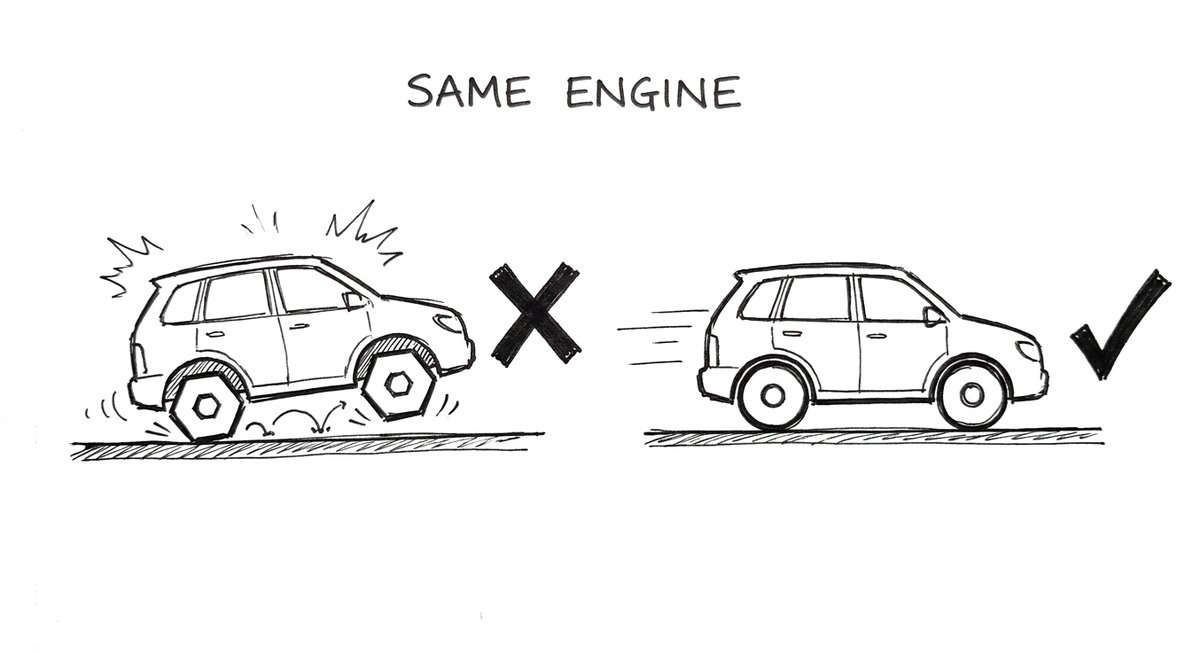
Phil has seen premium European units working no better than the cheap ones, at a COP of about three, because the system around them was wrong. That’s his hexagon wheels: the engine still moves the car, it just works far harder doing it. In his words, “the whole system is only as good as its weakest link.”
 12 min
What should I ask instead of “which brand”?
Ask what the design water temperature is. For a floor, the answer should be around 30 to 35 degrees, and if it’s 45 or 50, or nobody knows, Phil treats that as a red flag. Ask where the heat pump will go and whether it has room to breathe, because a unit boxed into a corner breathes its own cold air and can lose up to half its efficiency. Ask what insulation goes under the whole floor and around the edge, and what the noise figure is.
And ask who you’d call if the house isn’t warm in July. A manufacturer’s warranty covers faults in the machine. It can’t cover a system that makes a perfectly good machine work too hard, and that’s where the problems we’re called out to usually start. One company that designed and built the whole system can answer for all of it, and a pipe supplier, a plumber and a heat pump distributor each can only answer for their part.
Other questions people ask us about brands
Which brands does Euroheat use?
Your quote names the heat pump and the main equipment in each option. We work with makers whose units we know to be efficient, quiet and reliable over years, and whose pipe joints we’d trust under your floor for decades. We don’t rank brands in these articles, because the right unit depends on the house.
Is a European heat pump worth the extra money?
Often, for a quieter unit and a longer life, but only if the system lets it run at low water temperatures. A premium heat pump connected to a badly designed floor can cost as much to run as a cheap one.
Are floor heating kits from an online store any good?
The pipe in a kit may be perfectly good. What no kit can include is the design for your house: the heat-load calculation, the loop layout, the insulation and the water temperature it all has to run at. For one small bathroom, an electric mat is the simple answer, and our comparison of electric and hydronic floor heating explains where each makes sense.
Does the manufacturer’s warranty protect me if the system underperforms?
It covers faults in the machine. A heat pump working exactly as designed, in a system that makes it run too hot, isn’t faulty, so there’s nothing to claim. On systems we design and build, The Comfort Guarantee covers how the whole system performs, which is the part a warranty can’t.
Where to go from here
If you’re building in Perth or the south-west, the 5-minute quote gives you your options in writing within 3 working days, each with its price, a modelled running cost and the heat pump it uses, and you don’t need final plans to start. If you’re comparing quotes you already have, the Quote Comparison Decoder shows what each one includes in writing and what’s missing, which tells you far more than the brand on the box.