
Can floor heating pipes leak, and what happens if they do?
The short answer
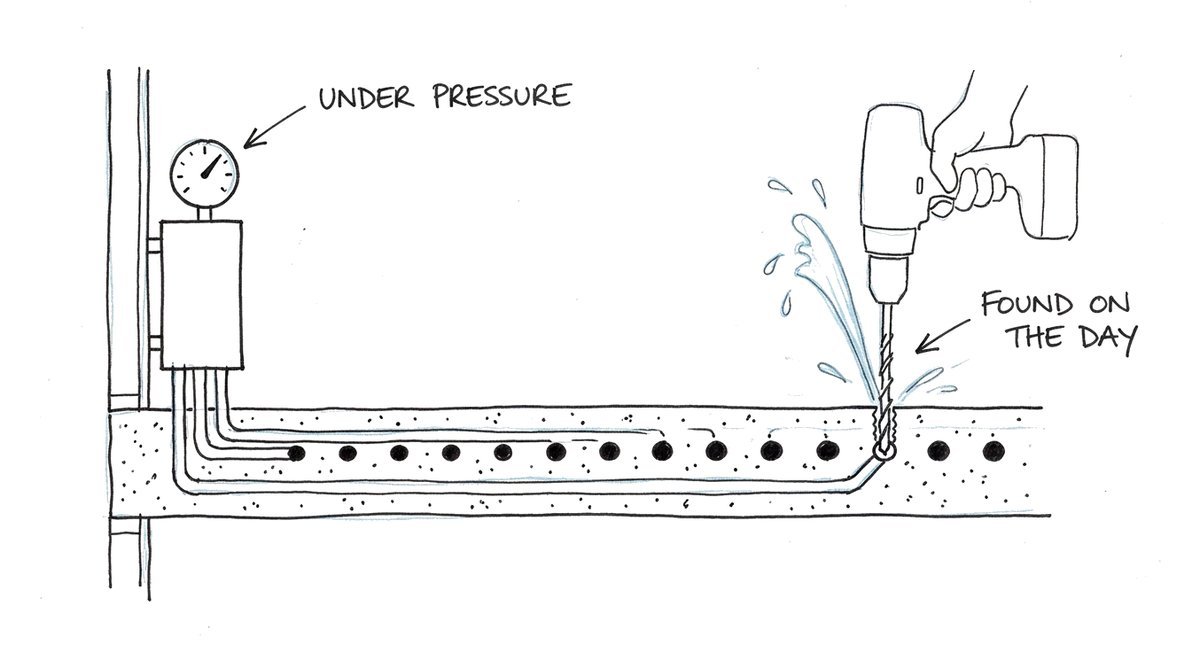
Not on their own. Floor heating pipe is a tough plastic made to be cast into concrete: it doesn’t rust or burst, and at the gentle temperatures a heated floor runs at, it outlasts most houses. A pipe leaks only if something cuts or punctures it, and that almost always means a drill or a saw during the build. That’s why the pipes are pressure-tested before the concrete goes in and kept under pressure while the house goes up: a hit shows as a jet of water on the day, and it’s repaired with a joint the pipe maker guarantees, before the floor covers it.
Water in pipes under the whole floor of a new house is a reasonable thing to feel nervous about. Most of us have lived with a dripping tap or a shower that leaked into the wall, and a leak you can’t see, under tiles you can’t lift, sounds like the worst version of that. It’s one of the questions we’re asked most, and the honest answer is more reassuring than people expect.
Why the pipe itself doesn’t fail
Floor heating pipe has nothing in common with old copper or galvanised plumbing. It’s a flexible plastic pipe made for being buried in concrete, laid in loops of up to about 100 metres that run from the manifold (the box where every loop starts and ends) out under the floor and back again. The water in it is warm rather than hot, around 25 to 40 degrees, and it’s the same water going round a sealed loop for years, kept apart from the water in your taps. The pipe is rated for 50 years under its standard’s test conditions, and at floor-heating temperatures it will outlast most houses.
Phil’s view, after years of looking at other people’s systems, is that the pipe is the last thing to worry about: “if you got a straight bit of pipe it’s not going to just burst and pop a leak or crack or anything like that.” The weak spot in any piping system is where two pieces are joined. In his words, “the weakest link for pipes is usually the jointing systems”, and that’s why we choose a pipe maker for the quality of its joints rather than its pipe. Most floor heating pipes are much alike, many from the same few factories. The joints are where they differ.
When pipes do get damaged: during the build
The real risk is the months between the pipes going down and the house being finished. A lot of trades work on and around that slab. Someone drills in to fix a wall frame, a plumber cuts a trench for a waste pipe, a peg goes in where nobody expected. On a building site, accidents like that happen now and then, and the pipe can’t get out of the way.
So the sequence on a Perth slab is built around catching it. The builder prepares the sand pad, we lay the insulation, the builder covers it with plastic and the reinforcing mesh, and we clip the pipes to the mesh. Then the whole floor is pressure-tested and certified before a drop of concrete is poured, and the pipes stay under pressure while the house goes up. A pipe that gets hit squirts water straight away, so it’s found on the day by the person who hit it. Nobody finds it five years later as a damp patch.
How a damaged pipe is repaired
A cut pipe gets repaired, and the repair is a small job. The concrete is opened up around the damage, the pipe is cleaned, a joint goes in, the loop is tested again and the hole is filled. Good pipe makers guarantee that joint even when it’s buried back in concrete, which is the whole reason the joint quality matters so much.
Cheaper pipe tends to come with a more basic joint. Phil’s experience is that it might hold for twenty years, or it might start weeping after six months, and nobody can tell you which on the day it goes in. Nobody wants a wet patch on the ceiling under an upstairs floor five years after moving in, so we’d rather not take the risk with your house.
 5 min
After you move in: the one thing to watch
Once the floor is finished, the pipes sit under the tiles and nothing touches them. The one thing that can is a drill. If you ever need to fix something into the floor, such as a door stop, a bolted-down kitchen island or a new toilet, look at the pipe layout first. Keep that drawing with your house papers, the way you’d keep the plans. And with the heating running, a thermal camera shows the loops as warm lines on the floor, so whoever is drilling can see exactly where not to.
If something did ever go wrong years later, you wouldn’t find out from a wet floor. A sealed heating loop shows it on the pressure gauge first, as a slow drop, and the service check about every two years is there to catch a pressure drop before it matters. The joints in a system are at the manifold and around the heat pump, where they can be reached, so that’s where anyone sensible looks first. A pipe deep in the slab is the last place to look.
Other questions people ask us about leaks
Can underfloor heating pipes burst?
Not on their own. Water pipes burst when the water inside them freezes or when they’ve been damaged. The water in a slab under a lived-in Perth house doesn’t freeze, and floor heating pipe is made to take the warmth and pressure of a heating system for decades. What can happen is a drill or a saw going through one, which is why the pipes stay under pressure during the build.
Will the pipes need replacing in 20 or 30 years?
No. At floor-heating temperatures the pipe will outlast most houses. The part that wears out over time is the heat pump outside, which gets replaced one day like any other appliance, and connects to the same pipes. Our article on how long hydronic heating lasts goes through each part.
Who pays if another trade damages a pipe during the build?
That’s settled between the builder and the installer, and it’s far easier to settle when the damage is found on the day. Builders and their trades can read who does what, before and after the pour, in who is responsible if a pipe is damaged.
Is cheap pipe from an online store just as good?
The plastic might be. What you can’t see is the joint system and whether the maker will stand behind a repair under concrete, and those are the parts that matter here. Our article on which pipe is used for floor heating explains what to look for.
Where to go from here
If you’re building in Perth or the south-west, the 5-minute quote gives you your options in writing within 3 working days, each with its price and a modelled running cost, and you don’t need final plans to start. If you’d like to read more first, our questions answered page covers warranties, maintenance and what happens on site, and the free guide to the five floor heating mistakes shows the ones that can’t be fixed once the slab is poured.