
Who is responsible if a floor heating pipe is damaged in the pour?
The short answer
Whoever the contracts say, and we won’t pretend to give legal advice on that. What a builder can control is how much argument there is. When the pipes are pressure-tested and certified before the pour and kept under pressure through it, damage shows on the gauge the moment it happens, so everyone knows when and where, and it’s repaired straight away with nothing built over it. Add a pipe layout signed off in writing before the truck is booked, and one company that designed, laid and tested the system, and most of the “whose fault” question goes away.
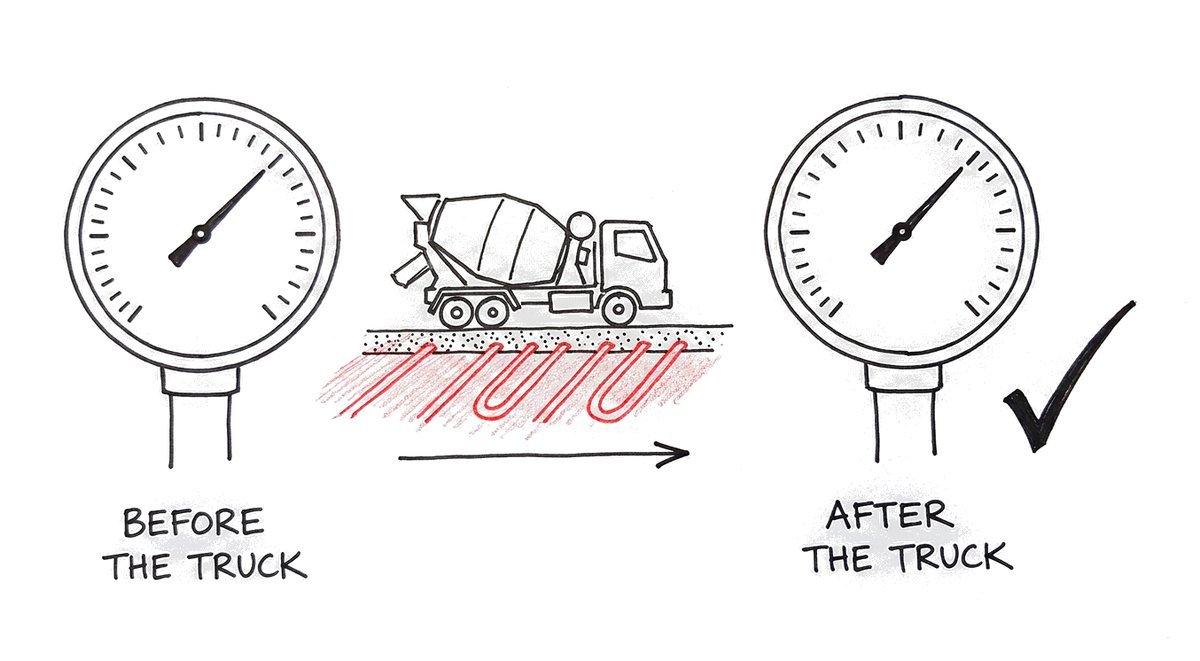
It’s a fair thing for a builder to ask before agreeing to a heated slab. A pour is a busy morning with a truck on a deadline, and pipe hidden under the concrete looks like a liability nobody can see. The honest answer has two parts: what the contracts say, and what the job does so nobody has to lean on them.
How does a pipe get damaged in a pour?
Floor heating pipe is a tough plastic made to be cast into concrete, and it doesn’t burst or crack by itself. It gets damaged the way anything on a site does, when something sharp or heavy meets it. Now and then that happens during a pour. It can also happen months later, when another trade drills, cores or pegs into the floor without checking where the pipes run.
The gauge that settles the argument
On our jobs the pipes are pressure-tested and certified before the concrete arrives, and the layout is photographed and signed off in writing before the builder books the truck. A verbal OK on the day doesn’t count. Then the system stays under pressure through the pour and while the slab cures. If anything nicks a pipe, the pressure drops and water shows at the spot at once, and the site rule is simple: if the gauge drops during the pour, tell us straight away.
That’s what takes the heat out of the responsibility question. Damage found at the pour has a time and a place, so nobody spends two winters arguing over whether it happened on lay day, at the pour or when the kitchen island was fixed down. And a cut pipe found on the day is a small job: the pipe is cleaned, a joint goes in that the pipe maker guarantees even buried in concrete, the loop is tested again and the work carries on.
Who does what before the truck arrives?
Responsibility gets easy when the jobs are written down. The builder prepares the sand pad and lays the plastic and mesh, with the mesh set high enough that the pipe clipped to it ends up with proper concrete cover. We lay the pipe to the design, test and certify it, and sign it off. The builder books the truck after that sign-off, makes sure every trade knows there’s pipe in the slab, and keeps drills and penetrations away from the pipework. Once the slab is down, the as-installed layout tells later trades where not to drill.
Who pays for a repair is whatever your contract with the heating installer and your contracts with your own trades say. Read those clauses before the pour rather than after, and if they’re silent, agree it in writing.
Why does one company owning the system make it simpler?
A nicked pipe on the day is the small version of the problem. The big version is a system that never quite works, two winters after handover, with nothing broken to point at. When the design, the floor, the hot water and the heat pump come from different trades, each can be right about their own part and the system still underperforms.
Phil saw exactly that at a beach house in Eagle Bay. An engineer designed the system, one plumber did the floor heating, another did the hot water and another company put in the heat pump. It only half worked, and in Phil’s words, “basically everyone was just pointing fingers but nobody really knew how it all works.” We sent an engineer, a technician and an electrician, and it was running as it should that day.
 3 min
3 min
On a system we design and build, the performance risk sits with us. That’s The Comfort Guarantee: every room reaches its designed temperature, or we fix it at our cost. It applies only to systems we design and build, because a guarantee is only worth something from the people who did the calculations.
Other questions builders ask us
Can a pipe damaged in the slab be repaired?
Yes. The concrete is opened around the damage, a joint goes in, the loop is retested and the hole is filled. Good pipe makers guarantee that joint even under concrete.
What if a pipe is hit after handover?
A sealed heating loop shows it first as a slow pressure drop at the manifold, which the regular service check picks up. The as-installed layout, and a thermal camera with the heating on, show where the pipe runs. Our article on whether floor heating pipes can leak covers it.
Does the heated slab hold up the pour?
No, as long as the specification is settled early. The pipes go in over a few days before the pour, and the truck is booked once the layout is signed off.
Where to go from here
If you have a job with floor heating on it in Perth or the south-west, send it through the 5-minute quote: options in writing within 3 working days, each with its price and a modelled running cost, at the same price as anyone. The free builder pack on our page for builders has the stage-by-stage questions, and what happens on site walks through each visit.