
Which pipe is used for floor heating, and does the choice matter?
The short answer
Almost every heated floor laid today uses plastic pipe, either cross-linked polyethylene (PEX) or PE-RT, usually 16 mm across with an oxygen barrier in its wall. That’s what goes into our floors too. Between reputable makers the pipe itself differs less than people think: it’s rated for 50 years under its standard’s test conditions, and at floor heating temperatures it will outlast most houses. What matters far more is the joins, how long each loop is, how closely the runs are laid, and whether the floor was designed around them.
The question usually comes after an evening of reading product pages, and with a slight worry behind it. Once the screed goes over the top, the pipe is there for the life of the house, so it feels like a choice you only get one go at. It is, but the plastic is the easy part of it. Here’s what goes into a heated floor, and where the real differences are.
What pipe goes into a heated floor?
PEX is polyethylene whose long molecules have been cross-linked, tied to each other, so it keeps its strength when it’s warm for decades. PE-RT is polyethylene made to cope with raised temperatures without that cross-linking. Both are proper heating pipes made and tested to their own standards, and both come in long rolls, so each loop can go down as one unbroken length. You’ll also come across multilayer pipe, plastic with a thin layer of aluminium in the middle, which holds whatever shape it’s bent into.
The oxygen barrier is a thin layer inside the pipe wall, and it’s worth asking about. Plain plastic lets a tiny amount of oxygen seep through into the water. That matters because many parts of a hydronic system are mild steel inside, including the pumps, the expansion vessel and any radiators, and oxygen in the water rusts them. Phil’s point is that with the air kept out of the system, and the water treated, those steel parts last 30 years or more.
Copper had its day in floors, and you’ll still find it carrying water to radiators in older homes, like the 1895 house in Fremantle where Phil filmed the copper running to each panel. New heated floors use plastic instead, mainly because it comes off the roll in lengths long enough for a whole loop.
Does the brand of pipe matter?
Less than the price tags suggest. Phil’s experience is that most floor heating pipe is made from the same kind of plastic, some of it in the same factories, and the pipes are almost as good as each other. Yet some cost three times as much as others. A straight length of good pipe doesn’t burst or crack by itself, so the plastic isn’t where the extra money goes.
Where it goes is the joins. In Phil’s words, “the weakest link for pipes is usually the jointing systems.” If a pipe gets cut on site, a good maker’s joint can be fitted, covered back over with concrete and still be guaranteed by the manufacturer.
A cheaper pipe with a basic joint might hold for twenty years, or it might weep after six months, and nobody wants a damp patch showing up in a ceiling five years later. That’s why we choose a pipe maker on the quality of its joins rather than on the pipe itself. We go further into brands in does the brand of floor heating matter.
 5 min
What matters more than the pipe?
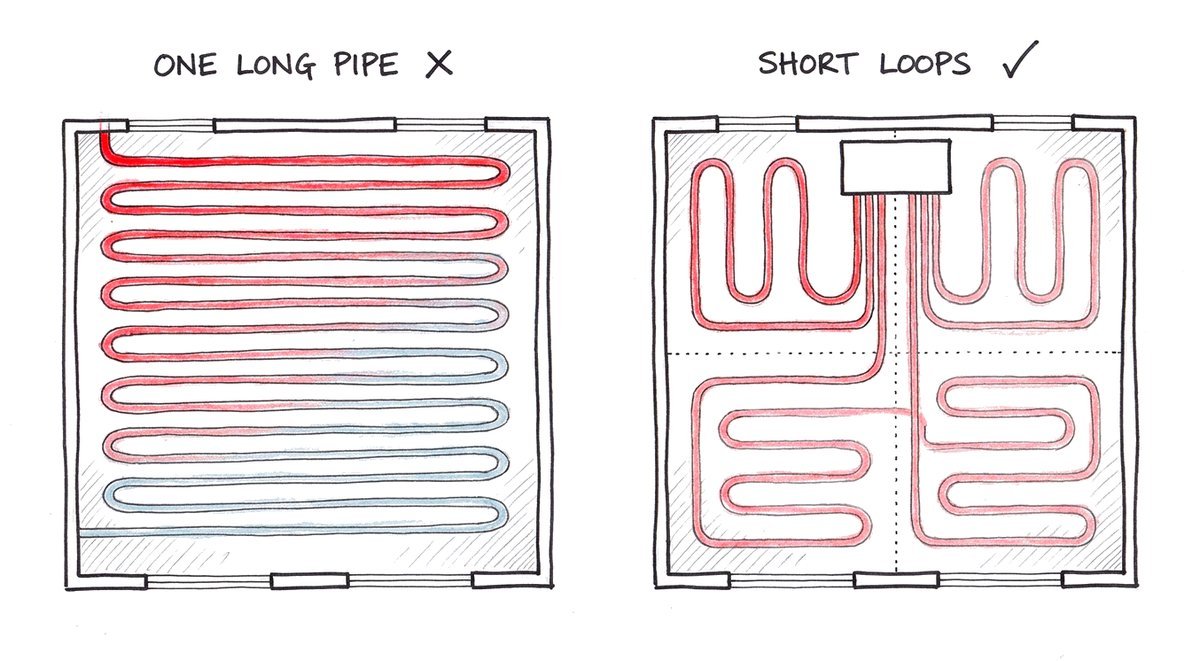
How it’s laid. Picture one very long pipe snaking through every room. The water gives up its heat as it goes, so by the far end it’s barely warm, and the pump has to be big and power-hungry to push water through that much pipe.
That’s why a floor is split into loops, each starting and finishing at the manifold, the box on the wall where every loop is joined. Phil keeps each loop to 100 metres at most, short enough for a small pump, and sets the water to come back only a few degrees cooler than it left, 37 out and 30 back in his example, so the whole floor is evenly warm with no cold patches.
The spacing matters as well. In our floors the runs are typically 200 mm apart, closer in bathrooms where a little more heat is wanted. And none of it works without what’s under the pipe: insulation below the heated layer, so the warmth goes up into the room instead of down into the ground, which we cover in does floor heating need insulation under the slab. Two floors can use exactly the same pipe and run very differently on the bill. The pipe is the cheap part.
Can the pipe leak, and how long does it last?
In the floor, a pipe leaks when something cuts or punctures it, usually a drill or a nail from another trade during the build. That’s why the loops are pressure-tested and then kept under pressure until the floor is finished: if someone hits one, water squirts out at once and it’s repaired then and there. Our article on whether floor heating pipes can leak covers what happens if one does.
As for age, the pipe is rated for 50 years under its standard’s test conditions, and a floor running on lukewarm water gives it an easy life. It will outlast the heat pump, and most houses. How long the rest of the system lasts is in how long hydronic heating lasts.
Other questions people ask us
Is PEX or PE-RT better for floor heating?
For a floor running on water at 30 to 35 degrees, either is fine as long as it’s a proper heating pipe with an oxygen barrier from a maker that stands behind its joins. We’d pick the maker before the material.
Is copper better for underfloor heating?
Copper carries heat well, but in a floor the pipe sits inside a screed or slab that spreads the heat anyway, so that advantage mostly disappears. Plastic comes in long enough rolls for whole loops, which is why new floors use it.
Can I lay the pipe myself to save money?
Laying pipe is the physical part, and plenty of people can do it. The running cost is decided before that, in the loop layout, the spacing, the insulation and the heat pump, and that’s the part a cheap job skips. If you have a quote in hand, the Quote Comparison Decoder shows which of those it covers.
Where to go from here
If you’re building in Perth or the south-west, the 5-minute quote gives you your options in writing within 3 working days, each with its price and a modelled running cost, and you don’t need final plans to start. If you’re still finding your feet, floor heating, explained walks through how the whole system fits together in a few minutes.