
How much do radiators cost to install in a Perth home?
The short answer
As a ballpark, a radiator system in Western Australia starts from around $3,500 per panel fully installed on a gas boiler, or around $7,500 per panel on a heat pump. That’s a general figure, not a quote: the real number moves with how many rooms you heat, how the pipes reach them, the panels you choose and the heat source. The heat pump costs more to put in and, in Perth, usually less to run. Installing takes about a day per radiator, and the 5-minute quote gives you your own figures in writing within 3 working days.
Price is usually the first thing people want to know about central heating radiators, and the hardest thing to find a straight answer to. Most pages either won’t give a number or quote the price of a single radiator from a hardware shop, which tells you nothing about heating a house. Phil doesn’t dress it up. On camera, his answer to what a radiator system costs starts with “to be honest it’s not cheap”, and if your budget is tight, he points you to reverse-cycle air conditioning as the cheaper thing to install. Here’s our ballpark, what moves it, and what a radiator system costs to run.
What’s in the price of each radiator?
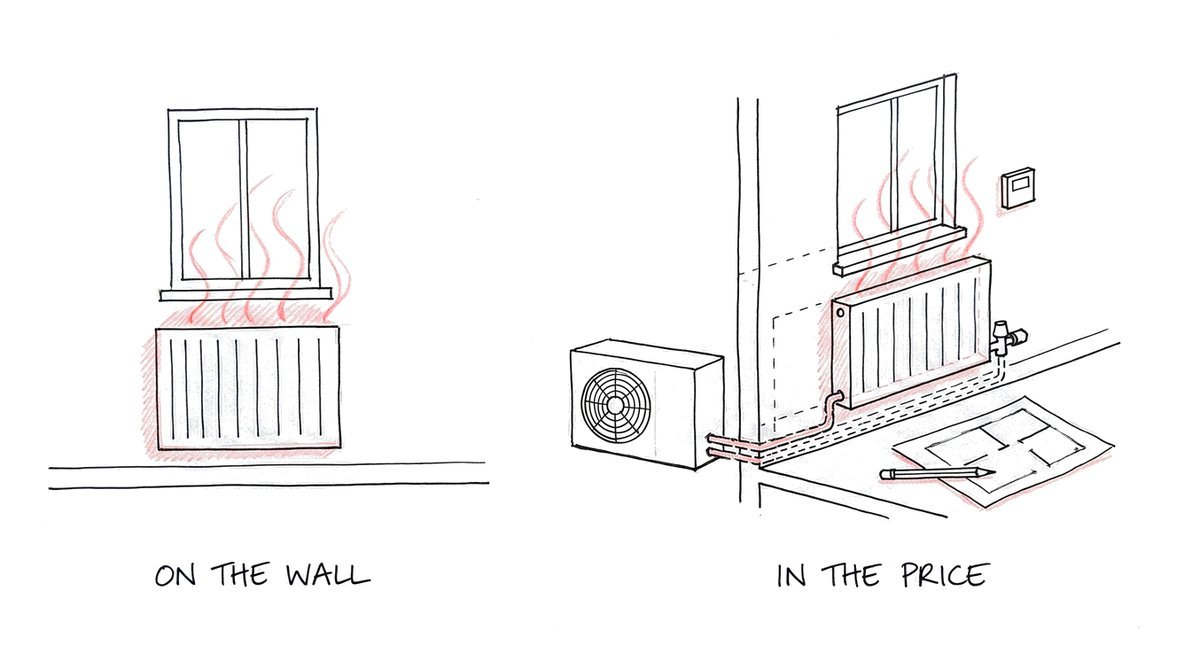
We give the figure per panel because the number of rooms you heat is the biggest single thing that moves the total. It’s “fully installed” because the radiator itself is a small part of the bill. Behind each panel there’s a share of the heat source that makes the warm water, insulated pipes running to every room, valves and controls, the labour to fit it all and commission it, and the design work that sizes each panel for its room.
Spread across the panels, that’s why the per-panel price is so much more than a radiator costs in a shop, and why it’s the honest way to quote. A house with more rooms needs more panels, so the total climbs with the size of the house and the number of rooms you want warm.
Why is a heat pump system dearer than gas?
Because the heat pump costs much more to buy and fit than a wall-hung gas boiler. Gas boilers are mass-produced and compact, and they cost less to put in.
We install both. On running cost a heat pump usually comes out ahead in Perth, which is why it’s what we suggest first, and if you’d rather have gas we’ll design and install a condensing boiler. If you already have a gas boiler in good order, the radiators can run from it, and your quote shows that option too, without the cost of a new heat source. Our article on radiators on a heat pump explains what changes in the design.
What else moves the price?
After the heat source, the biggest variable is how the pipes get from it to each room. Under a raised timber floor or through the roof space is the easy case. Running them along outside walls under a capping, or underground in a watertight sleeve, costs more. Then there’s the radiators you choose and the house itself:
| What | Usually costs less | Usually costs more |
|---|---|---|
| Heat source | Your existing boiler, or a new gas boiler | A new heat pump |
| Pipe route | Under a raised timber floor, or through the roof space | Along outside walls, or underground |
| Radiators | Standard steel panels | Vertical, column, cast iron or designer |
| The house | Insulated ceiling, sealed vents, ordinary windows | High ceilings, lots of glass, draughts |
| Power and gas | Switchboard with room for a new circuit | Switchboard upgrade, or new gas pipework |
The radiator style can move the price a long way. In Phil’s experience a cast-iron radiator might cost double a standard panel, and designer radiators can cost ten times as much. The house matters because a room with a wall of glass or a high ceiling loses more heat, so it needs a bigger panel and the heat pump has to be bigger too. That’s also why topping up the ceiling insulation and sealing the old wall vents before the heating goes in can make the whole job smaller.
What does it cost to run?
We won’t print a running cost for your radiators without your house in front of us, because any number would be a guess. What we can show is the arithmetic underneath. At Synergy’s home rate from 1 July 2026, 33.26 cents a kilowatt-hour, a plug-in electric heater turns each unit of electricity into one unit of heat. A heat pump turns the same unit into three to four units of heat, nearer three on a cold morning, so the same warmth costs a third to a quarter as much.
That’s why, designed right, radiators on a heat pump run in the same league as a good reverse-cycle system, without the blown air, and for a fraction of what plug-in heaters cost for the same warmth. Your quote shows a modelled running cost for each option, for a winter month and over twenty winters, worked out for your house and labelled as the modelled estimate it is.
How do I compare radiator quotes?
Two quotes for the same number of radiators can be far apart, and often the cheaper one skipped the sum. Radiators sized off a chart, square metres in and panel size out, look fine in May. The first cold week of July finds out the rooms with big windows, and the usual fix, turning the water hotter, makes a heat pump expensive to run. Phil says we get calls almost every week about radiator systems that don’t work as they should.
So ask each quote two things. Was every room’s heat loss calculated, from its glass, its orientation, its ceiling height and its insulation? And what water temperature is the system designed to run at? On a heat pump the answer should be around 45 to 55 degrees, and seventy means nobody designed it for a heat pump. The Quote Comparison Decoder helps you line two quotes up side by side.
Other questions people ask us
How long does installation take?
About a day per radiator, so a house with five radiators is about five working days, and on a bigger house more installers can work at once. You don’t move out; the installers move any furniture they need to, put it back and clean up each day.
How much is central heating to install for a whole house?
For radiators, a rough guide is the per-panel ballpark above times the number of panels. Most bedrooms need one, and an open-plan living, kitchen and dining area usually needs two or three. It’s a guide, not a quote, and the heat source you choose moves it most.
Do I have to pay for a design before I get a price?
No. The 5-minute quote is free and gives you prices. If you’d like the full room-by-room design before you decide, The Warm Home Plan is $490, 100% credited to your installation, and it’s optional: every room’s heat load calculated, each panel sized and placed, the heat pump sized and sited, and your running cost modelled.
Is a split system cheaper?
To install, yes. If you only need one room warm, a split system or even a plug-in heater is the cheaper answer. Radiators earn their place when you want the whole house evenly warm, quietly, without blown air. We compare the two in radiators or split systems.
Where to go from here
If you’re in Perth or the south-west, the 5-minute quote shows your options in writing within 3 working days, each with its price and a modelled running cost, and you don’t need plans to start. Tell us how many rooms you’d like warm and how the house is heated now. If you’d rather understand the design first, the free radiator guide explains how each room is sized, and The Warm Home Plan page sets out what the full assessment includes.