
Can radiators run on a heat pump?
The short answer
Yes, and most radiator systems we install now run on an air-to-water heat pump. What changes is the water: a heat pump is at its best making warm water, around 45 to 55 degrees, where a gas boiler can run at 70 or more, so every radiator has to be sized to heat its room with warm water. Sized that way, a good heat pump gives three to four units of heat for each unit of electricity, nearer three on a cold morning. A geothermal (ground-source) heat pump runs radiators the same way, though in Perth the drilling rarely pays for itself.
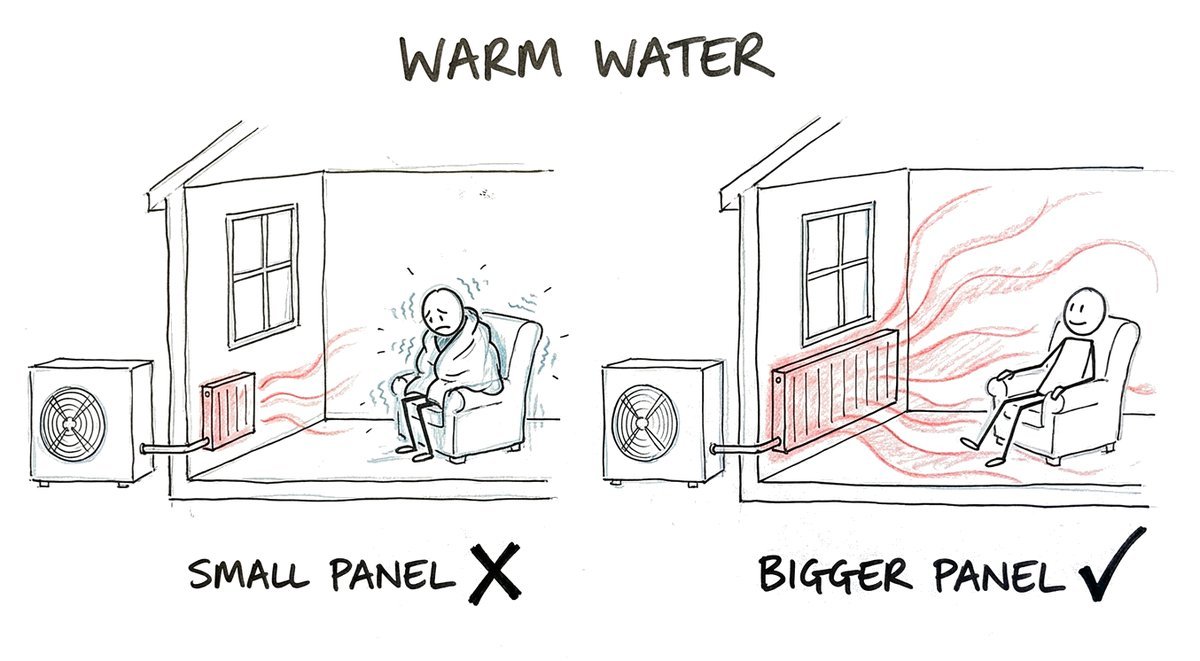
Most people who ask us this have either lived with radiators in Europe or the UK, where a gas boiler ran them, or have read somewhere that radiators need hot water and heat pumps can’t make it. Both have a grain of truth in them. A heat pump runs radiators very well, as long as the radiators were chosen for it, and that one condition is what this page is about.
Why does it matter what heats the water?
A radiator is a sealed steel panel full of water. Warm water flows in, the panel passes its heat to the room, and slightly cooler water flows back to be warmed again, round and round. What heats that water is up to you: a gas boiler on a wall, an air-to-water heat pump outside, or a ground-source heat pump connected to bores. The radiators can’t tell the difference.
The heat source can, though. For a gas boiler, making water at 45 degrees or at 70 makes only a small difference to its efficiency. A heat pump collects heat from the outside air and lifts it to the temperature you ask for, and the higher you ask, the harder it works.
Phil puts it simply: “it’s much easier for the heat pump to produce 30 or 35° water than it is 50 or 55° water.” For a good heat pump that can be the difference between about 500% efficiency at 35 degrees and about 250% at 55, which means twice the electricity for the same warmth.
That’s why radiators on a heat pump are designed to run on water as cool as each room allows. Ours are designed around 45 to 55 degrees, and the controls watch the temperature outside as well as inside, so on a milder day they send the water round cooler still, because the house needs less.
Why the radiators have to be bigger
A radiator’s output depends on how warm its water is. Fill a panel with 70 degree water and it pours heat into the room. Fill the same panel with 45 degree water and it gives noticeably less. So a room that needs a certain amount of heat on a cold July morning gets a bigger panel on a heat pump than it would on a boiler, or a deeper one with steel fins behind the front face to give the warm water more surface to work with.
This is where radiator systems on heat pumps go wrong. Size the panels as if a boiler were feeding them and the house feels fine through May. The first cold week of July finds them out, and the usual fix is to turn the water temperature up. The rooms get warm, and the heat pump loses the efficiency you bought it for.
Before you sign anything, Phil suggests asking one question: “What is the design temperature of the system water?” On a heat-pump quote, an answer of 65 or 70 degrees tells you nobody designed it for a heat pump. Our article on sizing a radiator for each room goes through how the sum is done.
Can my old radiators go on a heat pump?
Often, yes, with a room-by-room check first. Radiators from an old gas system were chosen for hotter water, so on a heat pump each one gives less heat than it used to. Rooms where the old panel was generous will still be fine. Rooms where it was only just big enough will need a bigger panel or a second one.
One owner who wrote up his own switch for Renew magazine found that his existing radiators “performed quite acceptably, just with a slower response” once the water ran at 55 degrees. That’s a fair picture of panels that weren’t sized for a heat pump: warm in the end, slower to get there. The heat-loss sum for each room tells you which ones can stay and which need help.
What about geothermal?
A geothermal system is a heat pump that collects its heat from the ground, through buried pipe, instead of from the air. It feeds radiators exactly the same way, and the same sizing rules apply. The ground a few metres down in Perth sits at around 15 to 20 degrees all year, much warmer than a 5 degree July morning, so the heat pump has less work to do, and like any heat pump it does best on the coolest water the rooms allow.
The trouble is the price of reaching that ground. On our Perth projects the bores or trenches have run, indicatively, from about $30,000 to $150,000, and a good air-source heat pump already does well in our mild winters, so the saving has a lot to earn back. We go through when it does pay, and when it never will, in what geothermal costs.
Heat pump or gas boiler for radiators?
We install both, and radiators work happily on either. On running cost a heat pump usually comes out ahead in Perth, so it’s what we suggest first. A gas boiler costs less to put in, and it makes sense where there’s no room outside for a heat pump to breathe, because a wall-hung boiler takes very little space. If you’d rather have gas, we’ll design and install a condensing boiler, the efficient kind, and if you already have a boiler in good order, the radiators can run from that. Your quote shows the options side by side.
Other questions people ask us
Will radiators on a heat pump feel warm enough?
Yes, if each panel is sized for its room. Radiant warmth also lets you sit comfortably at a lower setting. In the 1895 Fremantle house where Phil filmed his radiator videos, the owner sets the heating to 19 degrees, and Phil’s verdict on the day was “you might think that’s cold, but it’s perfectly warm.”
Can the same heat pump make my hot water?
It can, but Phil’s usual advice is to keep the hot water separate unless you’re really short of space, because two separate units usually work out simpler and cheaper. Our article on one heat pump for heating and hot water explains why.
Where does the heat pump go?
Outside, somewhere it can breathe. It pulls its heat out of the air, so it needs fresh air around it. Boxed into a tight corner it breathes its own chilled air and can lose up to 50% of its efficiency, which is why we decide where it goes on paper before anything is ordered.
Will my solar panels run it?
They help. On a sunny winter day the heat pump can be set to use what the roof is making. Radiators do most of their work early in the morning and in the evening, though, when the panels make little or nothing, so solar lowers the bill without carrying it.
Where to go from here
If you’re in Perth or the south-west, the 5-minute quote shows your options in writing within 3 working days, each with its price and a modelled running cost, and you don’t need plans to start. If you already have radiators or a boiler, say so in your notes and we’ll look at what can stay. If you’d rather read first, the free radiator guide explains how a radiator system is sized room by room, and heating an existing home has the short version.