
Radiators or split systems: which is better for heating an older home?
The short answer
For one room, a split system is hard to beat: it’s cheap to install, warms the room quickly and cools it in summer. Radiators cost more to put in, but they warm every room with warm water and no blown air. In an older home with high ceilings and vents, warm air from a split rises and much of it escapes, while a radiator warms the people and the room directly. On a heat pump, radiators run in the same league as a good reverse-cycle system. If one room is the problem, buy a split. If the whole house is cold all winter, radiators are the better answer.
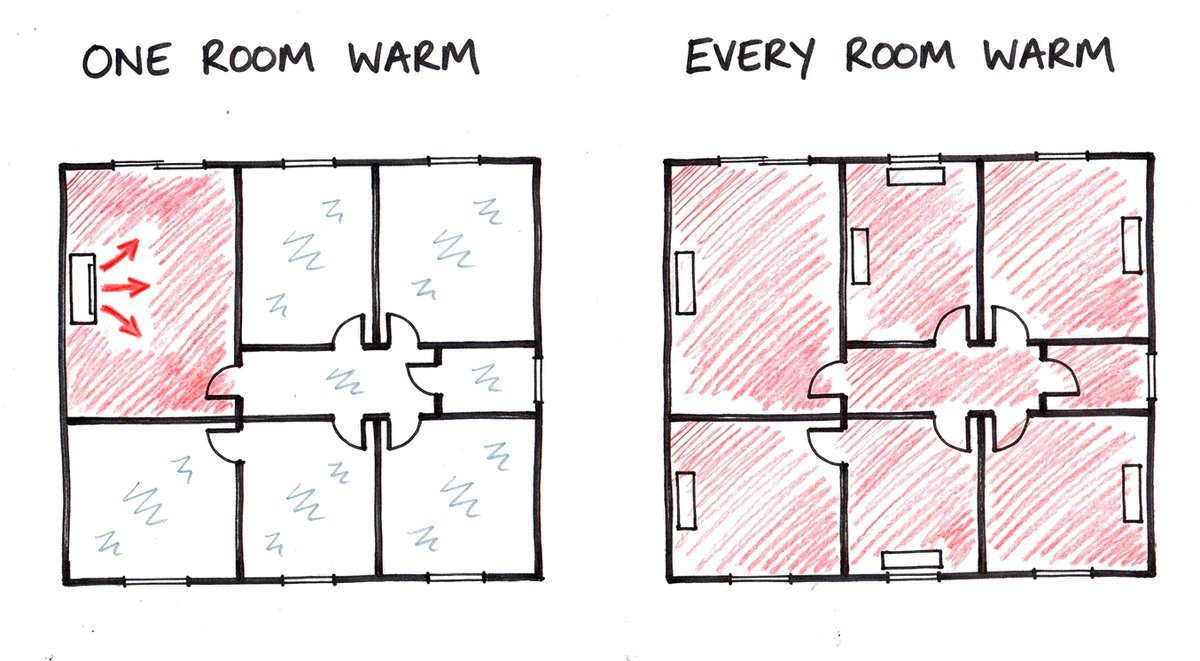
In a lot of older Perth homes winter runs the same way. There’s a split system in the living room, everyone ends up in there, and the doors to the rest of the house stay shut. The bedrooms are cold, the bathroom is colder, and the split works hard all evening without the room ever feeling quite right. When people ask us about a “wall-mounted heating unit”, this is usually the unit they mean, and the real question is whether there’s a better way to warm the whole house, which usually means central heating with radiators.
What a split system does well
A split system is a reverse-cycle air conditioner: a fan unit on the wall inside and a compressor outside. It’s a heat pump, so it turns each unit of electricity into several units of heat, and it does the cooling a Perth summer needs. It’s also the cheapest way to put real heat into a room. Phil says so himself: “It’s cheaper to put in reverse cycle air conditioning if you’re on a budget, that’s the best way to go.”
So if your problem is one living room on cold evenings, a split system is a sensible buy, and we’d tell you to get one. If the problem is one cold room for six weeks a year, even a plug-in heater from the hardware shop may be the cheaper answer. Radiators earn their place when the whole house is cold, room after room, through the whole winter.
Why an older house fights blown warm air
Federation cottages, 1920s and 30s bungalows and many older Perth homes were built for summer. High ceilings let the hot air collect above your head, and vents high in the walls and ceilings let it escape. In February that’s clever building. In July those same features carry away the warm air a split system makes. Warm air rises, gathers under the ceiling and leaks into the roof, so you sit on the couch in a cold layer while the warm air sits above you.
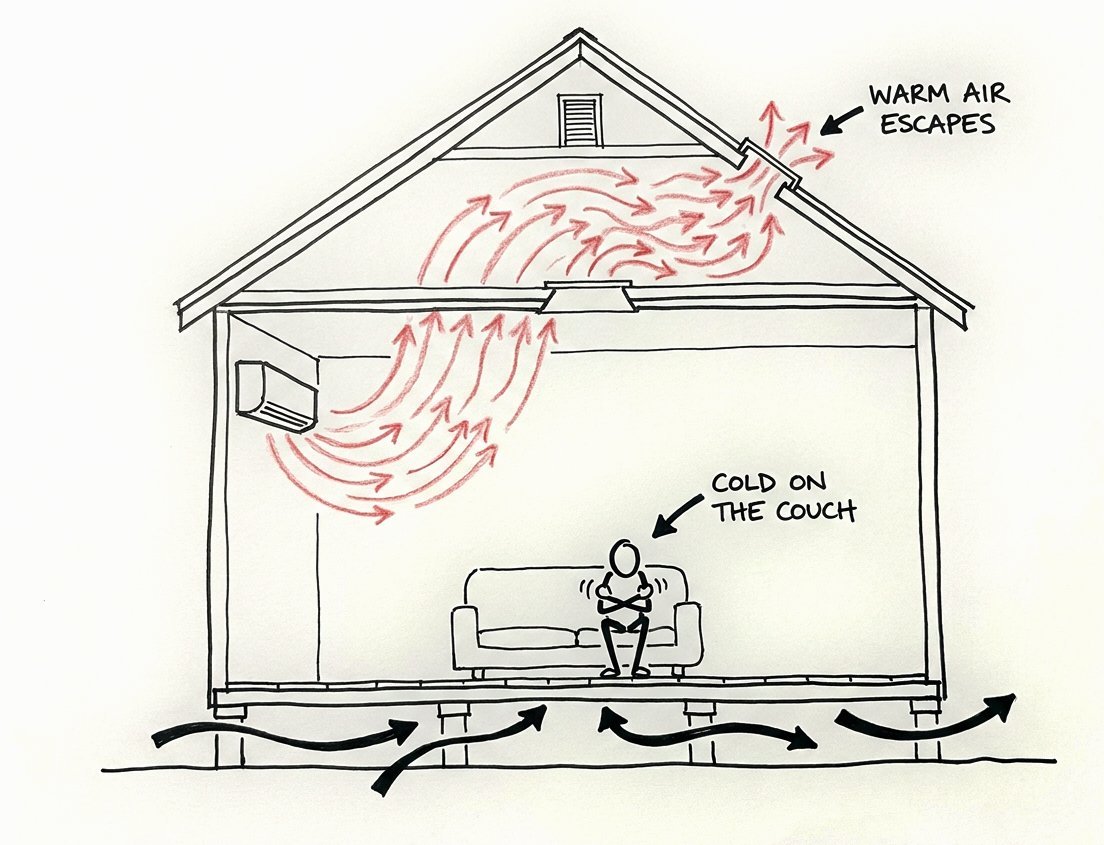
Phil points to a second problem. A wall unit blows its warm air in up high and draws air back in up high too, so a good share of the warmest air just goes round in a loop near the ceiling. And because only the air is warm, the walls, floor and furniture stay cold, and your body keeps losing heat to them. That’s the strange feeling everyone with a split system knows. As Phil puts it: “It says 25 or even 28° on the room temperature controller, but you’re still cold.”
How radiators heat differently
Most of Europe has heated its homes with radiators for about a hundred years. A heat pump or boiler warms water, the water runs through insulated pipes to a slim panel in each room, and the panel warms the room without a fan. Much of its heat travels the way winter sunshine does. Step out of the shade on a cold, still day and you feel warm at once, even though the air hasn’t changed. More than half the heat your body trades with a room goes by radiation, so that’s the warmth you notice.
Because a radiator warms the walls, floor and furniture as well as you, the room feels warm at a lower setting. Filming in an 1895 Fremantle house we heat with radiators, Phil pointed out how low the thermostat sits: “The owner sets the heating to 19°. Now, you might think that’s cold, but it’s perfectly warm.” Radiators have no moving parts, so they’re silent, and there’s no warm draught drying your eyes or keeping the dust moving. We’re engineers, not doctors, so we won’t promise anything for anyone’s health, but people who switch often mention the quiet first.
 6 min
6 min
What each costs to put in and to run
A split system is much cheaper to install, and we won’t pretend otherwise. A radiator system is a bigger job: a heat source, insulated pipes to every room and a panel in each. As a general figure, not a quote, a radiator system in Western Australia starts at around $3,500 per panel fully installed on a gas boiler, or around $7,500 per panel on a heat pump. The real number depends on the number of rooms, how the pipes can be run and the heat source you choose.
We install both heat pumps and gas boilers; on running cost a heat pump usually comes out ahead in Perth, so it’s what we suggest first. Against a split system, the running cost is closer than most people expect, because a split and a radiator system on a heat pump both get several units of heat from each unit of electricity. Designed properly, radiators run in the same league as a good reverse-cycle system.
Where the radiators come out ahead is in what you get for that money: every room warm, no blown air, and a house that holds its warmth. Compared with plug-in electric heaters, there’s no contest. Phil’s way of putting it is that with a heat pump you can heat basically a whole house for the electricity a plug-in panel heater uses to warm one room.
Which should you choose?
If you only need one room warm, buy a split system. If you’re tired of heating one room and shutting the doors on the rest, and the house has high ceilings, timber floors or solid brick walls that never seem to warm up, radiators are the better way to heat it. Plenty of people keep their split system for summer cooling and let the radiators do the winter.
A radiator client of ours in Mosman Park put it this way: “For the first time, we’ve had a warm house without needing to use heaters in every bedroom or reverse cycle air conditioning – on a cold day it’s great to wake up in a warm house.”
Other questions people ask us
Can I keep my split system for cooling?
Yes, and most people do. Radiators are for heating, so a split system or ducted air conditioning still does the summer, and the radiators take over in winter.
Is ducted reverse-cycle any better in an old house?
It reaches every room, which is a real advantage. But it heats the same way, with warm air blown in from vents in the ceiling, and that air rises and finds the gaps in an older house just the same.
How long does it take to put radiators in?
A radiator installation in an existing home takes about a day per radiator, so a house with five radiators is about five working days. Nothing is dug up and you don’t have to move out. The pipes run under the floor, through the roof space or down wall cavities, depending on the house.
Do radiators work with a heat pump?
Yes, and that’s how we install most of them. The panels have to be sized for the cooler water a heat pump makes, which is why every room is calculated. We explain it in radiators on a heat pump.
Where to go from here
If you’re in Perth or the south-west, the 5-minute quote gives you your options in writing within 3 working days, each with its price and a modelled running cost, and you don’t need plans to start. If you’d like to read first, adding radiators to an older home covers what the job involves, our free radiator guide explains how a system is designed room by room, and heating an existing home has the short version.