
Which type of radiator is best for my home?
The short answer
For most homes, a standard steel panel radiator. It’s made by the million, it’s the cheapest radiator for the heat it gives, and sized properly it keeps a room as warm as any other type. Cast iron suits a heritage house if you love the look, at roughly double the price, and designer radiators can cost many times more. What decides whether a room is warm is the size of each panel and where it goes, worked out for that room, far more than its type.
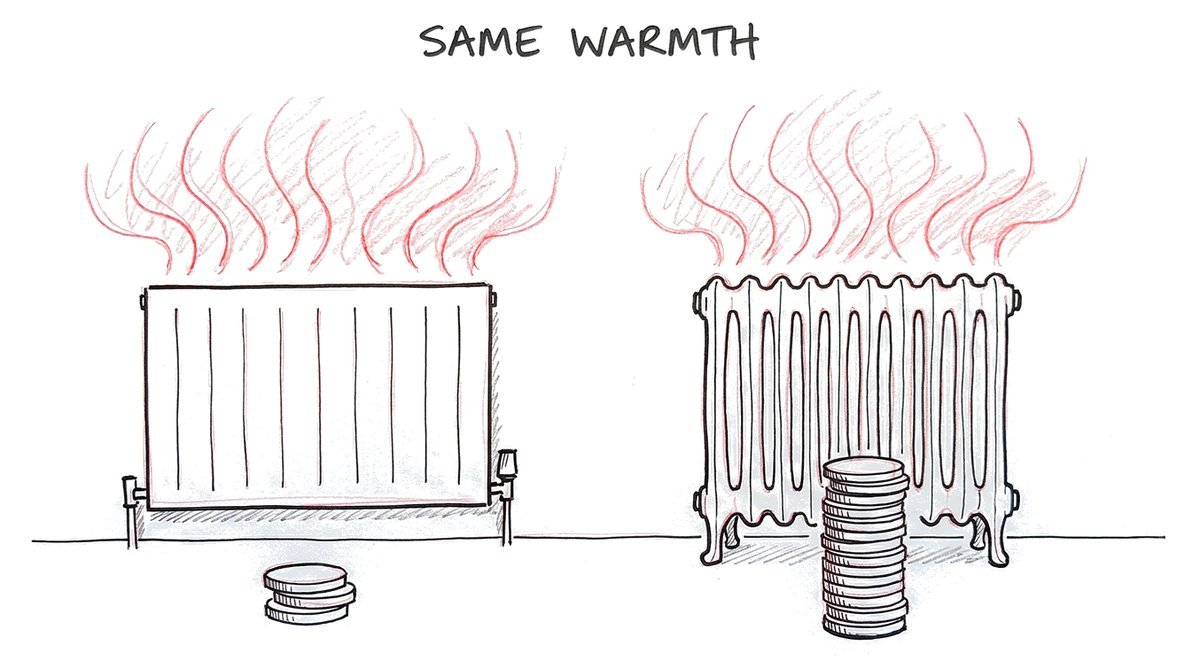
Look up radiators and you’ll find hundreds of shapes: flat panels, tall columns, ornate cast iron, polished towel rails, ones that look like sculpture. It’s easy to think the type is the big decision. In our experience it’s one of the smaller ones, and the more useful question is what each room needs and which panel gives it that for the least money and fuss.
Panel or column radiator?
A panel radiator is a flat steel panel filled with water, with a smooth or ribbed face. It’s what most of Europe has on its walls, made in huge numbers, which is why it’s the cheapest way to buy radiator heat. Some people find them plain. Phil doesn’t mind them, which he puts down to his European background: to him they just look normal and blend into the room after a while. Most of the radiators we fit are standard steel panels.
A column radiator is built from a row of upright tubes, the look of a classic old radiator. Steel columns give you that look new, and cast-iron columns are the real heritage article. Both cost more than a panel for the same heat.
Single or double panel?
Panels come in layers. A single panel is one flat sheet of water. A double panel is two, one behind the other, usually with zig-zag steel fins between them that warm the air rising through. More layers and fins mean more heat from the same patch of wall. The common double panel with fins is what the trade calls a type 22, and it’s the one we fit most.
There’s a trade-off in how the heat arrives. In Phil’s numbers, about half to 60% of a radiator’s heat goes out as radiant warmth, the kind that warms you directly the way winter sun does through a window, and most of the rest as a slow, silent drift of warm air. A flat single panel gives the biggest radiant share, and deeper panels with fins lean a little more on the air.
On a heat pump, where the water is only warm, the deeper finned panels are usually what it takes to get enough heat into the room, and the warmth still arrives quietly, with no fan. We explain why in radiators on a heat pump.
Cast iron or steel?
Cast iron is heavy and holds a lot of water and metal, so it’s slower to warm up and slower to cool down. It’s the right look for many Federation and heritage homes, and after standard panels it’s the radiator we put into houses like that most often. It costs more, though: in Phil’s experience about double a standard panel. In his words, “you have to be really committed to the aesthetics to go for one of the special radiators.”
Steel doesn’t mean short-lived. Inside its white factory finish, a steel radiator is plain mild steel, and as long as the system is kept free of air and the water is treated against corrosion, Phil expects them to last 30 years or more. Aluminium and stainless steel radiators exist too, mostly in the designer ranges.
Vertical or horizontal?
A vertical radiator is a tall, narrow panel or column. It earns its place on a wall with height but little width, beside a door or between two windows, and it costs more than a low horizontal panel giving the same heat. Most rooms suit the low horizontal panel, which is why it’s the default. We usually fix panels about 100 to 150 millimetres above the floor, where they draw in the coolest air near the floor and send it up gently warmed.
Where should the radiators go, and how many?
Under the window is the tradition. In old European houses with leaky windows, a radiator under the glass made a curtain of warm air against the draughts. Perth houses don’t need that, so a radiator can go on any wall where nothing blocks it, though under a window is often still the easiest spot because there’s no furniture in the way.
Don’t hide it. A couch 20 or 30 centimetres in front of a radiator still lets it work, but Phil reckons it might work 10 to 20% less effectively, and its radiant warmth can’t reach you through the back of the couch. Big rooms are more comfortable with two smaller radiators than one huge one. Most bedrooms need one, and an open-plan living, kitchen and dining area usually needs two or three.
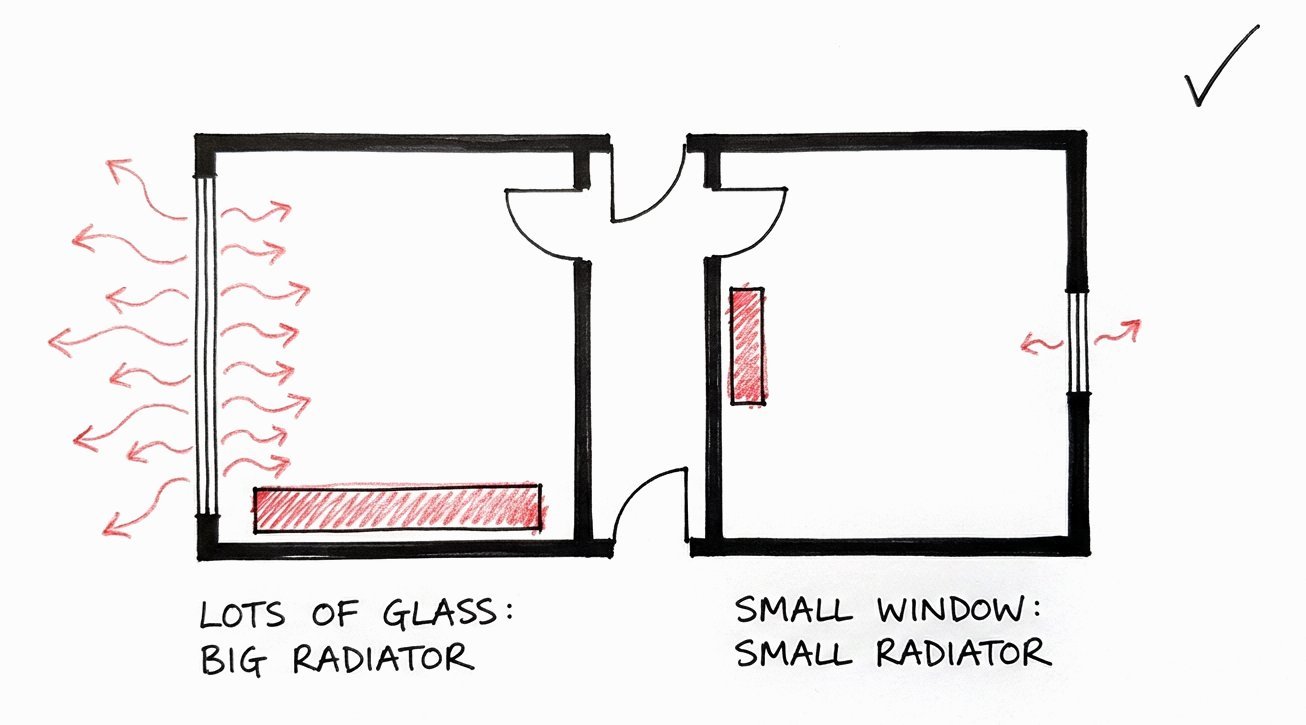
The size is the part that matters most, and it comes from a calculation for each room: how much glass it has, which way it faces, how well it’s insulated and how high the ceiling is. Our article on what size radiator each room needs walks through it.
 12 min
Other questions people ask us
What about a heated towel rail?
A towel rail on the same warm water dries the towels and takes the chill off the bathroom, and it’s what most bathrooms get. Phil’s advice is to choose a standard one for value for money, because it works just as well as the fancy ones.
Which radiator brand is best?
We don’t push a brand, and we’re not tied to any radiator maker. The panel for each room is chosen on its size and output, so the calculation makes the call, not a catalogue.
Is an oil-filled or electric panel heater the same thing?
No. A plug-in heater turns each unit of electricity into one unit of heat, while a radiator fed by a heat pump gets three to four units of heat from each unit of electricity. For one cold room for a few weeks a year, though, a plug-in heater is the cheaper answer. We compare them in radiators vs panel heaters.
Can I paint a radiator to suit the room?
Yes, in any ordinary colour. Avoid metallic paints, which cut the heat it gives off. Our short guide to painting radiators has the details.
Where to go from here
If you’re in Perth or the south-west, the 5-minute quote shows your options in writing within 3 working days, each with its price and a modelled running cost, and you don’t need plans to start. If you have a look in mind, cast iron for a Federation hallway or a slim vertical beside a door, put it in your notes and we’ll price it next to the standard panel. If you’re not ready yet, the free radiator guide covers how a radiator system is designed room by room.