
Radiators vs panel heaters and convectors: what’s the difference?
The short answer
A central heating radiator is a steel panel filled with warm water from a heat pump or gas boiler that serves the whole house. Panel heaters, radiant wall panels, heated tiles and convection heaters are electric: each heats its own room and turns one unit of electricity into one unit of heat. A heat pump turns it into about three, so radiators cost roughly a third as much per unit of warmth to run, and a great deal more to put in. For one room used now and then, an electric heater is the sensible buy. For a whole house kept warm all winter, radiators.
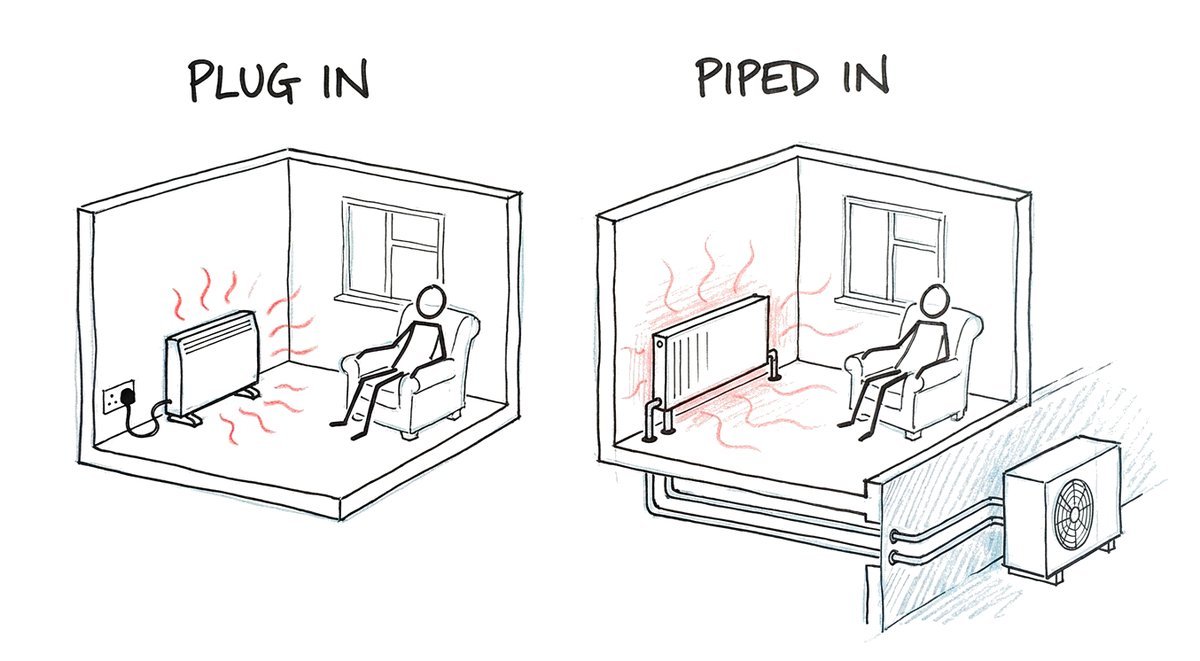
The names don’t help. Shops sell oil-filled heaters as radiators and infrared panels as radiant heaters, so it’s a fair question whether a panel heater from the hardware store is a cheaper version of a radiator system. They have a lot in common: both are silent, and neither blows air at you. The difference is where the heat comes from, and that decides what they cost to run and how much of the house they can keep warm.
What is a radiator in a central heating system?
A hydronic radiator, the kind found in most European homes, is a flat steel panel joined by two pipes to a heat source, usually an air-to-water heat pump outside. The heat pump warms water to around 45 to 55 degrees, and a small pump sends it round every radiator in the house and back again in a closed loop. Each panel is sized for its own room and the whole house runs off one machine, which is what central heating means.
Phil explains how the heat leaves the panel. Around 50 to 60% goes out as radiant warmth, the kind you feel stepping out of the shade into winter sun, and another 30 to 40% warms the air that drifts up through the fins at the back. There’s no fan and nothing moving, so the panel is silent, and the air moves gently enough that nothing feels blown or dry.
Panel heaters, radiant wall panels and heated tiles
These are all electric. A panel heater or an infrared wall panel has an element that warms a flat surface, and radiant tile heating is an electric mat or cable laid under the tiles. Because they warm a surface, they give some of the same gentle warmth as a radiator, and they’re cheap and simple to put in: plug them in, or run a cable from the switchboard.
The catch is the electricity. As Phil puts it, an electric heater takes in 1 kilowatt and gives out about 0.99 kilowatts of heat. A heat pump moves heat out of the outside air instead of making it, so each unit of electricity brings in about three to four units of heat, nearer three on a cold morning at radiator temperatures. In an 1895 house in Fremantle, Phil checked the data and found the radiator system running at 4.5. In his words, “you can heat basically a whole house for the same amount of electricity that you need to heat one room” with a panel heater.
What about convection heaters and convectors?
A convection heater warms the air and lets it rise. Fan heaters, oil-filled column heaters and most finned plug-in heaters work this way. The warm air heads for the ceiling, so you end up sitting in the cooler layer underneath it. A radiator does some of this too, through the convector fins at the back, but most of its warmth comes off the face of the panel, and the walls and furniture warm up and give heat back.
Phil is fair about the oil-filled heater. You plug it in, it works and it costs a couple of hundred dollars, but it has the same problem as every electric heater: one unit of heat for every unit of electricity. That’s fine for an hour in a cold study and expensive as the main heating for a house.
What does each one cost to run?
The arithmetic is simple at Synergy’s home rate of 33.26 cents a kilowatt-hour. A panel heater, heated tiles or a convection heater gives about one unit of heat per kilowatt-hour, so each unit of warmth costs about 34 cents. A heat pump feeding radiators gives about three, so each costs about 11 cents. For a few hours a week that gap is small change. For a whole house every morning and evening from May to September, it’s the difference between leaving the heating on and switching it off when the bill arrives.
Putting them in is the other way round. Phil’s rough figure for an electric panel heater is a few hundred dollars, up to about a thousand. A radiator system in Western Australia starts at around $3,500 per panel fully installed on a gas boiler, or around $7,500 per panel on a heat pump. That’s a general figure, not a quote, and the real number moves with the rooms, the layout and the heat source. We install both; on running cost a heat pump usually comes out ahead in Perth, so it’s what we suggest first.
 9 min
9 min
What about radiant cooling panels?
A radiant cooling panel runs the idea backwards: cold water goes through a panel, usually in the ceiling, and soaks heat out of the room. It meets the same limit as floor cooling. Phil’s picture is a cold drink from the fridge on a warm day, wet on the outside within minutes. A chilled surface does the same on a humid afternoon, so it has to be kept above that point, and it can only take the edge off. A cooled floor in Perth gives about a quarter of the cooling a typical house needs.
Radiators are for heating, and they don’t cool a house in summer. Phil isn’t shy about what does: “air conditioning is fantastic. Like you need it for cooling.” Radiators for winter and air conditioning for summer sit happily side by side in the same house.
Which one belongs in which room?
It depends on how much of the house you’re heating, and for how long. A study used for an hour on cold evenings is a job for a panel heater: cheap to buy, and the running cost stays small because it barely runs. One bathroom floor is a job for heated tiles, and Phil says so himself. If it’s only the living room, a reverse-cycle split system heats it well and cheaply, because it’s a heat pump too.
Radiators earn their place when you want the whole house warm, every room, all winter, without blown air and without carrying a heater from room to room. That’s the job central heating does, and it’s where the three-to-one difference in running cost adds up. Our comparison of radiators and split systems goes through that choice for an older home.
Other questions people ask us
Is an oil-filled heater a radiator?
Only in shape. It’s an electric heater with oil sealed inside to spread the warmth, so it runs on the same one-for-one sums as any plug-in heater. A central heating radiator has no element at all: it’s warmed by water from a heat pump or boiler elsewhere.
Are infrared panels cheaper to run than a split system?
No. A reverse-cycle split system is a heat pump, so it gets about three units of heat from each unit of electricity, and an infrared panel gets one. The panel’s strengths are that it’s silent and costs little to put in.
Is electric underfloor heating the same as heated tiles?
Yes: an electric mat or cable under the floor. It’s the right answer for one small bathroom and a dear one for a whole house. Our article on electric and hydronic floor heating has the running-cost sums.
Can radiators run on my existing gas boiler?
Often, if the boiler is in good order. Your quote shows that option next to a heat pump, each with its price and modelled running cost, so you can compare them side by side.
Where to go from here
If you live in Perth or the south-west and want the whole house warm, the 5-minute quote gives you your options in writing within 3 working days, each with its price and a modelled running cost, and you don’t need plans to start. If you’d rather read first, the free radiator guide explains how a radiator system is sized room by room, and heating an existing home has the short version.