
Can my air conditioner’s waste heat warm my pool?
The short answer
Yes, but not with an ordinary split system. When an air conditioner cools your house, its outdoor unit blows the heat it took out into the air. A heat-recovery heat pump, which makes the cooling for the house and hot water at the same time, can send that heat into the pool and the tap hot water instead. It only works while the house is being cooled, it has to be designed in from the start, and it isn’t free to run. Where we’ve done this with geothermal on the right project, the payback has been as short as about four years.
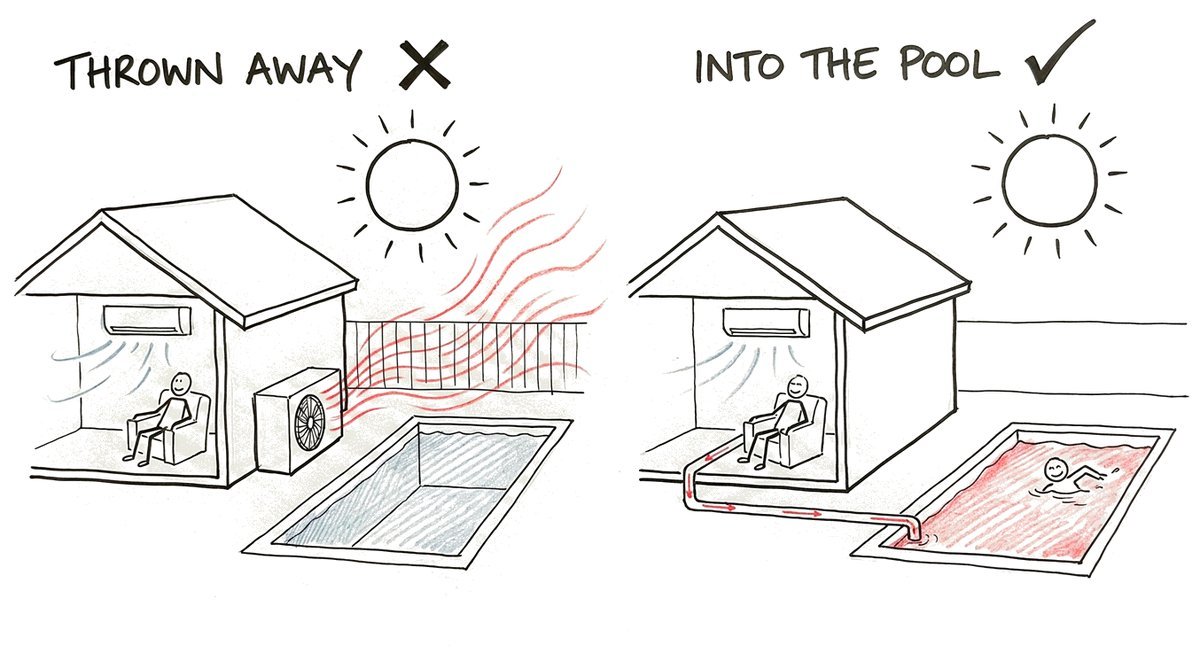
It’s a February afternoon, the air conditioning is running flat out, and the outdoor unit is blowing hot air over the side fence. Ten metres away the pool sits a couple of degrees too cold for anyone to get in. Plenty of people have stood between the two and wondered why the heat can’t go from one to the other. On the right house it can.
Where does an air conditioner’s heat go?
Put your hand behind an old fridge and it’s warm. That warmth is the heat the fridge took out of your milk, moved outside the box. An air conditioner does the same job on a whole house: it pulls heat out of the rooms and dumps it outside through the outdoor unit, whose fan blows it into the air. On a hot Perth afternoon that’s a lot of heat, and all of it is thrown away.
A pool, meanwhile, is losing heat all the time and needs more of it to stay at swimming temperature. So the idea is sound. One part of the house has heat it wants rid of, another part wants heat, and a pipe between them does the job of two machines.
Why can’t my split system do it?
Because an ordinary split or ducted system is built to do one thing with its heat: blow it into the outside air. The outdoor unit is a sealed box full of refrigerant, and there’s nothing in it to connect a pool to. As Phil says, you can’t do this with a standard heat pump. You need one that heats and cools at the same time.
That machine makes chilled water for the cooling and hot water on the other side, from the same electricity. The chilled water goes to fan coil units in the rooms, which look and work much like ordinary air conditioning heads, just a little bigger. The hot water goes through a heat exchanger into the pool, and the pool water never mixes with the system water. Because the whole cooling system is built around it, heat recovery suits a new build or a major renovation where the cooling is being designed from scratch, and it’s part of why we design heating, cooling, hot water and pool as one system.
How does it work on a real Perth house?
Phil filmed one in Dalkeith. When the house is being cooled, the heat that comes out of it goes first to the tap hot water tank, so the showers and the kitchen get it. Once that tank is full it goes to the pool. Only when the tank and the pool are both full does the system get rid of the leftover heat into the ground. On similar systems that have run for a few years, Phil says they recover about 90 to 95% of that heat, though he’s careful to add that it depends heavily on the house and how much cooling it needs.
He’s just as careful about the running cost. Anyone who tells you a system like this costs nothing to run is wrong, in Phil’s words: “It’s not true. There are still running costs.” The heat pump uses electricity to cool the house, the way any air conditioner does. The pool simply gets the heat that comes out the other side, which an ordinary system would have thrown over the fence.
 21 min
How much can it save?
It depends on two things: how much cooling the house does, and how much heat the pool wants. As a yardstick, a gas or electric pool heater costs about $3,280 to keep a 60,000 litre pool warm through the warm six months, on our modelled estimate. Recovered heat can take a bite out of that bill on every day the house is being cooled, and not on the days it isn’t.
We won’t promise a figure before we’ve seen the house, because the honest answer swings widely. On the right project, a pool alongside floor heating and air conditioning, Phil has seen heat-recovery geothermal pay back in as little as about four years. On others it has taken 15 or 16. A proper design shows you that payback for your house before you spend anything.
When isn’t it worth it?
When there isn’t much heat to recover. A well-built Perth house that only needs its air conditioning on the hottest few weeks of the year has little to give the pool, and a pool that’s rarely used has little need of it. If your house already has split systems that work, replacing them just to capture their heat for the pool is hard to justify.
For those houses there’s a simpler route: a pool heat pump that runs on solar you’d otherwise export, which our pool heating page explains, and which doesn’t depend on the air conditioning at all. And whichever way you go, a cover on the pool at night saves more heat than any machine makes, as we explain in keeping the heat in your pool.
Other questions people ask us
Will it heat my pool in winter?
No. In winter the air conditioning isn’t cooling, so there’s no waste heat to send anywhere. That’s when the same heat pump goes back to heating the house, and we don’t recommend heating a pool through a Perth winter in any case.
Can I add this to my existing air conditioning?
Not to an ordinary split or ducted system. Heat recovery needs a heat pump built to cool the house and heat water at the same time, so it usually means designing the cooling around it, in a new build or when the old system is due for replacement.
Does the pool water go through the air conditioner?
No. The pool has its own circuit, and the heat crosses over through a heat exchanger, so the pool water and the system water never touch.
Can the same heat warm my tap water?
Yes, and on the Dalkeith house the hot water tank gets first call on it, before the pool. Our article on one system for heating, cooling, hot water and the pool explains how the pieces fit together.
Where to go from here
If you’re building or renovating in Perth or the south-west, the 5-minute quote gives you your options in writing within 3 working days, each with its price and a modelled running cost, and you don’t need plans to start. Tell us about the pool and the air conditioning in your notes. If you’d like to understand the alternatives first, read heating the pool from your home’s heat pump or what it costs to heat a pool in Perth.