
How much does it cost to heat a pool in Perth?
The short answer
It depends more on when you heat the pool and whether it’s covered than on the heater. A gas or electric pool heater costs about $3,280 to keep a 60,000 litre pool warm through the warm six months, roughly $18 a day (our modelled estimate). A heat pump does it on a fraction of the electricity, and running only on solar you’d otherwise export, it costs little more than the 2 cents a unit you’d have been paid for that power. A cover can cut a heated pool’s heat loss by up to 75%. Winter heating is where the real money goes, and we don’t recommend it.
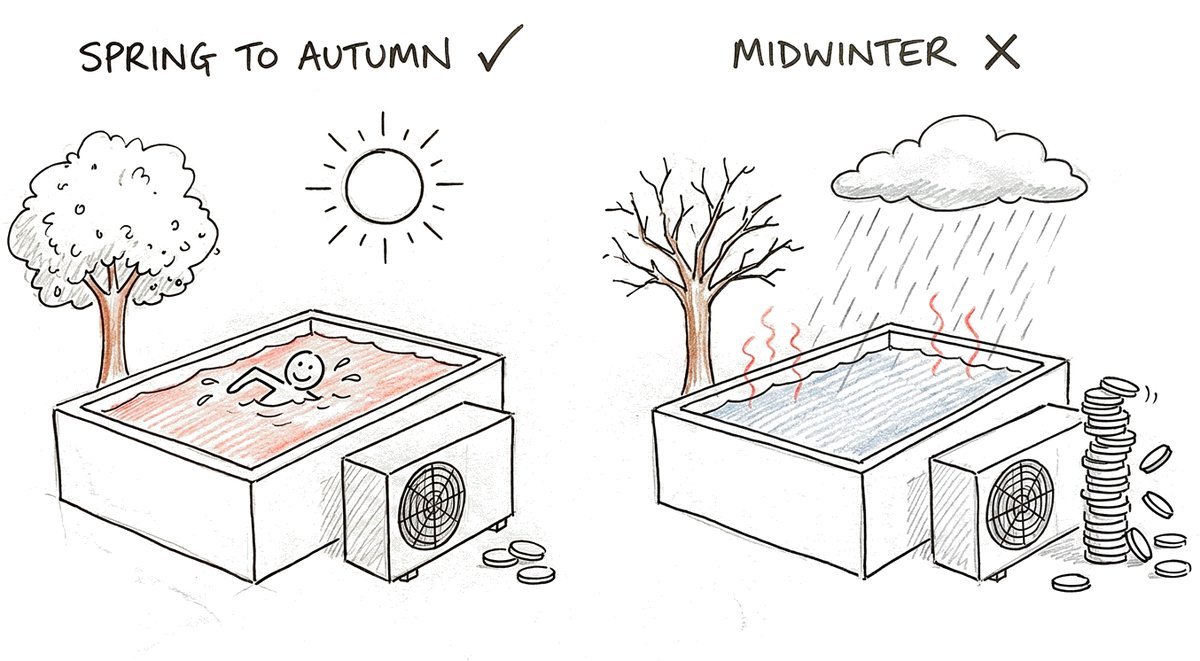
Most people ask this after the first summer in a new house. The pool got a hard few weeks in January, then sat there, blue and beautiful and a bit too cold for anyone to bother. On our modelling, a typical shaded Perth pool reaches a comfortable 30 degrees on its own on only six to nine days a year. So the real question is what it costs to make it swimmable for the rest of the warm season, and that has a straight answer.
What decides what a heated pool costs to run?
Five things, roughly in order of how much they move the bill. First is the season: a pool held warm from spring to autumn needs a fraction of the heat it would need through winter, because the air and the nights are warmer. Second is the cover, because most of the heat goes out through the surface. Then come the temperature you want the water at, the pool’s size and how much shade and wind it gets, and last the heat source and what you pay for its energy.
People usually start with the last one, the heater, and it matters. But the best heater there is still ends up refilling a leaking bucket if the pool sits uncovered every night. Phil’s way of putting it is that pools leak energy like a sieve, so the first job is always to slow the leak.
The cheapest heat is the heat you don’t lose. The federal government’s energy advice is that a bubble cover can cut heat losses from a heated pool by as much as 75%, so a covered pool needs a much smaller share of the heat an uncovered one does, whatever the heater. When someone asks us about pool heating, the first thing we ask back is how often the pool is used and whether there’s a blanket, because the answer changes the size of everything else. We go through covers, pipes and the pool shell in keeping the heat in your pool.
What does a gas or electric pool heater cost?
Our modelled estimate, at today’s West Australian prices, is about $3,280 to keep a 60,000 litre pool warm through the warm six months, which works out at around $18 a day. That’s the figure to measure everything else against. It’s high because both make heat the hard way. An electric element turns each unit of electricity into one unit of heat and no more, and a gas heater burns gas for every bit of heat the pool needs.
We install gas boilers for home heating as well as heat pumps, so this isn’t a campaign against gas. For pools, though, Phil’s view is clear: because a pool loses heat all day and all night, a gas heater just keeps burning more gas to replace it, and that makes it the dearest way to keep a standard pool warm.
What does a heat pump cost to run?
A heat pump doesn’t make heat, it moves it. It takes warmth out of the outside air and pumps it into the pool, using electricity only to do the moving, so it gets about three units of heat from each unit of electricity and more than that in warm summer air. Summer is when you want the pool warm, so the heat pump is working in its best conditions.
Run from the grid, that electricity costs you Synergy’s home rate, 33.26 cents a unit from 1 July 2026. That still makes a heat pump much cheaper to run than an element for the same heat, but it adds up over a season if the machine runs through the evening or on cloudy days.
What if the heat pump runs on my solar?
This is where Perth is unusually well placed. Under the WA Government’s buyback scheme, solar you export to the grid between 9pm and 3pm earns 2 cents a unit, and 10 cents between 3pm and 9pm. You buy the same power back in the evening at about 33 cents. So every unit of midday solar you put into the pool instead of the grid costs you the 2 cents you’d have been paid for it, and very little else.
The trick is that the heat pump has to use only the spare solar, and a timer can’t do that. When a cloud passes, or the oven or the air conditioning comes on, a timer keeps the heat pump running and quietly starts buying grid power at 33 cents. The system on our pool heating page watches the solar and the house second by second and throttles the heat pump down to whatever is spare, which needs a heat pump whose output can be turned down. Most older pool heat pumps are simply on or off.
On our modelling for a typical 60,000 litre pool, that set-up pays for itself in just over four years against a gas or electric pool heater, with the water held at 28 to 30 degrees across the warm season. In a cloudy week there’s less spare solar, and the water drops a few degrees.
How do solar collectors and air conditioning waste heat compare?
Solar pool collectors on the roof are the other cheap-to-run option, and the federal government’s energy advice says solar is cheaper to run than electricity or gas for heating a pool. They only heat while the sun is on them, they need a good piece of sunny roof, and that’s roof your solar panels can’t use.
Heat recovered from the air conditioning is the cheapest heat of all, because the house is getting rid of it anyway. It only exists while the house is being cooled, though, and it needs a heat pump built to cool the house and heat water at the same time, so it’s designed in, not bolted on. We explain it in using your air conditioner’s waste heat for the pool.
| Heat source | What it runs on | What it costs to run |
|---|---|---|
| Gas or electric pool heater | Gas, or grid power at about 33 cents a unit | About $3,280 for a 60,000 L pool over the warm six months (modelled estimate) |
| Heat pump on grid power | Grid power, about three units of heat for each unit used | A fraction of an electric element’s cost for the same heat |
| Heat pump on spare solar | Midday solar you’d otherwise export for 2 cents | Little more than the export credit you give up |
| Solar collectors | Sun on the roof | Low; only heats while the sun shines |
| Air conditioning waste heat | Heat the house is getting rid of | Low, but only while the house is being cooled |
What does it cost to heat a pool through winter?
More than it’s worth, which is why we don’t recommend it or quote it. Through June and July the water loses heat to cold air and colder nights around the clock, and any heater ends up replacing it day after day for a pool nobody much wants to swim in. The government’s own advice is the same in fewer words: only heat your pool or spa when you need it.
If you’d like the option of a warm pool for the odd winter weekend, size the heating to bring the pool up in about a day and leave it off otherwise. That’s how a Dalkeith pool Phil filmed is set up, and it costs far less than holding the water warm all season.
Other questions people ask us about pool heating costs
What does a pool heat pump cost to run in Perth?
There’s no single figure, because it depends on the pool, the cover and when the heat pump runs. Running only on spare midday solar, it costs little more than the 2 cents a unit you’d have earned exporting that power. Running from the grid in the evening, it pays the full 33 cents a unit. Your quote shows a modelled running cost for your own pool.
Is gas cheaper than a heat pump for a pool?
Not to run. Gas costs less per unit of energy than grid electricity, but a heat pump gets about three units of heat out of every unit of electricity, more in summer air, and a pool’s constant heat loss punishes the less efficient machine. Phil’s view is that gas is the most expensive way to keep a standard pool warm.
How much does it cost to install pool heating?
It depends on the pool, the heat source and whether you already have solar, so we won’t put a figure here that might be wrong for your pool. The 5-minute quote gives you the price in writing.
Can my home’s heating heat pump do the pool as well?
Often, yes, because it sits idle in summer when the pool needs it. We explain how in heating the pool from your home’s heat pump.
Where to go from here
If you’re in Perth or the south-west, the 5-minute quote gives you your options in writing within 3 working days, each with its price and a modelled running cost for your pool, and you don’t need plans to start. If you’d like to see how a heat pump runs a pool on spare solar first, our pool heating page shows the system working, and our heat pump page explains the machine itself.