
Which floor coverings work best over floor heating?
The short answer
Hard floors work best. Tiles, stone and polished concrete let the heat straight through, and they’re also the floors that feel coldest without it. Timber, vinyl and carpet all work over floor heating too, but they hold some of the heat back, so the floor gives out less and has to be designed for them from the start. Our floors are designed to give out up to 80 watts per square metre under hard finishes, and less under softer ones. The one rule: tell whoever designs your heating every floor covering, room by room, before construction starts.
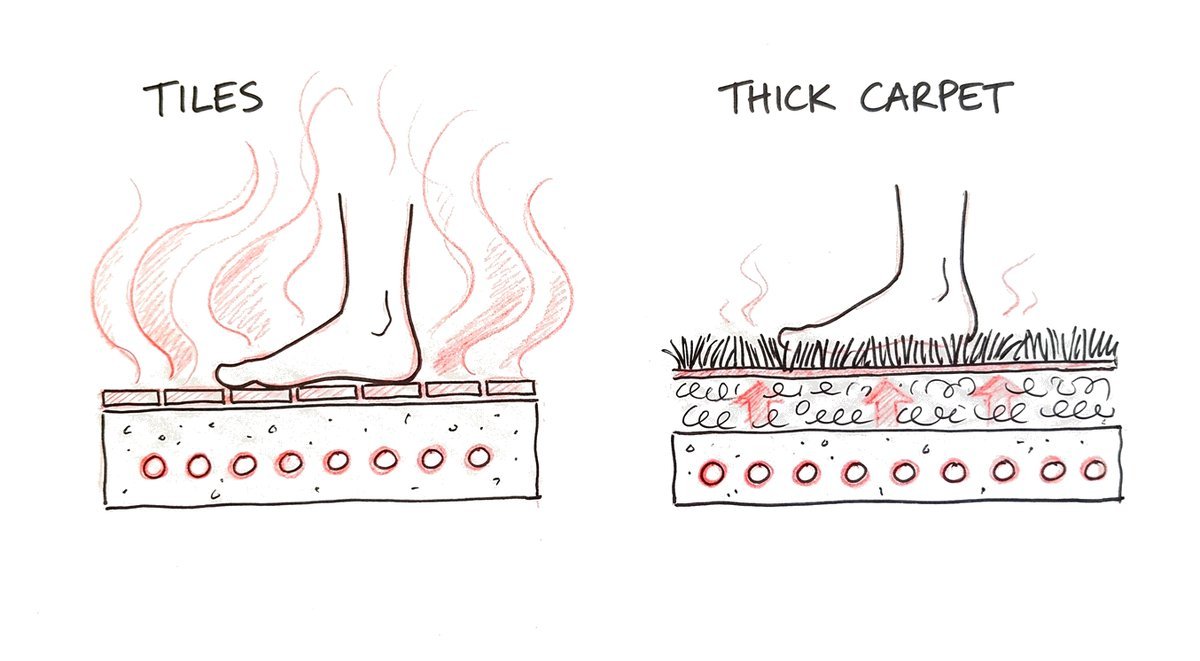
The floor you walk on and the floor that heats you are the same floor, so choosing one is half of choosing the other. It’s one of the first things we ask anyone planning floor heating, and the answer changes the design. You can have almost any floor you like. What matters is deciding it early enough for the heating to be built around it.
Why do tiles, stone and polished concrete work best?
Because they’re good conductors, so the warmth in the floor comes straight through to your feet and into the room. That’s also why they feel so cold in July without heating: a hard floor draws heat out of a bare foot far faster than carpet does. It’s the reason so many Perth homes, built on tiles or polished concrete with summer in mind, feel cold all winter. Heat the floor, and the thing that made the house cold becomes the heater.
Under hard finishes we design floors to give out up to about 80 watts per square metre. A heated tiled room won’t feel hot underfoot, just pleasantly warm, and tiled rooms like bathrooms and kitchens feel slightly warmer to bare feet than carpeted ones, even at the same room temperature.
With tiles over a heated screed, the expansion joints the screed needs are planned with the tiler, so they fall in the grout lines and are filled with a flexible sealant in the grout colour. Phil says people tend to picture a valley running across the living room. Once the furniture is in, nobody finds them.
Will polished concrete crack with floor heating under it?
Not if it’s designed for it. With polished concrete the slab is the finished floor, so the pipes sit inside the surface you look at. It works very well, as long as the pipe sits at the right depth, the steel mesh sits near the top of the slab where the structural engineer specifies, and expansion joints go where the floor needs room to move. That takes the structural engineer, the concreter and the heating designer working it out together before the pour. We go through it in will my polished concrete floor crack.
 6 min
6 min
Can I have timber floors over floor heating?
Yes, with planning. Timber holds back more heat than tile, and it moves as its moisture and temperature change, so the system is designed around it: the pipe spacing, the water temperature, and how the boards are fixed so that nothing is nailed or screwed anywhere near a pipe. For solid boards, we use a system of timber battens with the pipes running between them in plates that spread the warmth, insulated from the structure below. Floor heating laid without allowing for timber can underperform, and in the worst case damage the boards.
Old timber floors are a different question. In an 1895 Fremantle home with its original jarrah boards, the old rooms got radiators, and floor heating went into the new extension and bathroom, all running from one heat pump. If you’re living with raised timber floors in an older house, we cover the options in floor heating under raised timber floors.
Does carpet work with floor heating?
It does, and plenty of homes have carpet in the bedrooms over a heated floor. Carpet and its underlay are insulation, though, so less of the heat gets through and the room takes a little longer to respond. The carpet won’t feel warm to the touch the way tiles do. The room still will, and that’s the difference between a cold, uninviting bedroom and one that’s comfortable to walk into.
What matters is that the design knows the carpet is coming. The thicker the carpet and underlay, the more the floor has to make up for, and a system designed around tiles that later gets thick carpet laid over it will struggle on the coldest mornings. If you’re choosing carpet, choose it before the heating is designed, and say so if you change your mind.
What about vinyl, laminate and rugs?
Vinyl and laminate work over floor heating as well. Like timber, they reduce what the floor can give out, so tell your heating designer, and check that the product you’ve chosen is one its maker allows over a heated floor. A rug is a small carpet: it’s fine on a heated floor and just slows the warmth in the spot it covers. We say more about rugs, beds and big furniture in can I put rugs and furniture on a heated floor.
Other questions people ask us
Will my floor feel hot?
No. A well-designed hydronic floor feels pleasantly warm at most, and you notice it more on tiles than on carpet or timber. Electric mats often run hotter, because they’re usually sized to warm a small floor fast.
Can I change my floor coverings later?
Swapping one hard floor for another makes little difference. Swapping tiles for thick carpet takes away a good part of what the floor can give out, so talk to whoever designed the system before you do it.
Can I mix tiles, timber and carpet in one house?
Yes, and most houses do. Each room’s pipe layout is designed for the floor it will have, which is why we need the floor coverings room by room rather than one answer for the whole house.
What’s the best floor for a heated bathroom?
Tiles, which is handy, since that’s what most bathrooms have. If the bathroom is the only room you want heated, an electric mat under the tiles is usually the better buy than a hydronic system.
Where to go from here
If you’re building in Perth or the south-west, the 5-minute quote gives you your options in writing within 3 working days, each with its price and a modelled running cost, and you don’t need final plans to start. Tell us your floor coverings in the notes if you know them. If you’re not ready for that, the Running Cost Calculator shows what floor heating costs to run, built right and built cheaply, for your floor area.