
Can I put rugs, beds and furniture on a heated floor?
The short answer
Yes. A hydronic floor runs only gently warm, on water at around 30 to 35 degrees, so ordinary rugs and furniture are fine on it. What they do is cover the floor: a rug works like a small blanket over the warmth beneath it, and a bed or sofa with a solid base sitting flat on the floor holds the heat in under it, so that patch gives less to the room. Furniture on legs lets the warmth out around and underneath. Kitchen islands and built-in cupboards are planned at the design stage, with no pipes under them but insulation all the way through.
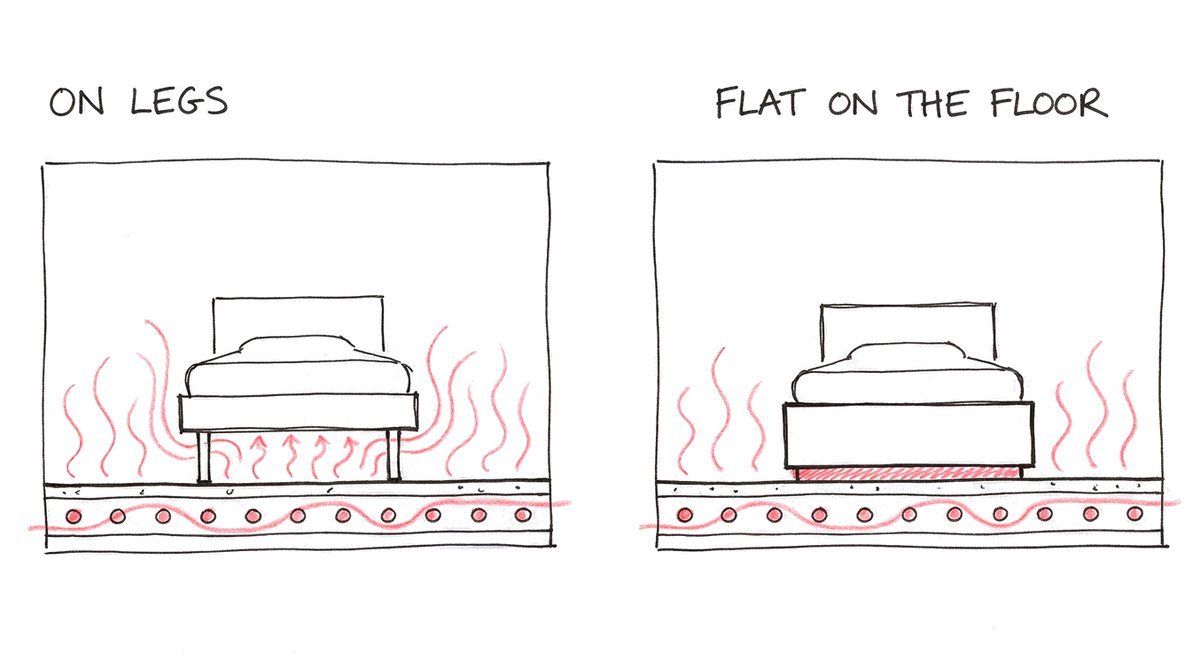
People sometimes ask this as if a heated floor were a stovetop. It’s nothing like one. A well-designed hydronic floor feels warm to bare feet and nowhere near hot, far cooler than a heater in the corner, which Phil points out has to run at 90 or 100 degrees. The real question is what furniture does to the warmth: it gets in the way a little, in the spots it covers.
Do rugs work on a heated floor?
Yes. A rug is a small blanket laid over the warmth: it slows the heat coming up through it, so the floor under the rug runs a little warmer and the room gets a little less from that patch. A thin flat-weave rug makes very little difference. A thick wool rug on a thick underlay makes more, the same way thick carpet does across a whole room, which we cover in which floor coverings work best.
A few rugs on a floor that was designed for tiles won’t change much, because the rest of the floor carries on as before. A big rug that covers most of the living room is one to tell the designer about, so the room’s heating allows for it. If a rug has a rubber backing or its own underlay, ask the shop whether it suits a heated floor.
What about beds, sofas and other furniture?
Anything on legs is the easy case. The warmth rises around it and up through the gap underneath, so the floor carries on heating the room as if the furniture weren’t there. Anything with a solid base sitting flat on the floor, like an ensemble bed base, a storage bed or a sofa with a skirt to the ground, covers its patch the way a thick rug does: the warmth builds up a little underneath and the room gets less from that spot.
That’s rarely a problem. Bedrooms are usually kept a little cooler anyway, and a bed covers only part of the floor. In a small bedroom where a big solid-based bed takes up most of the floor, though, a bed on legs lets the floor do more of its job.
What happens under kitchen islands and built-in cupboards?
They’re planned before the pipes go down, because they never move. There’s no point heating the floor under a kitchen island, a run of cupboards or a built-in robe, so the pipes stop at their edges and go around the plumbing that comes up through the floor to an island sink. The insulation is different. It goes under the whole floor, joinery included, as we explain in insulation under the slab.
It gets skipped often enough, in installers’ own photos of their work, that Phil made a video about it. In his words, “people leave out the insulation underneath the island bench”, usually to save a little money, and two things follow. Warmth slides sideways under the joinery and down into the slab below, so you’re paying to heat concrete nobody stands on. And the screed sits hard on bare concrete in one patch and on slightly springy insulation beside it, so the two move differently, and that’s where cracks start.
 4 min
4 min
What should I tell the designer?
Where the fixed things go, and what the floor will be covered with. That means the kitchen layout and the island, the built-in robes and cupboards, and the floor coverings room by room, including any big rugs. All of it needs to be settled before the pipes go down. Move the island after the pour and you either have a cold patch where it was meant to be, or a bench sitting over heating pipes that its fixings must not hit.
The same goes for anything you ever want to screw into the floor later. Find out where the pipes run first; we explain why in can floor heating pipes leak.
Other questions people ask us
Will the heat damage my rugs or furniture?
Not on a hydronic floor. It runs on lukewarm water and feels gently warm, never hot, so your furniture sits on it much as it would on a sunny patch of floor. Electric mats can run their surface hotter, so if you have one, check the maker’s instructions before covering it.
Should the pipes go under where the bed will be?
Yes. Beds, sofas and freestanding cupboards get moved over the years, so the floor under them is heated like the rest of the room. Only the things built in for good, such as the island and the joinery, are left out.
Where to go from here
If you’re building in Perth or the south-west, the 5-minute quote gives you your options in writing within 3 working days, each with its price and a modelled running cost, and you don’t need plans to start. Put your floor coverings in the notes if you know them. If you’re still planning the house, the Slab Pour Deadline Checker shows how long you have to settle the kitchen and the joinery before the pour.