
Is floor heating safe for children, pets and older people?
The short answer
Yes. A hydronic heated floor is about as safe as home heating gets for small children, pets and older people, because there’s nothing hot in the room to touch. The water in the pipes runs at around 40 degrees or less, so the floor feels warm underfoot rather than hot, and there’s no flame, fan, glowing element or power cord anywhere in the room. The heat pump that warms the water sits outside, like the outdoor half of an air conditioner. What’s worth checking is the build: sealed pipes that were pressure-tested before the floor went down, and a house that stays evenly warm in every room.
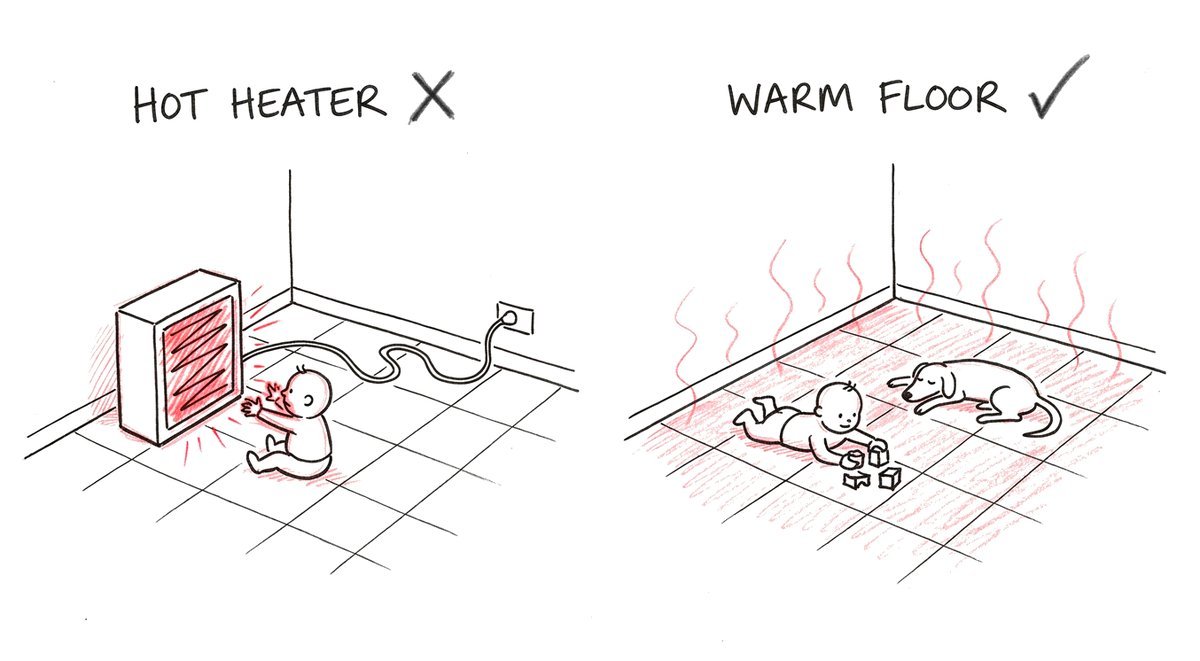
This question comes from parents of crawling babies, from people whose dog sleeps on the kitchen tiles, and from families planning a home where an older parent will live. Underneath it there’s usually a simple picture: a heater in the floor sounds as if it should be hot. It helps to know how low the temperatures really are, and where the heat actually comes from.
How hot does a heated floor get?
Not very. In a hydronic floor the heat comes from water running through plastic pipe set in the concrete, and that water is warm rather than hot. Phil’s rule of thumb is water at around 40 degrees, and a well-designed floor on a heat pump usually runs cooler than that, at 30 to 35 degrees, and lower again on a mild day. The floor surface sits below the water temperature, because the heat has to travel up through the screed and the tiles to reach it.
So on a cold morning the tiles feel pleasantly warm under bare feet. Phil compares it to a concrete footpath on a cool spring day after the sun has been on it all afternoon: you can feel the warmth coming off it, and you’d happily sit on it. That’s the whole floor of the room, at a gentle temperature, with no single spot hotter than the rest.
Compare that with the heaters most of us grew up with. Phil makes the point that a gas heater in the corner has to run at 90 or 100 degrees to push its warmth across to the far side of the room, and the element of a plug-in bar heater glows red. Those are the temperatures that make you keep children and pets back from a heater. Spread a low temperature over the whole floor instead, and there’s no hot spot to keep anyone away from.
Is it safe for babies, toddlers and pets lying on the floor?
Yes, and this is where floor heating is at its best. Babies and toddlers spend much of the day on the floor, and in a Perth winter the floor is usually the coldest surface in the house, because it’s tiles or polished concrete laid on a slab. With floor heating the floor becomes the warmest surface in the room instead. A baby on a play mat or a toddler building blocks is in the warmest place in the house rather than the coolest, and the dog gets a warm patch of tiles to stretch out on.
Just as important is what isn’t in the room. There’s no heater to tip over, no cord to pull or trip on, no fan or hot grille at toddler height, and nothing glowing in the corner. The thermostat on the wall is the only part you see, and it’s a small box that measures the room. Everything that does the work, the heat pump and the pumps, sits outside or behind a cupboard door.
 6 min
What about older people, or someone living with dementia?
We’re engineers, not doctors, so we won’t promise anything about anyone’s health. What we can say is that cold homes are a real problem in southern Australia. The World Health Organization’s recommended minimum indoors is 18 degrees, and when researchers put sensors in 100 homes across five states including WA, 81% sat below that on average through the whole of winter. The researchers name older people among those most at risk.
For an older person the practical points matter more than the physics. Floor heating keeps the whole house evenly warm, hallway and bathroom included, so getting up at night doesn’t mean walking from a warm bedroom into a cold corridor (one reason we suggest heating the whole house rather than a few rooms). There’s no heater to carry from room to room and nothing to remember to switch on, because the system runs on a timer and the house is already warm when they get up.
For a family caring for someone living with dementia, those same things count, along with one more: nothing in the room is hotter than the floor itself. A flat floor with no vents, grilles or cords is also one less thing to step around.
Is it safe to have water pipes under the floor?
The pipe is a sealed loop of plastic pipe set in the concrete, with the same water going round and round. It only leaks if something cuts or punctures it, such as a drill or a nail, and that risk belongs almost entirely to the building stage. That’s why the pipes are pressure-tested before any concrete goes over them and kept under pressure while the house goes up. If another trade does hit one, water shows straight away and the pipe is repaired before the floor is finished.
Quality floor heating pipe is rated for 50 years under its standard’s test conditions, and at floor-heating temperatures it will outlast most houses. Our article on whether floor heating pipes can leak goes into the detail.
The system also carries the safety parts any hydronic system has: an expansion vessel, a small tank that takes up the water’s growth as it warms, a pressure relief valve as a backstop, and automatic vents that let out trapped air. And there’s no electrical wiring in a hydronic floor at all, only water in pipe, so the questions people ask about wires under electric mats don’t apply.
Does the heat pump or boiler need watching?
A heat pump has nothing burning in it. It’s the same kind of machine as the outdoor half of a reverse-cycle air conditioner, using electricity to collect heat from the outside air and put it into the water, and it sits outside where it has air to breathe. Like any heat pump it should have a check about every two years to stay at its best.
We install gas boilers too, if you’d rather have gas, although in Perth a heat pump usually comes out ahead on running cost, so it’s what we suggest first. A gas boiler has a flame, so it’s treated like any gas appliance. In Australia it usually goes on an outside wall, and it gets the same regular check. Either way, the machinery stays outside the rooms you live in, and the only thing that comes inside is warm water.
Other questions people ask us
Can floor heating burn you?
Not a hydronic floor. The water runs at around 40 degrees or less and the floor surface is cooler than the water, so it feels warm underfoot rather than hot. Children and pets can lie on it all day.
Is electric floor heating safe too?
Yes, when it’s installed properly, but it works differently. Phil explains that electric cables heat up to around 90 degrees and then switch off, over and over, which is why an electric mat is controlled by a sensor in the floor that stops it overheating. A hydronic floor runs low enough to be controlled by the room temperature instead. For one small bathroom an electric mat is often the sensible choice, as our comparison of electric and hydronic floor heating explains.
Are radiators safe around small children?
Radiators on a heat pump run on water at around 45 to 55 degrees, so the panel feels warm to the hand, with no glowing element and no fan. They are warmer than a heated floor, though, so in a new home where floor heating can go in, the floor is the gentler of the two.
Does floor heating dry out the air?
It doesn’t blow air, so there’s no draught across your skin and no dust kept moving around the room. Whether that helps with asthma or allergies is a question for your doctor; we cover what we can say in floor heating, allergies and damp.
Where to go from here
If you’re building in Perth or the south-west, the 5-minute quote gives you your options in writing within 3 working days, each with its price and a modelled running cost, and you don’t need final plans to start. If you’d like the other common questions answered first, our questions answered page covers them, and the Running Cost Calculator shows what a well-built floor costs to run for your floor area.