
Is floor heating better for allergies, asthma and damp?
The short answer
It can help in one plain, mechanical way: a heated floor has no fan, so it doesn’t blow dust and allergens around the room the way ducted or split-system heating does. It also keeps floors and walls warmer, and warm surfaces are less likely to collect the condensation that mould grows on. Beyond that we make no health promises, because we’re engineers, not doctors. Damp is usually a moisture and ventilation problem first, and no heating system fixes it on its own.
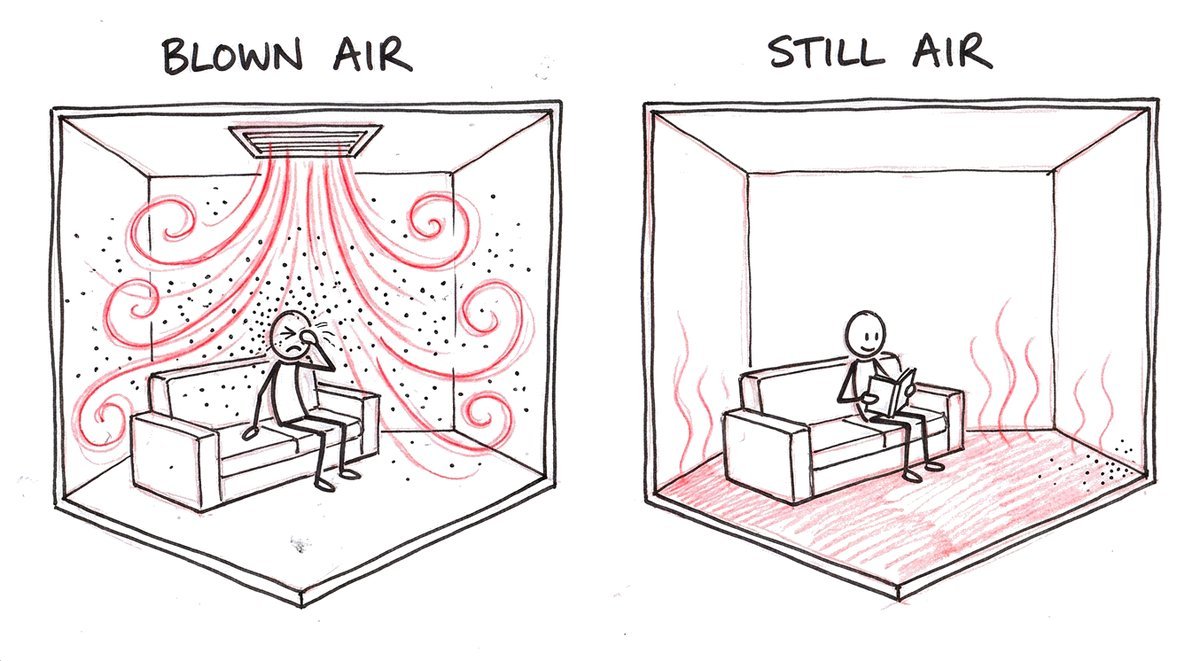
People ask us this for good reasons: a child with asthma, a partner who wakes up congested, a black patch behind the wardrobe every August. Some of the older articles on this site promised that floor heating kills bacteria, viruses and dust mites. We’ve taken those claims down, because we can’t stand behind them. Here’s what we can say as engineers, and where you’d want a doctor’s view instead.
What does floor heating change about the air?
Ducted and split-system heating can only warm a room by moving air. A fan pushes heated air out at speed, it swirls around the room, and whatever is in the air goes with it: dust, pollen, pet hair. Phil’s point about blown air is simple. It stirs up the dust, and because it’s moving past your skin it dries your eyes and throat. Try pointing a hair dryer at your face for a minute and you’ll know the feeling.
A heated floor works mostly by radiation, the same way the sun warms your face on a cold day. Between 50 and 60 percent of the heat your body trades with a room goes that way, so a warm floor can keep you comfortable without a fan anywhere. Some warm air still rises gently off the floor, but nothing is blasted around and nothing is carried between rooms through ducts. That’s the mechanical difference, and it’s real. Whether it changes anyone’s symptoms is a question for their doctor.
Being warm enough matters too. A study of 100 homes across southern Australia, including WA, found four in five averaged below 18 degrees through winter, the minimum the World Health Organization recommends. The researchers note that cold indoor temperatures can make other problems such as mould worse.
Can floor heating help with mould and damp?
Mould needs moisture, and in a house that moisture mostly condenses out of the air onto whatever is coldest: the corner of an outside wall, the window frames, the back of a wardrobe pushed against brick. Heat that warms the room’s surfaces, not just its air, keeps those spots warmer, so they’re less likely to stay wet. A heated bathroom floor also dries quickly after a shower.
But heating doesn’t take moisture out of a house. Showers, cooking, drying clothes and simply breathing all put water into the air, and it has to leave through exhaust fans and fresh air coming in. Homes approved in WA since 1 May 2025 have had to meet the national building code’s condensation provisions for exactly this reason. If a room is damp because of a leak, rising damp or a blocked vent, fix that first. Floor heating on top of a wet wall is money spent in the wrong order.
Is any kind of heating worse for asthma?
We’ll leave the medical side to the people qualified to give it, but the WA Department of Health is clear about one thing. Its advice on gas appliances in the home says unflued gas heaters, the kind with no chimney or flue, can release air pollutants into the room, while flued heaters send the pollutants and water vapour outside. It suggests electric heaters, which produce no indoor air pollution.
Hydronic heating keeps any burning out of the rooms you live in. A heat pump burns nothing at all. If you choose a gas boiler instead, it’s flued, so whatever it burns goes outside, and the room is warmed by water in the floor. That’s also one less source of moisture: an unflued heater puts water vapour straight into the room you’re trying to keep dry.
What about fresh, filtered air?
Floor heating warms a house. It does nothing to bring fresh air in or filter it, and in a well-sealed modern home that’s a separate job. Heat recovery ventilation brings in filtered outside air and sends stale air out, carrying away smells and moisture, while keeping most of the warmth you’ve paid for. Phil is careful to say what it isn’t: it doesn’t heat or cool your home.
It earns its place in a tight, well-insulated house, especially where somebody reacts to the air. In an older, draughty home, seal and insulate first. Either way the filters need changing, because blocked filters do a poor job. Our article on ventilation filters for pollen and smoke goes further.
Can moisture get into the floor heating itself?
The pipes are a sealed loop, so the heating water stays inside them and never meets the air in the room. The part of a heated floor that has to be kept dry is the insulation underneath. Phil sees insulation made for walls and roofs laid under floors, where it slowly soaks up moisture from the ground. A board that started out at R1 can end up nearer R0.2 or R0.3, and the first sign is a power bill creeping up.
The fix is simple and has to happen before the pour: an insulation board made to sit under a floor, strong enough to carry it and resistant to moisture, with the builder’s plastic membrane laid over it before the steel mesh goes down. More on choosing it in the insulation under a heated floor.
Other questions people ask us
Does floor heating kill dust mites or bacteria?
We don’t claim that it does. You’ll find the claim online, including in older articles that used to be on this site, but we haven’t seen evidence we’d stand behind. If allergies are the reason you’re asking, talk to your GP or an allergy specialist about what will make a difference.
Will floor cooling make my floors damp in summer?
It can if it’s done carelessly, the way a cold drink gets wet on the outside on a humid day. A properly designed system watches the indoor temperature and humidity and keeps the floor just warmer than the point where moisture would form. We explain how in floor cooling and condensation.
Are radiators the same as floor heating for dust?
Much the same. A radiator has no fan and no moving parts. It gives off about half its heat by radiation and warms the rest of the air slowly and gently, so it doesn’t stir the room up the way blown air does.
Where to go from here
If you’re building or renovating in Perth or the south-west, the 5-minute quote gives you your options in writing within 3 working days, each with its price and a modelled running cost, and you don’t need plans to start. Mention in your notes if anyone in the house has asthma or allergies, so we can include ventilation in the conversation. If you’d rather read first, our page on heat recovery ventilation covers fresh, filtered air in a sealed house.