
Can heat recovery ventilation filter out pollen and bushfire smoke?
The short answer
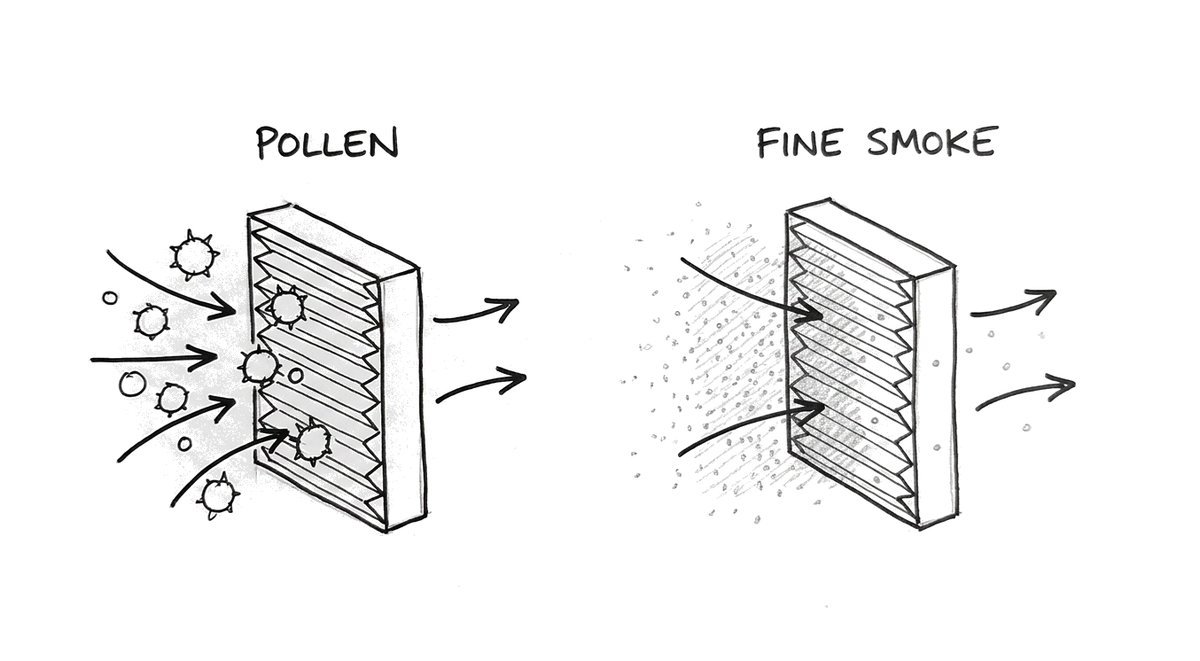
Pollen, mostly. Pollen grains are large by filter standards, so the filter on the fresh air coming in catches them far more easily than it catches smoke, though pollen also rides in on clothes and through open doors. Bushfire smoke is harder, because much of it is tiny particles, and no ventilation filter turns smoky outside air into clean air. On a heavy smoke day, WA Health’s advice is to keep outside air out, so turn the ventilation right down or off until it clears. We’re engineers, not doctors, so we’ll tell you what a filter catches, not what it will do for your hay fever.
Filtered fresh air is the reason most of our clients raise heat recovery in the first place. Somebody in the house reacts to pollen in spring, or the smoke from a bushfire or a prescribed burn drifts over the suburb and there’s nowhere to escape it with the windows open. It’s a fair hope that a ventilation system will help. It does help, within limits that are worth knowing before you buy one.
What filters does a heat recovery unit have?
Usually two kinds. A coarse filter catches the bigger dust and debris from outside, and a finer one behind it does most of the hard work and catches the finer particles. In a central unit they sit behind a panel on the front of the box, a couple of screws away, and you can change them yourself. Each room-by-room wall unit has its own pair behind its cover.
The finer the filter, the more the fan has to push to get air through it. So a unit has to be made to take a fine filter, and you can’t simply swap the finest filter you can find into any unit and expect the same airflow. Most heat recovery units sold here are European, and their filters are graded on European scales, so the useful question to ask is what the finest filter is that your unit is designed to take.
How well does it keep pollen out?
Well, for the air it brings in. The US Environmental Protection Agency uses pollen as its example of a large airborne particle and tobacco smoke as its example of a small one, and a fine filter has a much easier time with the big ones. The part people forget is that pollen doesn’t only come through the ventilation. It comes in on clothes, hair and the dog, and through every door that’s opened on a windy spring day.
Where heat recovery really helps is in letting you keep the windows shut. In a sealed house the fresh air arrives through the filter, slowly and all day, rather than through an open window, and people who live with these systems tell Phil they don’t have to wipe the dust off the furniture as often. That’s a different daily experience from a window cracked open, and it’s one of the things that makes heat recovery worth it in a well-sealed home.
What can it do about bushfire smoke?
Less than people hope. Smoke carries large particles and very fine ones, and WA Health warns that it’s the fine ones that get deep into the lungs. A fine filter catches a share of them, and on a lightly hazy day that’s worth having.
But a heat recovery system’s job is to bring outside air in, and when the outside air is full of smoke, WA Health’s advice is to stay indoors with the windows and doors shut and to use only air conditioners that circulate the air already inside, not ones that draw air in from outside. The US EPA says the same about fresh-air intakes: close them, or set the system to recirculate.
So on a heavy smoke day, turn the ventilation down to its lowest setting, or off, and turn it back up once the air outside has cleared. A sealed house with heat recovery is in a better position here than a leaky one, because when you turn the fresh air off, the smoke has far fewer ways in. For extra protection in the room you sleep in, WA Health suggests a portable air cleaner with a HEPA filter, sized for the room. For smoke from your own fireplace, see heat recovery ventilation and a wood fire.
Why do the filters need changing?
Because a clogged filter makes everything worse. The fan has to push harder to get air through it, so the system gets noisier, uses more power and moves less fresh air, and a system with blocked filters ventilates badly and costs more to run than no system at all. Filters are the one job the owner has.
Most units count down to a filter change and tell you when it’s due, and for room-by-room units Phil’s rule of thumb is about every six months. After a smoky spell, check them sooner. The EPA’s advice is to replace a filter when it looks dirty, dark brown or black, which during smoke can be well before the timer says so.
Will it help my allergies or asthma?
We can’t promise that, and we’d be wary of anyone who does. Even the EPA, asked whether air cleaners and filters reduce allergy or asthma symptoms, answers “Possibly”, and says the studies don’t always show major improvements. What we can say as engineers is what the system does: it brings in filtered fresh air, takes out the moisture and smells, and lets you keep the windows shut. What that means for your health is a question for your doctor. Our article on floor heating, allergies and damp takes the same line.
Other questions people ask us
Can I fit a HEPA filter to a heat recovery unit?
Only if the unit is made to take one. A HEPA filter resists the air more than the standard filters, so the fan has to be able to push through it at your design airflow. Ask what the finest filter your unit is rated for is before you buy.
Does it clean the air that’s already in the house?
Not directly. It filters the air coming in and slowly replaces the stale air inside, all day and night. It isn’t a room air purifier, which is why WA Health suggests a portable HEPA cleaner for the bedroom during heavy smoke.
Will it stop mould?
It helps with the cause by drawing the steam out of bathrooms and kitchens before it settles, and a sealed house with no fresh air is where damp tends to build up. Filters themselves don’t fix mould that’s already there, and the EPA says the same.
What does heat recovery ventilation actually do?
It swaps stale air for fresh, filtered air and keeps most of the warmth or coolness while it does. We explain how in what heat recovery ventilation is and how it works.
Where to go from here
If you’re building or renovating in Perth or the south-west, the 5-minute quote gives you your options in writing within 3 working days, each with its price and a modelled running cost, and you don’t need plans to start. Mention pollen or smoke in your notes so the filters are chosen with it in mind. If you’d like the one-page version first, our heat recovery page covers when heat recovery is worth it and where it goes wrong.