
Can I have heat recovery ventilation and a wood fire?
The short answer
Yes, but the fire’s air has to be planned. A wood fire burns air and sends it up the chimney, and a sealed house has few gaps for that air to come back through. Heat recovery ventilation takes out about as much air as it brings in, so on its own it doesn’t starve the fire; the fans that only push air out, like the rangehood, are the bigger worry. The tidy setup is a closed wood heater that draws its air from outside through its own pipe. We don’t install wood heaters, so treat this as general principle and have the heater installer confirm the detail.
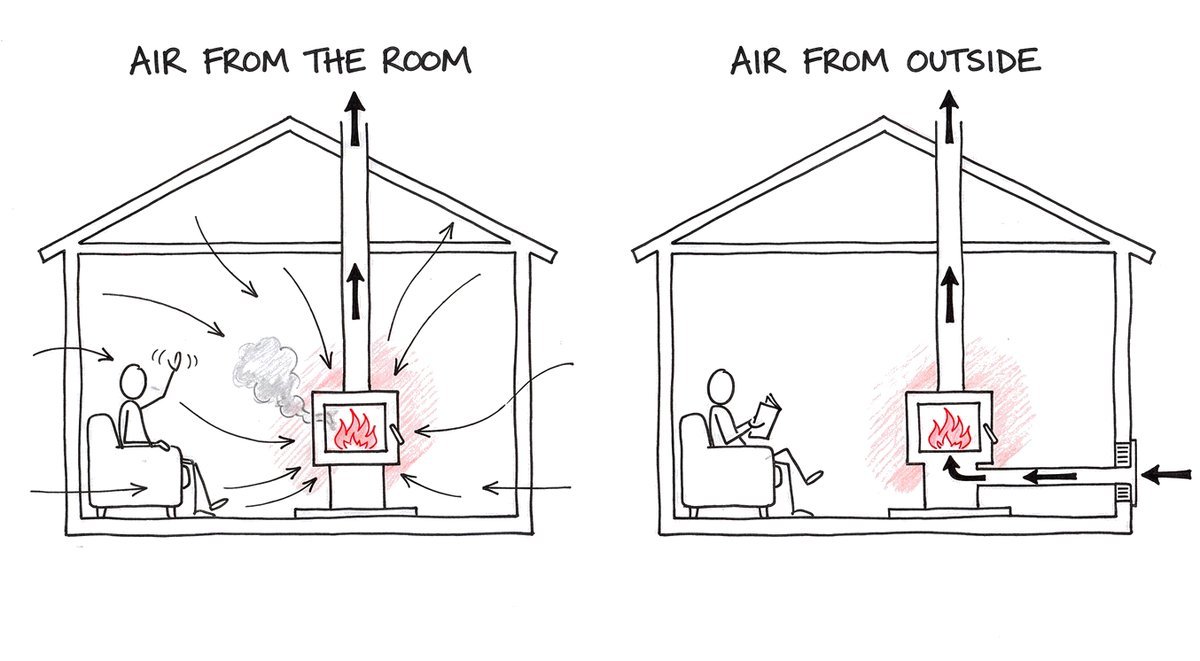
A fire on a winter evening is one of the things people least want to give up when they build a modern, well-sealed house, and there’s no reason they should. It just behaves a little differently in a sealed house than in the draughty one most of us grew up in. Below are the plain principles. We don’t install wood heaters, so for your particular heater, its flue and its air supply, the heater installer and the maker’s instructions have the last word.
What does a fire need from the room?
A fire needs air to burn, and its chimney works by drawing that air, with the smoke, up and out of the house. Every bit of air that goes up the flue has to be replaced by air coming in from somewhere. An open fireplace draws a lot of room air up the chimney, a closed heater with a glass door much less, but both take some.
In an older Perth house nobody had to think about this. Air leaked in around the windows, under the doors and between the floorboards, and the fire simply took what it needed.
Why a sealed house changes things
A well-sealed house is built to stop exactly those leaks, which is how it keeps its heat, and WA’s 7-star energy rules for new homes, in force since 1 May 2025 (HIA), push new houses that way. So in a tight house the fire has to get its air from a route it’s been given, or it competes with everything else that moves air in and out.
The things it competes with are the fans that only push air out: the rangehood over the stove, the bathroom exhaust fans, a vented clothes dryer. Each one sends air outside without bringing any back, so the house is very slightly sucked on, and in a tight house the easiest way back in can be down the flue. That’s how a fire can puff smoke into the room when the rangehood goes on, especially while it’s being lit.
Where heat recovery ventilation fits
Heat recovery is a balanced system. The same unit takes stale air out of the kitchen and bathrooms and brings about the same amount of fresh air into the living areas and bedrooms, so on its own it doesn’t pull on the house the way an exhaust fan does, as long as it’s set up and commissioned with its airflows in balance. That makes it a far better neighbour for a fire than a house full of exhaust fans.
What it won’t do is feed the fire. It moves a small amount of air slowly, around the clock, sized for the people in the house, and it was never meant to supply a fire. Its fresh-air intake outside should also sit well away from the chimney, for the same reason Phil keeps a unit’s intake and exhaust grilles apart: so the house doesn’t breathe back in what it has just sent out.
The setup that lets them live together
The tidy answer is a closed wood heater that takes its combustion air from outside through its own pipe, often called an outside air kit. The fire then breathes outdoor air, sends its smoke up the flue and leaves the air in the rooms to the ventilation. Some heaters are made to work this way and others can be fitted for it; whether yours can is a question for the maker’s instructions and the installer.
In Australia, wood heaters are installed to AS/NZS 2918, the standard for domestic solid fuel heaters, along with the maker’s instructions. When you talk to the installer, ask where the heater will get its air and what happens when the rangehood is running, and whether a carbon monoxide alarm makes sense in your layout.
An open fireplace is the hard case in a sealed house. It takes far more air than a closed heater, and warm room air can drift up the chimney whenever it isn’t closed off, so if one is in your plans, raise it with your designer and the fireplace installer early, while there’s still room to plan its air.
Other questions people ask us
Will heat recovery spread the fire’s warmth through the house?
No. It moves a small amount of air slowly and doesn’t heat anything; in Phil’s words it “doesn’t heat or cool your home”. What it does is keep most of the fire’s warmth in the house when the stale air is changed, instead of losing it through an open window.
Will smoke from my chimney or the neighbours’ come in through the system?
The fresh-air intake should be placed away from your own flue, and the filters catch dust and pollen from the incoming air. How much wood smoke a filter stops depends on the filter, which our article on heat recovery filters goes into.
What about a gas fireplace?
The same principle applies. Ask where it gets its air and where its fumes go: a flued gas fire that takes its air from outside and sends its fumes straight out sits easily in a sealed house.
Do I still need a fire if I have floor heating?
For warmth, usually not, because a well-built heated floor keeps the whole house warm all day. Plenty of people keep a fire for the pleasure of it on a cold evening, which is a perfectly good reason. Our article on a wood fire with floor heating covers how the two share a winter.
Where to go from here
If you’re building or renovating in Perth or the south-west, the 5-minute quote gives you your options in writing within 3 working days, each with its price and a modelled running cost, and you don’t need plans to start. Mention the wood heater in the notes so we know it’s part of the house. If you’d rather read first, heat recovery ventilation, straight is the one-page version, and how heat recovery ventilation works explains the parts.