
Do I need heat recovery ventilation if I have floor heating or radiators?
The short answer
Floor heating and radiators don’t need heat recovery to work, and they don’t ventilate the house either: they warm the rooms and leave the air where it is. Whether you need heat recovery depends on the house. A well-sealed new home has few gaps, so fresh air has to come in on purpose, and heat recovery does that while keeping most of the warmth your heating put into the air. An older, draughty home already swaps its air through the gaps, so seal it first and think about heat recovery after.
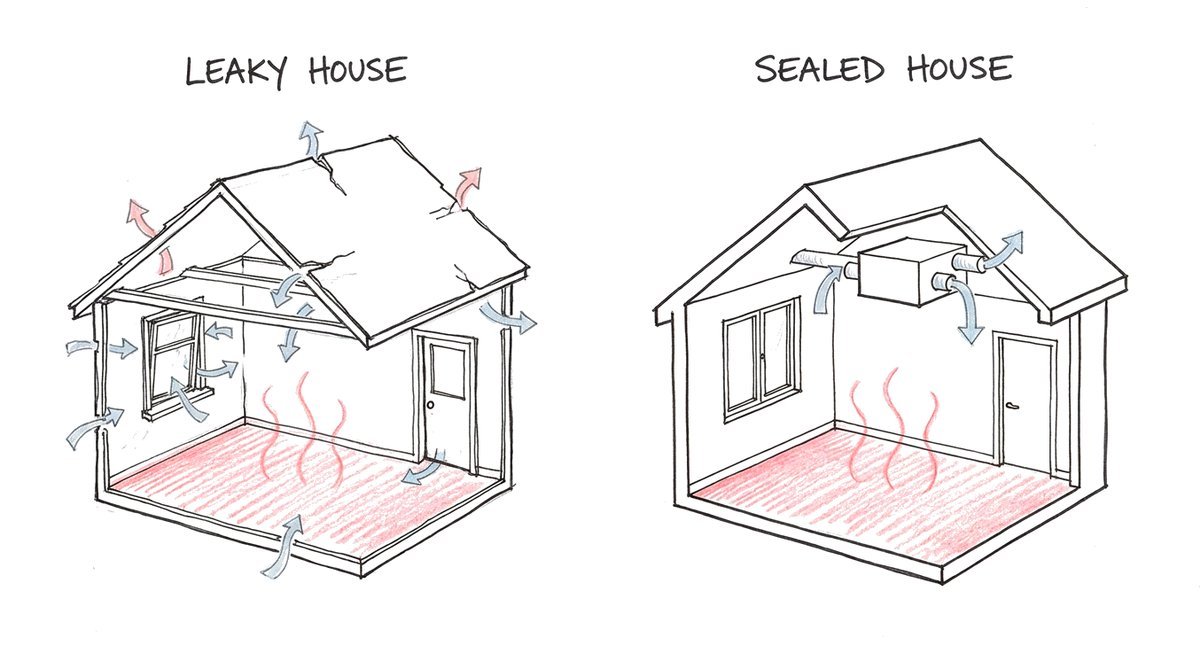
It’s a fair question, usually from someone who has settled on floor heating or radiators and then heard the builder or the energy assessor mention heat recovery. Both kinds of heating move warmth around with water, quietly, with nothing blowing, so it’s natural to wonder whether the house needs anything else. Sometimes it does, sometimes not yet, and the house is what decides.
Does floor heating ventilate the house?
No. A heated floor or a radiator warms you mostly by radiation, the way winter sun feels warm on your face when the air is cold, and it warms the walls and the furniture too. Nothing blows, so the air in the room stays still, which is a big part of why it feels so comfortable. It also means the air in the house is simply the air in the house: the heating brings no fresh air in and sends no stale air out.
The same goes for whatever heats the water. An air-source heat pump, a ground-source heat pump or a gas boiler only warms the water in the pipes, and none of them touches the air in the rooms. So whichever heats your floor or radiators, ventilation is a separate question with its own answer, and heat recovery works alongside any of them.
Why a sealed house needs its air brought in on purpose
People breathe out moisture and carbon dioxide, and showers, cooking and drying washing add a lot more water to the air. In an older home with gaps around every window and door, the air changes many times over without anyone helping it. New homes built since WA brought in the 7-star energy rules and the new condensation rules on 1 May 2025 (HIA) are meant to be better sealed and better insulated, and that’s what keeps their heat in.
So in a sealed house the stale, damp air has to be taken out deliberately. You can open windows, which in July lets the warmth from your floor walk straight out, or run fans that throw heated air outside. Heat recovery does the same job while handing most of the warmth in the outgoing air to the fresh air coming in.
What heat recovery adds to a house with floor heating or radiators
Phil explains it with a radiator. The radiator warms the room, the walls and the air, and if you open a window, that warmth escapes. With heat recovery you leave the windows shut and still get fresh air, and keep most of the heat you’ve already paid for. It runs day and night at a low speed through small grilles, so like the floor heating, there’s nothing blowing at you.
In Perth’s mild climate the energy saving is modest, and we wouldn’t buy it for that alone. The stronger reason is the air itself: fresh, filtered air with the windows shut and a quieter house with the traffic kept outside. People also tell Phil they wipe the dust off the furniture less often. Our article on how heat recovery ventilation works explains the parts.
When you can do without it, for now
In an older home that leaks air, heat recovery comes later. Seal and insulate first and ventilate second, because spending on recovery before sealing is spending in the wrong order. Start with the gaps: high wall vents that let warm air out, and ceiling batts that have been pushed aside and no longer cover the whole ceiling. Phil’s view is that a few simple steps like these can cut the heating a house needs by a surprising amount, before anyone talks about radiators.
It’s also fine to wait. If you’re happy opening a window, or the budget is going on the heating first, heat recovery can come later: room-by-room wall units go into an existing home without any ducts, and Phil has a pair in his own. A new build is the exception. If heat recovery is even a maybe, put the duct routes and a cupboard for the unit on the drawings now, because they’re cheap on a drawing and expensive in a finished ceiling.
 13 min
Other questions people ask us
Will heat recovery make my floor heating cheaper to run?
Only against the alternative of opening windows or running exhaust fans, and in Perth that saving is modest. The big lever on a floor heating bill is how the floor is built: for a 200 m² home, about $240 a winter month built right against about $601 built cheaply (modelled estimates, on an air-source heat pump at Synergy’s July 2026 rate).
Does floor heating help with condensation and mould?
Warm floors and walls help, because condensation forms on cold surfaces. But heating doesn’t remove moisture; taking damp air out of the bathroom, laundry and kitchen where it’s made is the ventilation’s job. Our article on floor heating, allergies and damp goes further, and we’re engineers, not doctors.
Is a heat recovery dehumidifier the same thing?
No. A dehumidifier dries the air in a room by pulling water out of it. Heat recovery swaps damp indoor air for fresh outdoor air, which deals with moisture by taking it out where it’s made.
Where to go from here
If you’re building or renovating in Perth or the south-west, the 5-minute quote gives you your options in writing within 3 working days, each with its price and a modelled running cost, and you don’t need plans to start. Mention heat recovery ventilation in the notes so we know you’re weighing it up. If you’re wondering whether a new 7-star home needs heating at all, read does a 7-star home still need heating, and for the one-page version of heat recovery, see heat recovery ventilation, straight.