
What is heat recovery ventilation, and how does it work?
The short answer
Heat recovery ventilation (HRV) is a quiet fan system that takes stale, damp air out of a well-sealed house and brings the same amount of fresh, filtered air in. The two air streams pass each other inside a heat exchanger, so the warm air going out warms the cold air coming in without mixing. It runs day and night at a low speed, changing the air somewhere between about 0.3 and 2 times an hour depending on the house. It doesn’t heat or cool your home: it keeps most of the warmth, or coolness, you’ve already paid for while the air is swapped.
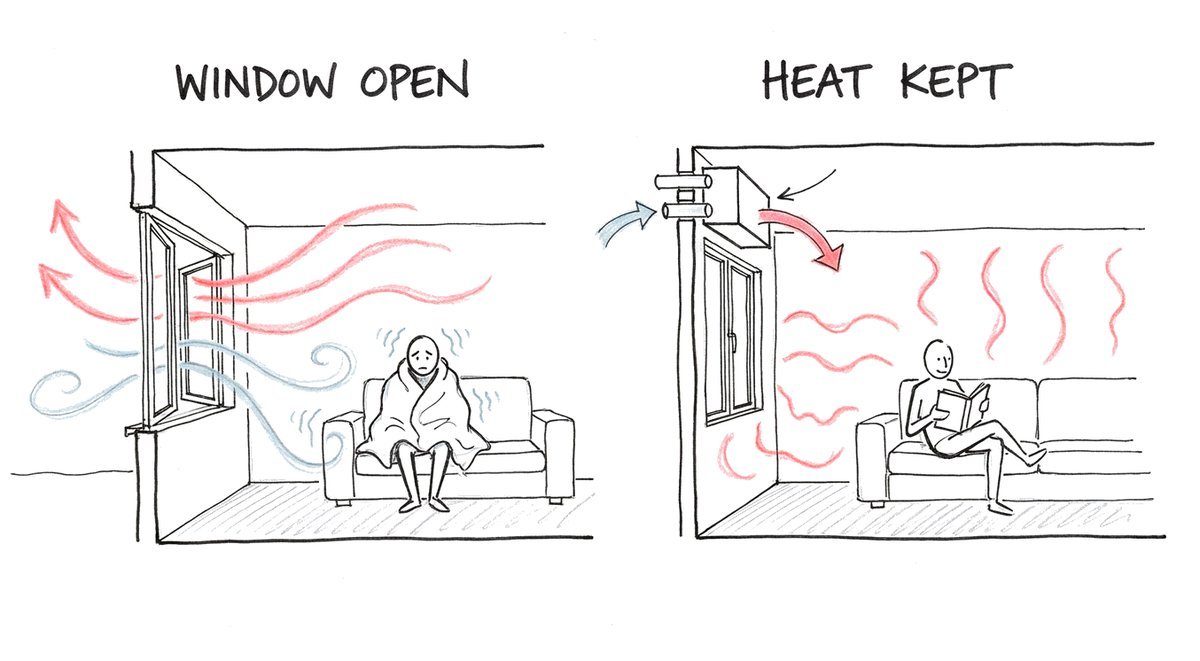
You may have heard it called HRV, MVHR or a fresh-air system, usually from a builder or an architect talking about a well-sealed house. The idea is simple, and there are fewer parts than the catalogues suggest. Below it is in plain words, using a central system like the one Phil takes apart in his video, then the room-by-room kind.
Why would a house need its air swapped?
We breathe out moisture and carbon dioxide, showers and cooking add steam, and smells hang about. In an older Perth house that air leaks away through the gaps around windows and doors, and fresh air leaks in, whether you want it to or not. A well-sealed new house keeps its heat because it has far fewer gaps, and WA’s 7-star energy rules and condensation rules for new homes, in force since 1 May 2025 (HIA), push new houses in that direction.
So in a sealed house the air has to be changed on purpose. Opening a window does it, but on a July morning it lets the heat you paid for walk straight out, and in February it lets the heat in. Phil describes the people heat recovery suits in personal terms: if you’re the one who complains when a room gets stuffy and goes round opening windows, it was made for you.
How does it keep the heat?
The heart of a central unit is a heat exchanger, a block of thin channels where the air going out and the air coming in slide past each other with only a thin wall between them. The warmth crosses the wall and the air doesn’t, the same way a cold can held against a warm cup of tea picks up the warmth without the drinks ever mixing. In summer it works the other way round, keeping most of the coolness from your air conditioning inside.
The small wall units do it differently, with a ceramic block that works like a storage heater on a 40-second cycle. The fan pushes stale room air out through the block, which soaks up its warmth, then reverses and pulls fresh air in through the same warm block. Phil’s example: with the room at 22 degrees and 15 degree air outside, the fresh air comes in at around 20 or 21. A little is lost each time, which is why heat recovery makes fresh air cheaper without making it free.
What a central system looks like in a house
The fresh air goes into the rooms where you spend time, the bedrooms and the living areas. Stale air comes out of the rooms where moisture and smells are made: the kitchen, the bathrooms, the toilet and the laundry, with a double-sized extract in the shower. The air drifts slowly through the house from one to the other, so every room is gently flushed without anyone feeling a breeze. Each grille has its own small duct, about 75 millimetres across, and the small ducts gather at a manifold before one larger duct runs to the unit.
The unit itself is about the size of a bar fridge, hung on a wall somewhere central such as the laundry, a linen cupboard or the garage, and the filters slide out by hand. It needs a power point and a drain for the water it takes out of the air. Outside there are two grilles, one where fresh air comes in and one where stale air goes out, set apart so the house doesn’t breathe its own exhaust. For a small home, up to around 125 m², a compact unit can hide in the ceiling instead.
Controls range from a speed switch on the unit to a wall controller that tells you when the filters are due, and some measure carbon dioxide and turn the airflow up when a full house makes the air stuffy. Where the fresh-air grille sits matters more than any of that: on the far side of the room from the door, so the air crosses the room instead of slipping straight out into the hall.
 18 min
Central or room by room?
The room-by-room kind uses small units set into the outside walls, each with a grille about 30 centimetres square, working in pairs: while one blows stale air out, its partner draws fresh air in, and they swap. They need no ducts, which is why they suit existing homes, extensions and single problem rooms. They’re a little noisier, though, and every one needs a spot on an outside wall clear of cupboards, which can be hard to find. Phil, who has a pair at home, keeps them to living rooms, kitchens and studies.
Given the choice, Phil’s view is plain: “if you can, I would suggest the centralised unit because it is quieter”. A central system also serves the whole house evenly and lets the grilles go in the ceiling, the wall or the floor. Its weak spot is the ducts, which is why it works best when it’s planned on the drawings of a new house. Our article on central or room-by-room heat recovery goes into which suits which home.
What heat recovery ventilation doesn’t do
It doesn’t replace your heating or your air conditioning. In Phil’s words, “what it doesn’t do is it doesn’t heat or cool your home.” We get calls from people hoping to swap their air conditioner for one, and with nearly every unit on the market it doesn’t work that way. The heating still comes from your floor heating, radiators or air conditioner; heat recovery just stops most of that warmth leaving with the stale air.
It also can’t rescue a leaky house or a bad installation. In a draughty home the air already changes through the gaps, so seal and insulate first. And the most common failure in WA is ducts run bare through a hot roof space, where the roof takes back the heat the unit just saved; our article on what heat recovery costs explains why that’s the part of the price not to cut.
Other questions people ask us about heat recovery
Is heat recovery ventilation the same as a heat recovery heat pump?
No, the name covers two different things. Heat recovery ventilation keeps the warmth in the air it swaps. A heat recovery heat pump reuses heat a system would otherwise throw away, such as the heat your air conditioning pulls out of the house in summer, sent to the pool or the hot water tank instead of the sky. Our article on one system for heating, cooling, hot water and the pool covers the second kind.
Which kind of heat exchanger is best?
Central units use a block of thin channels where the two air streams pass each other; wall units use a ceramic block that stores heat and gives it back. Both do the job. In a Perth house, where the ducts run and how quiet the unit is matter far more to how it performs than which core is inside.
Does heat recovery ventilation help with mould and condensation?
It takes damp air out of the bathroom, laundry and kitchen where it’s made, and that’s what keeps condensation down in a sealed house. It can’t fix a leak or rising damp, and we’re engineers, not doctors, so we don’t make health promises.
Does it run all the time?
Yes, ideally around the clock at a low speed, which is why it’s quiet and you don’t notice the air moving. You can turn it up for a party or a steamy shower, and some controllers do that by themselves.
Where to go from here
If you’re building or renovating in Perth or the south-west, the 5-minute quote gives you your options in writing within 3 working days, each with its price and a modelled running cost, and you don’t need plans to start. Mention heat recovery ventilation in the notes so we know you’re weighing it up. For the one-page version, see heat recovery ventilation, straight, and if your house already has floor heating or radiators, read whether you need heat recovery as well.