
Can heat recovery ventilation work with ducted air conditioning?
The short answer
Yes, and they do different jobs. A ducted air conditioner heats or cools the air already in your house and blows it round again; heat recovery ventilation swaps that air for fresh and keeps most of the warmth or coolness as it does. They can live side by side as two separate systems, or the fresh air can be fed into the air conditioner’s ducts, which has to be designed for. Either way, every duct that crosses a Perth roof space needs insulating, or the heat recovery is lost before the air reaches the room.
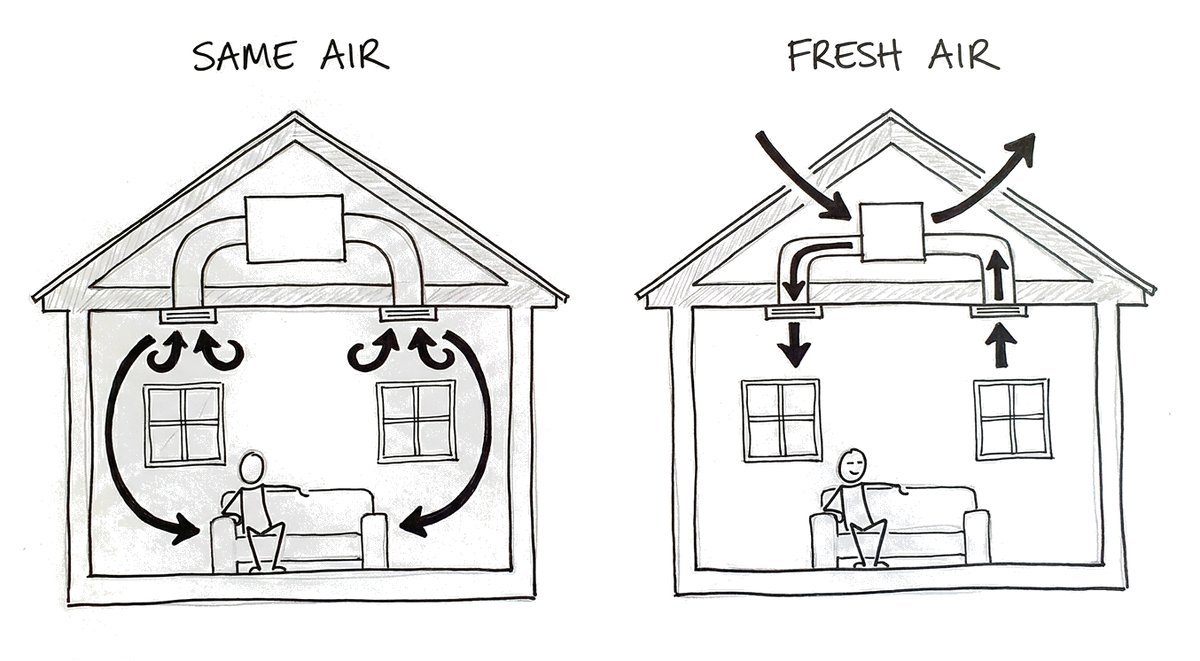
This question usually comes from one of two people. One already has ducted reverse-cycle in a newish, well-sealed house and has noticed the air goes stale with the doors and windows shut. The other is building, has been offered both, and wonders whether they’ll fight each other. They won’t, as long as they’re designed together.
What your ducted air conditioner does with the air
A ducted system pulls air from the house through a return grille, heats or cools it in a unit in the roof space, and blows it back out through the ceiling outlets. It’s the same air going round, warmed or cooled on each lap. Unless it’s been set up to draw some air from outside, it brings no fresh air into the house at all.
In an older, draughty house that never mattered, because fresh air leaked in through the gaps anyway. In a well-sealed house it does. With the doors and windows shut, the steam from the showers and the cooking and the air everyone breathes out have nowhere to go, and the air conditioner just keeps stirring them.
Why heat recovery won’t replace the air conditioner
The two get confused because both have ducts and grilles in the ceiling. Heat recovery moves a small amount of air slowly and all the time, to change the air, while the warming and cooling stay with the air conditioner. Phil is clear about it: “what it doesn’t do is it doesn’t heat or cool your home.” We get calls from people hoping to swap their air conditioner for one, and with nearly every unit on the market it doesn’t work that way.
What heat recovery does for the air conditioner is keep its work in the house. Open a window for fresh air on a 35 degree afternoon and the air comes in at 35, and the air conditioner has to cool it all over again. With heat recovery, most of the coolness in the stale air going out is handed to the fresh air coming in, so less of what you’ve paid for leaves the house.
Two ways to put them together
The simplest is side by side. The heat recovery unit gets its own small ducts and grilles, bringing fresh air into the bedrooms and living areas and taking stale air from the kitchen and bathrooms, and the air conditioner carries on as before. The heat recovery runs around the clock at a low speed and the air conditioner runs when you want heating or cooling, so neither depends on the other. The cost of this way is a second set of grilles in the ceiling.
The other way is to feed the fresh air into the air conditioner’s own ducts, which Phil describes as a bit of fresh air added automatically into the air conditioning system. It means fewer holes in the ceiling, but the two now share fans and ducts, so the design has to settle how fresh air reaches the bedrooms when the air conditioner is off and where the stale air leaves. If the ducts aren’t sized and designed for it, Phil’s warning is that some rooms end up without enough fresh air or extraction.
The roof space, where both systems can lose
In most Perth houses both systems run their ducts through the roof space, which bakes in summer and goes cold on winter nights. The flexible silver ducts of an air conditioner come insulated. The thin grey ducts supplied with most heat recovery units don’t, because they’re made for European houses, where the ducts run inside the heated part of the building.
Run those bare ducts through a Perth roof and the unit recovers the heat, then the roof takes it straight back off the air on its way to the room. Phil’s verdict: “Your heat recovery capability is basically blown. It’s gone.” The fix is to keep the heat recovery unit and its ducts inside the insulated part of the house, in a bulkhead or an insulated box built into the ceiling space, or to use insulated duct of the air conditioning kind. That works, Phil says, as long as it’s sized for the extra resistance, because the unit has to push harder to get air through it.
 3 min
Who should design it?
Ducted air conditioning is usually designed and installed by an air conditioning contractor, and heat recovery is sometimes added later by somebody else. Each can do a good job of their own part. The trouble is the join: who decides where the fresh air comes in, how the two share the ceiling, and who answers when one bedroom is stuffy. That’s why we design ventilation alongside the heating and cooling, so there’s one design and one team to ask.
If you’re building and haven’t chosen yet, there’s a third arrangement worth a look: floor heating for the winter warmth, with a ducted fan coil system for cooling and top-ups, both run from one heat pump. Our article on floor heating and air conditioning in the same house explains how that works, and heat recovery fits alongside it the same way.
Other questions people ask us
Can I add heat recovery to my existing ducted system?
Often, yes. In a finished house the simplest way is usually room-by-room wall units, which need no ducts and leave the air conditioner alone. Tying a central unit into existing ducts depends on the system and the roof space, and needs someone to look at both.
Will heat recovery make my air conditioner cheaper to run?
Compared with opening windows, it keeps most of the warmth or coolness in the air it swaps, so the air conditioner has less to make up. It doesn’t change what the air conditioner uses on the air it’s already circulating, and in Perth’s mild climate the saving is modest. We don’t put a percentage on it, and you should be wary of anyone who does before they’ve seen the house.
Where should the heat recovery unit go?
Phil’s usual spots for a central unit are the laundry, a linen cupboard or the garage, somewhere central so the ducts stay short. A compact unit goes in a bulkhead or an insulated box in the ceiling. Loose in the roof space is the one place to avoid.
Do I still need to clean the air conditioner’s filter?
Yes. Heat recovery filters the fresh air it brings in, and the air conditioner’s filter cleans the air going round the house. Both need cleaning or changing, and a blocked filter makes either system work harder for less.
Where to go from here
If you’re building or renovating in Perth or the south-west, the 5-minute quote gives you your options in writing within 3 working days, each with its price and a modelled running cost, and you don’t need plans to start. Mention the ducted air conditioning and heat recovery in the notes so we know what you’re weighing up. For the one-page version, see heat recovery ventilation, straight, and for the parts of a system and how they work, read what heat recovery ventilation is.