
Does geothermal work in a hot climate like Perth’s?
The short answer
Yes, and a hot summer is where the ground earns much of its keep. Cooling a house means pushing heat out of it, and it’s far easier to push that heat into ground sitting at 15 to 20 degrees, or into Perth’s groundwater at around 20, than into 35 or 40 degree air. Perth’s winters are mild, so the heating advantage is smaller here than in cold countries. The one summer job where the air wins is heating a pool, and the best systems avoid the problem by sending the heat they take out of the house straight into the pool.
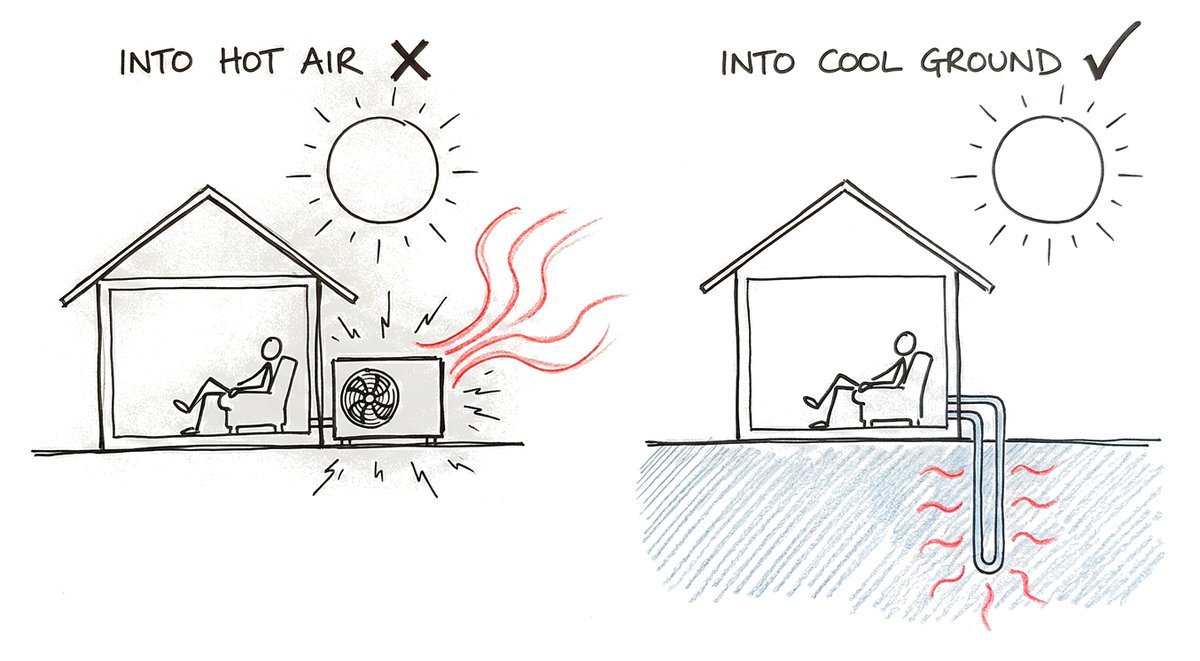
Most of what’s written about geothermal comes from Europe and North America, where it’s a way of getting through months of frost. Perth is the other way round. Our winters are short and mild, and our summers are long and hot, so it’s fair to wonder whether something designed for snow makes any sense here. It does, though for different reasons than the brochures give.
Why a hot summer suits the ground
An air conditioner cools a house by moving heat out of it and dumping it somewhere else, and with an ordinary unit that somewhere is the air outside. The trouble is timing. On a 40 degree afternoon, when you need cooling most, the outdoor unit has to push heat into air that’s already hotter than anything in the house, so it works its hardest and burns the most electricity on the days you lean on it hardest.
A few metres down, the ground doesn’t know it’s summer. It sits at roughly the same temperature all year, and Perth’s aquifer stays at around 20 degrees. Phil puts it simply: “it’s much easier to reject that heat into the 15 degree ground than the 35 degree air”. That’s why, in Perth, the ground earns its keep on a January afternoon as much as on a July morning.
There’s a quieter benefit too. With no fan unit outside, there’s nothing humming under the neighbour’s bedroom window on a hot night. In Phil’s experience a lot of disputes between neighbours are about air conditioning noise, and in a climate as mild as ours, a system that’s hidden away and silent is often the main reason owners choose geothermal at all.
And in winter?
This is where Perth differs from the places geothermal comes from. In northern Europe a heat pump can face 20 or 30 degrees below zero, with the heating running four to eight months of the year, and pulling heat out of that air is hard work, so the steady ground makes a big difference. The Bureau of Meteorology’s Perth station averages 8.1 degrees overnight in July. A good air-source heat pump copes with that comfortably, so the gap the ground closes in winter is real but modest.
Put both seasons together and our Perth projects have run up to about 40% cheaper than air-source, less on a mild site. Cheaper, never free: as Phil puts it in his videos, if the air-source system costs 100% to run and the geothermal one 60%, you still get 60% of the bill. Whether that saving pays for the bores is a question for your site, and our geothermal cost article goes through the sums.
The catch with a pool in summer
Here’s where hot weather works against the ground. Heating a pool in February means taking heat from somewhere and putting it into the water. The air outside might be 30 degrees, while the ground is still at its steady 15 to 20. So for summer pool heating, a geothermal heat pump drawing on the ground does worse than an ordinary air-source pool heater drawing on hot air.
There are two ways round it. A hybrid system can switch sources, taking heat from the air when the air is warmer and from the ground when it isn’t. The better answer, where a house has both cooling and a pool, is heat recovery.
The heat pump is already pulling heat out of the house to cool it, so instead of dumping that heat into the ground, it sends it into the hot water tank and then the pool. On similar systems we’ve run for a few years, Phil’s figure is that about 90 to 95% of the summer heat ends up in the tank and the pool, though it varies from house to house. That’s the situation where geothermal pays back fastest, in as little as about four years on the right project. There’s more on it in heating the pool from the house’s heat pump.
 5 min
Does the ground fill up with heat?
It can, which is one more reason a ground loop is sized by calculation. A closed loop that only ever has heat pushed into it, summer after summer, slowly warms the ground around it and gets a little less effective each year. A house that needs a lot of cooling and little heating is exactly that case, so the bores are designed with it in mind, or the system is given somewhere useful to put the heat first. On our heat-recovery jobs the ground is the last resort, used only when the hot water and the pool are already full.
What about the tropics or the desert?
We only work in Perth and the south-west, but the same physics applies anywhere. In a desert, the days are scorching and the nights can be cold, and the ground ignores both, which suits a heat pump well. In the tropics the ground sits warmer than it does in Perth, so the cooling advantage is smaller, though still there, and there’s almost no heating to do.
Humidity changes the delivery more than the source. In a humid climate, cooling has to dry the air as well as cool it, and that’s a job for fan coils: ducted air conditioning units that run on chilled water from the heat pump instead of refrigerant. Floor cooling can’t do it alone. Even in dry Perth it covers only about a quarter of the cooling a typical house needs, and its water has to stay just above the point where condensation would form on the floor.
Other questions people ask us about geothermal in summer
Can geothermal replace my air conditioning?
It can run the air conditioning. The same heat pump feeds ducted fan coil units with chilled water, so you get ducts and grilles like any ducted system, with the heat going into the ground or the pool instead of out of a box in the side path.
Is geothermal noisy on a summer night?
There’s no outdoor fan unit at all. The heat pump sits in a plant room or garage, and a good one sounds like a fridge. Phil recorded one running so you can hear it for yourself.
Can my solar panels run it in summer?
Summer is where solar and cooling line up best, because the panels produce most on the afternoons the house needs cooling most. With large water tanks the system can store that energy, pre-cooling the house and filling the tanks while the sun is up, so it draws less from the grid in the evening.
Where to go from here
If you’re building or renovating in Perth or the south-west, the 5-minute quote gives you your options in writing within 3 working days, each with its price and a modelled running cost. Tell us in your notes if there’s a pool or a lot of cooling in the plans, because that’s what decides whether the ground is worth it. For the one-page version, read geothermal, straight, and for the pool side, how pool heating fits in.