
How do I keep floor heating running costs down?
The short answer
Most of a heated floor’s running cost is decided before the slab is poured: insulation under the heated layer and down the slab edge, a heat pump with room to breathe, and a design that lets the floor run on lukewarm water. Built that way, floor heating in a 200 m² Perth home runs at about $240 a winter month; built cheaply, the same floor costs about $601 (both modelled estimates). Once you’ve moved in, set a comfortable temperature and leave it, let a timer follow your day, and use cheap midday power if your plan has it.
Built right, floor heating runs in the same league as a good reverse-cycle system, and gives you a warm floor and no blown air for it. Built cheaply, the same floor in the same house costs about two and a half times as much to run, every winter. Most of the difference is settled before the concrete goes in, so if you’re still at the drawing stage, you’re reading this at the right time. If you’ve already moved in, the last two sections are for you.
Where does the running cost get decided?
Under the floor, before the pour. Heat goes wherever it’s coldest, and under a Perth house that’s the sand. A heated slab with no insulation underneath and none around its edge can lose up to 70% of the heat you pay for into the ground, and a single edge running into a path, an alfresco or a pool can double or triple the bill on its own. Insulation under the heated layer and down the slab edge is the biggest single thing you can do for the running cost, and you get one chance at it.
That’s most of the gap in the short answer. At Synergy’s July 2026 home rate of 33.26 cents a kilowatt-hour, our modelled estimate for a 200 m² home is about $240 a winter month built right against about $601 built cheaply, or about $36,100 over twenty winters. The Running Cost Calculator works it out for your own floor area.
Why does lukewarm water cost less to make?
A heat pump makes warm water by moving heat in from the outside air, and the hotter the water it has to make, the harder it works. Phil puts it simply: “it’s much easier for the heat pump to produce 30 or 35° water than it is 50 or 55° water.” A good heat pump in a well-designed system might deliver about five units of heat for every unit of electricity at 35 degrees, and about two and a half at 55. Same machine, half the efficiency.
A floor can run on lukewarm water because the whole floor is the heater, and a big surface doesn’t need to be hot to warm a room. That only holds if the design lets it. Pipe pulled back from the walls to save a few metres, or a floor designed for tiles that later gets thick carpet, pushes the water temperature up, and the bill with it. Ask whoever designs your system what water temperature the floor is designed for. For floor heating, Phil’s answer is 30 to 35 degrees.
Where should the heat pump go?
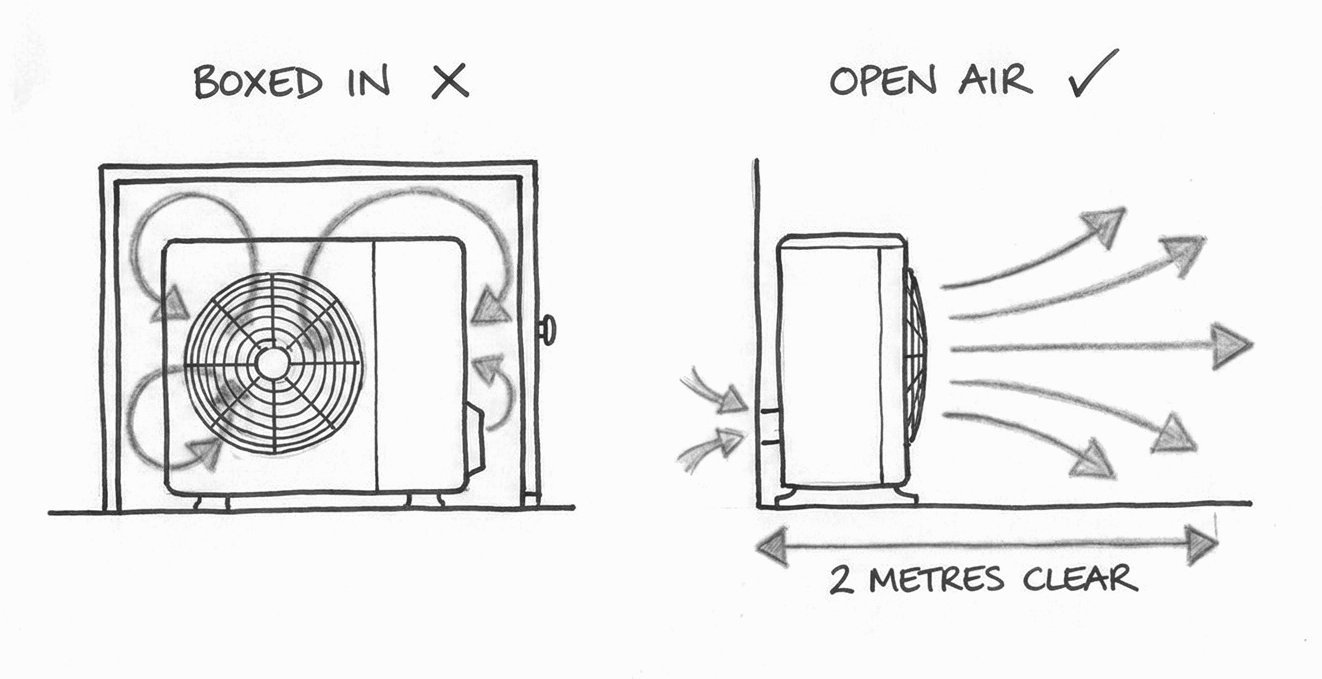
Outside, with room to breathe. An air-source heat pump pulls its heat out of the air around it, and if it’s boxed into a side passage, a store room or behind a fence, it ends up breathing its own chilled exhaust and can lose up to half its efficiency. Leave at least two metres of open air in front of the fan and the maker’s clearance behind and beside it, and fix its spot on the drawings, while moving it still costs nothing. There’s more on choosing and placing one on our heat pumps page.
What should I set it to, and should I leave it on?
Set it to a temperature that feels comfortable, and resist turning it up. Because a heated floor warms you directly, most people are comfortable at a lower setting than they’d choose with blown air. Phil likes to point to an 1895 Fremantle home where the owner sets the heating to 19 degrees and the rooms are perfectly warm. Every degree you don’t need is heat you don’t buy, and we go into settings in what temperature floor heating should run at.
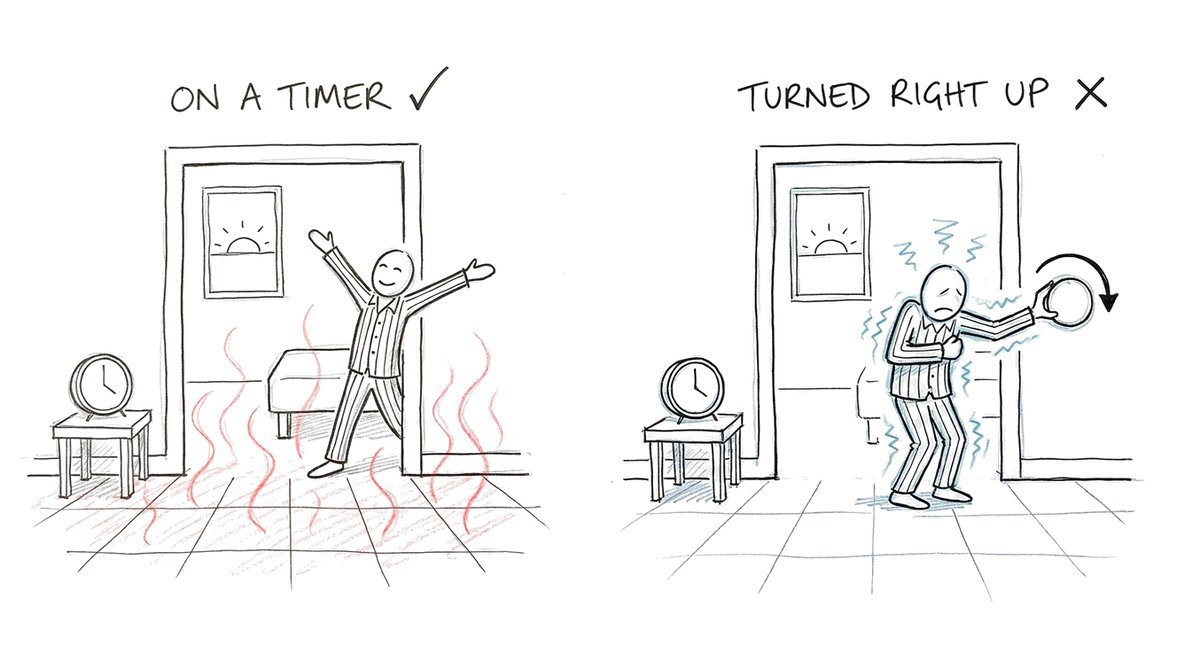
Then let a timer follow your day: warm before you get up, easing off while you’re out, back on before you get home. A screed responds within half an hour, so it can follow your day closely, while a heated slab needs a longer head start. What doesn’t help is turning the thermostat right up on a cold morning. The floor gives out heat at its own pace, so it won’t warm any faster, and the room overshoots later. Rooms you rarely use can be turned off at the manifold, like a tap, until someone comes to stay.
Can cheap midday power cut the bill?
It can help, and Perth is a good place for it. Synergy’s Midday Saver plan prices power between 9am and 3pm well below the evening peak, and rooftop solar produces most in the same hours. A floor with some mass can soak up heat in the middle of the day and give part of it back into the evening, so a heat pump that does more of its work at midday buys more of its power cheaply.
It won’t carry a winter night on its own, because the heat is needed most in the mornings and evenings when the sun isn’t up. And no amount of solar makes up for a floor that leaks heat into the ground. We go through the details in running floor heating on cheap midday power.
 12 min
Other questions people ask us
Is a gas boiler cheaper to run than a heat pump?
In Perth a heat pump usually comes out ahead on running cost, which is why it’s what we suggest first. If you’d rather have gas, we design and install gas boilers too, and the same rules about insulation and water temperature apply.
Is it cheaper to leave floor heating on all the time?
Not usually. A timer that follows your day uses less than running around the clock, as long as it starts early enough for the floor to catch up. What costs more is switching it on by hand when you feel cold, then turning it up because nothing seems to be happening.
Will solar panels make it free to run?
No. Solar lowers the bill, especially if the system does some of its work in the middle of the day, but the heat is needed most when the sun isn’t up. Get the floor right first, then let the solar help.
Does a thermostat in every room save money?
Rarely. People with a thermostat in every room tend to end up setting them all the same. A few zones, by level or by how you use the house, plus turning spare rooms off at the manifold, gets you the saving without the extra cost.
Where to go from here
If you’re building in Perth or the south-west, the 5-minute quote gives you your options in writing within 3 working days, each with its price and a modelled running cost, so you can see what each one costs to run before you choose. You don’t need plans to start. If you’re not there yet, the Thermal Risk Scan finds the heat leaks in your design before the slab goes down.