
How long does hydronic heating last?
The short answer
The part in the floor lasts longest. Floor heating pipe is rated for 50 years under its standard’s test conditions, which are far harsher than a floor heated with water at 30 to 35 degrees, so in a heated floor it will outlast most houses, with a lifespan of up to 100 years. The heat pump or boiler is the part that wears, like any machine with a fan and a motor, and its life depends on its quality, where it sits and how hard the system makes it work. When it’s due, it’s replaced on its own and the floor stays where it is.
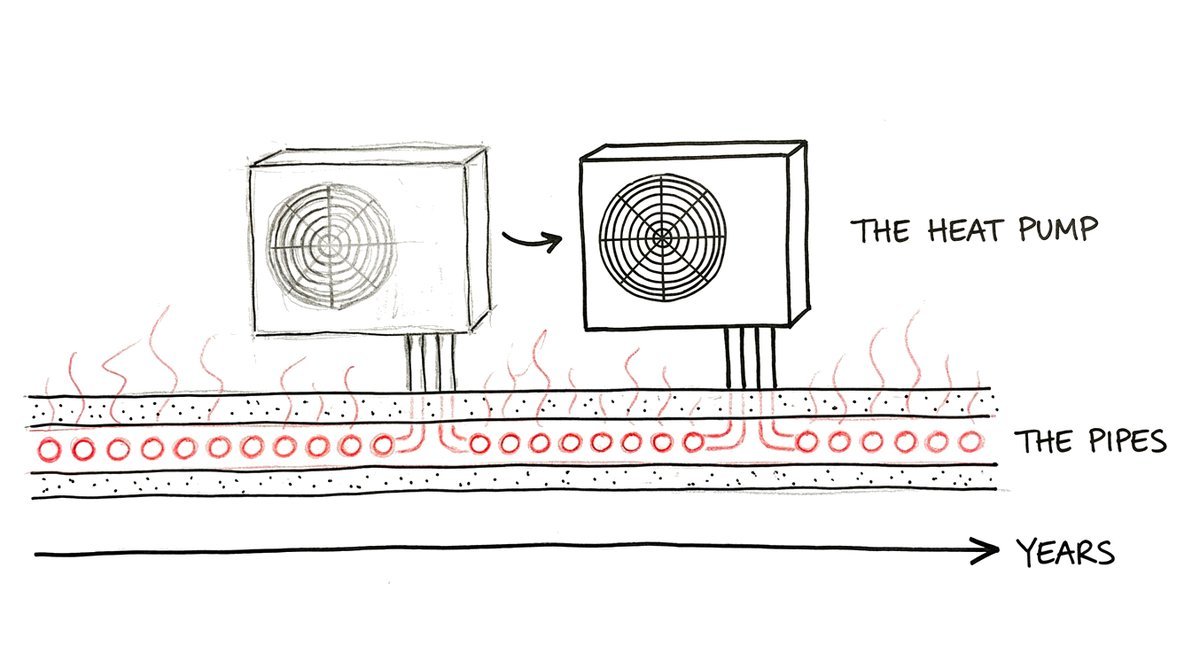
It’s a fair thing to ask before you bury pipes in concrete. A split system on the wall is easy to replace when it dies, but a heated floor feels permanent, and nobody wants to find out in fifteen years that the expensive part was the part that failed. The good news is that the parts that wear out are the ones you can reach.
Which parts last, and which wear out?
A hydronic system has three kinds of parts, and they age very differently. The pipes in the floor have no moving parts at all and simply carry warm water. The manifold, where every loop starts and ends, and the controls sit somewhere you can open a cupboard and get at them, so a valve, a pump or a thermostat can be changed without going near the floor. The heat pump or boiler does the hard work, with a compressor, a fan and pumps running every winter, and it’s the part that will one day need replacing.
That split is the reason a well-designed system can be looked after for decades without a jackhammer ever touching the slab. Some systems we put in 15 to 20 years ago are only now having their first service. They still run, though a regular check is what keeps a heat pump at its best.
How long do the pipes in the floor last?
Far longer than the machine that heats them. The plastic pipe used for floor heating is rated for 50 years under the test conditions in its standard, which are hotter and harder than anything a heated floor puts it through. At floor-heating temperatures it will outlast most houses, and its lifespan runs up to 100 years. A straight length of it won’t burst or start leaking by itself.
The weak point Phil watches for is the joints, which is why the quality of a pipe system’s joints matters more to us than the brand of pipe. A straight length of pipe only leaks if someone cuts or drills into it, which is why every loop is pressure-tested before the concrete goes on and kept under pressure while the house is built, so any damage shows straight away. A good pipe system can be repaired and covered over again. Our article on whether floor heating pipes can leak goes through what happens if one is hit.
 5 min
5 min
What about the heat pump or boiler?
Like a car, it lasts as long as it’s built and treated to last, and we won’t give you a single number because the range is wide. A few things make a big difference. Cheaper units tend to be the noisiest, the least efficient and the shortest-lived, all at once.
A heat pump boxed into a corner keeps breathing its own cold air and works harder for every unit of heat, and Phil’s view is that the extra strain shortens its life. So does a floor designed to need hot water: floor heating should run on water at around 30 to 35 degrees, and a system that asks for 45 or 50 makes the heat pump labour all winter.
Where it lives matters too. Phil’s experience is that outdoor units close to the beach have a harder life in the salt air, which is worth knowing if you’re in a coastal suburb. Our article on whether a heat pump will last near the coast covers that. When a heat pump or boiler does reach the end of its life, it’s disconnected and a new one goes in its place. The floor, the pipes and the manifold carry on.
What does the warranty cover?
There are two layers. Each component carries its own manufacturer’s warranty, and the length varies from part to part and maker to maker, so ask for the list with your quote. On top of those, every installation we do carries our 5-year workmanship warranty.
For systems we design and build, The Comfort Guarantee sits above both: warm every winter, for as long as you own the home, guaranteed on every part we control. A warranty covers a part or a piece of work for a set time. The guarantee covers the result, which is every room reaching and holding the temperature we designed it for, and if it doesn’t, we fix it at our cost. You can read the full wording in our frequently asked questions.
How do I know when something needs replacing?
The signs are usually gradual. Rooms take longer to warm up than they used to, or one area never quite gets there. The pressure gauge on the system keeps dropping and needs topping up. The heat pump gets louder, starts and stops more often or shows fault codes, or the power bill climbs for the same comfort.
None of those means the floor has worn out. In an older system the fault is usually in the parts you can reach: a valve, a pump, the balancing, the controls or the heat source. Have it checked before you replace anything. If an old gas boiler is the problem, a heat pump can take over from it, though radiators may need checking, because a heat pump runs best on cooler water than a boiler does. Our article on what to do when something goes wrong has more.
Other questions people ask us
Do floor heating pipes ever need replacing?
Not in the normal life of a house. The only reason a pipe would need work is damage, such as someone drilling into the floor, and even then it’s a repair at that spot rather than a new floor.
How often should the system be serviced?
We recommend a check of the heat pump or boiler about every two years, or every year if your heat pump’s warranty asks for that. It keeps the machine at its best and catches a slow pressure drop before it turns into a cold morning. The pipes themselves need nothing.
Can you look after a system someone else installed?
Often, yes. We assess it first to see what it is, what condition it’s in and whether parts are still available, and then tell you honestly whether it’s worth repairing.
Where to go from here
If you’re in Perth or the south-west and your heat pump or boiler is due for replacing, or you’re building and planning a system to last, the 5-minute quote gives you your options in writing within 3 working days, each with its price and a modelled running cost. If you’d rather read first, our article on what maintenance hydronic heating needs covers the routine side of looking after it.